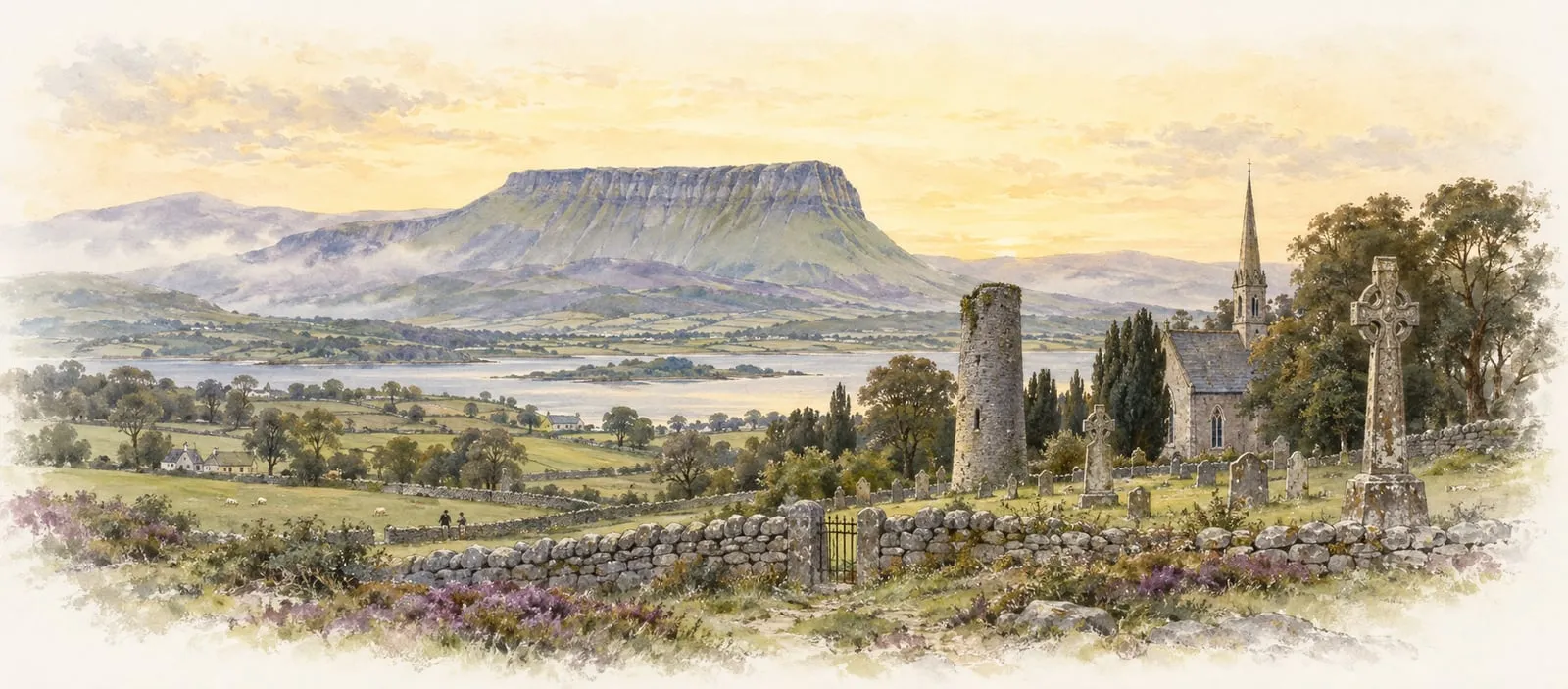
The places behind the poems
From Sligo's lakes to the tower at Ballylee: where Yeats lived, walked and wrote, and the poems each place gave him. Tap a pin, or read on place by place.
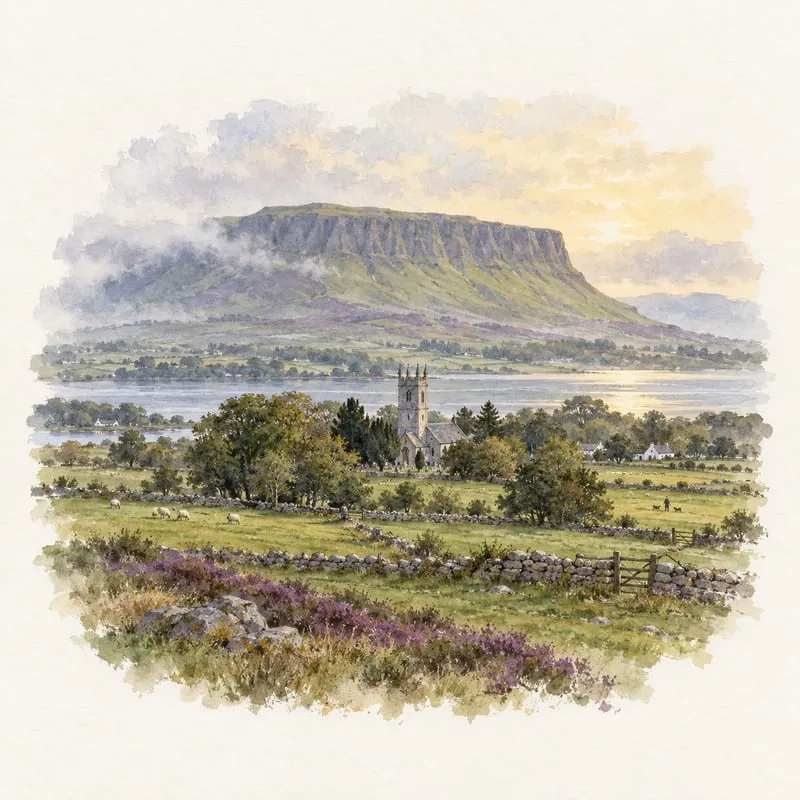
Sligo
His mother's county, where he spent his childhood summers, and where he asked to be buried.
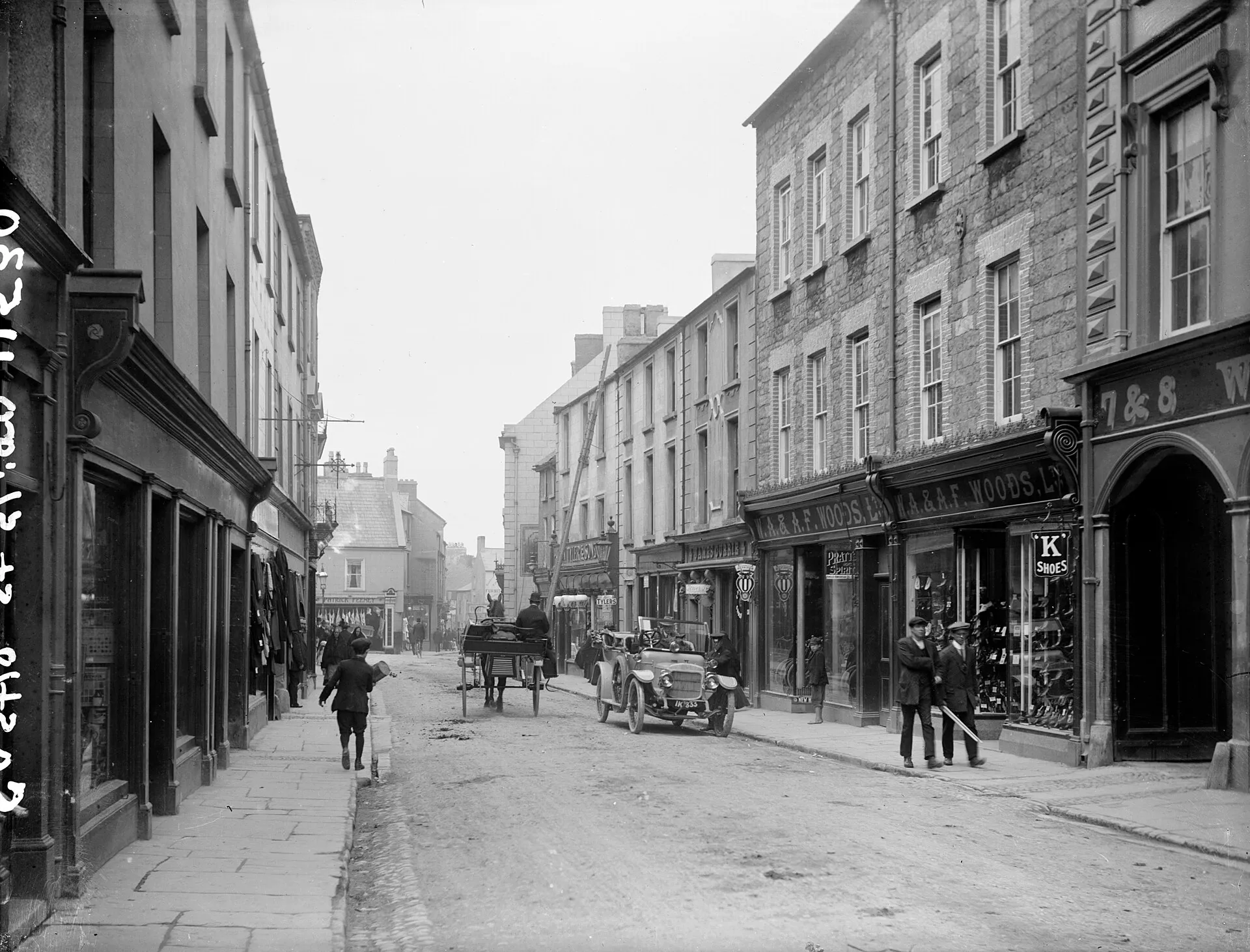
Castle Street, Sligo (c. 1910)Robert French, c. 1910. Public domain, Wikimedia Commons 1865-1890s
Sligo town
Home of his mother's family, the Pollexfens, merchants and shipowners. He spent long childhood stays at Merville, the Pollexfen house, and came to think of the county as his 'country of the heart'.
Yeats Memorial Building
Former bank beside Hyde Bridge on the Garavogue, now home of the Yeats Society Sligo. Rowan Gillespie's 1989 statue of Yeats stands across the river.
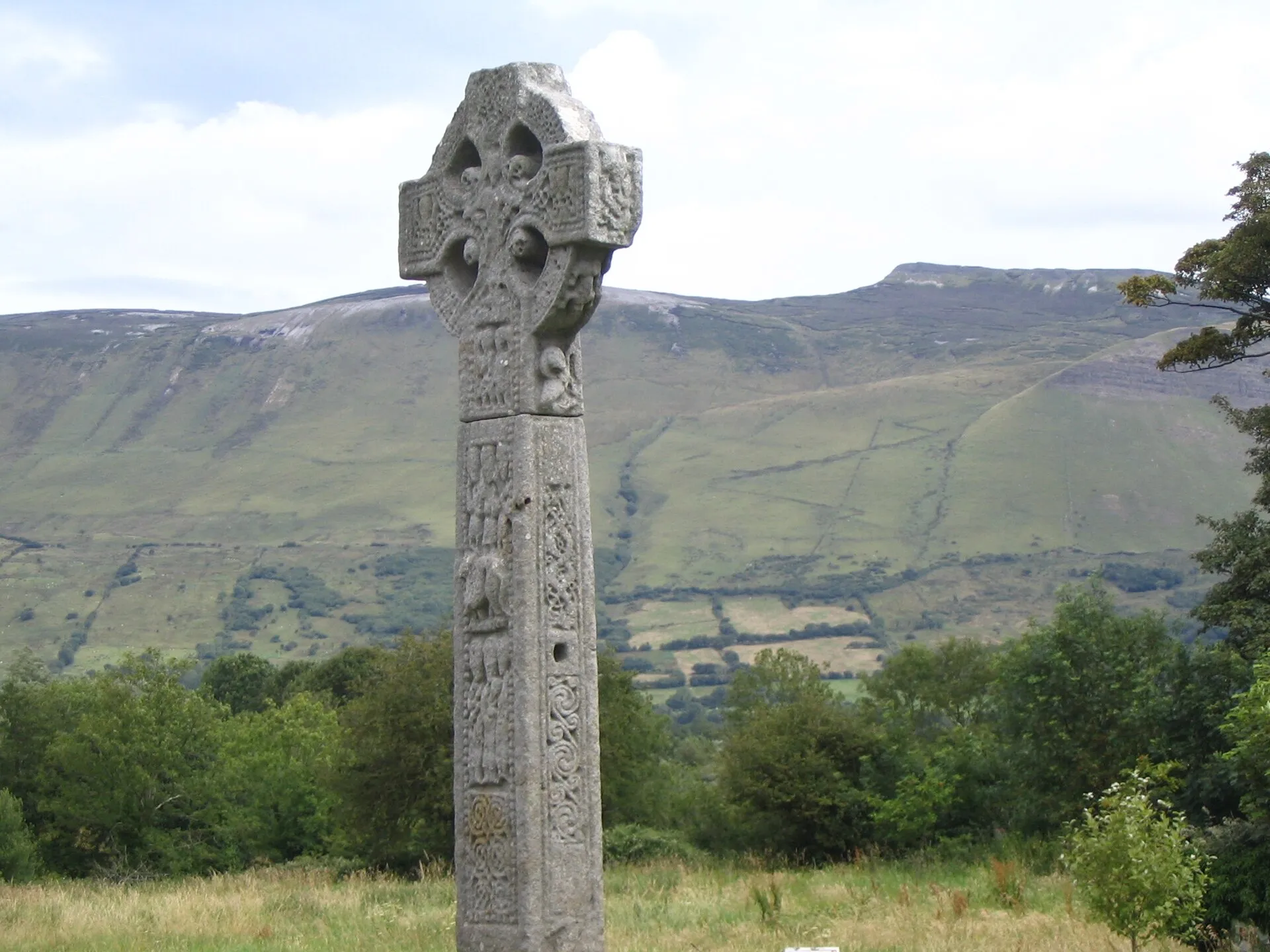
Drumcliffe high cross with Ben BulbenPatrice78500, 2006. Public domain, Wikimedia Commons 1948-present
St Columba's churchyard, Drumcliffe (Yeats's grave)
Yeats's great-grandfather John Yeats was rector here. The poet asked in 'Under Ben Bulben' to be buried in this churchyard, and his remains were brought from France and reburied on 17 September 1948 under the epitaph 'Cast a cold eye / On life, on death. / Horseman, pass by!'
Poem:Under Ben Bulben
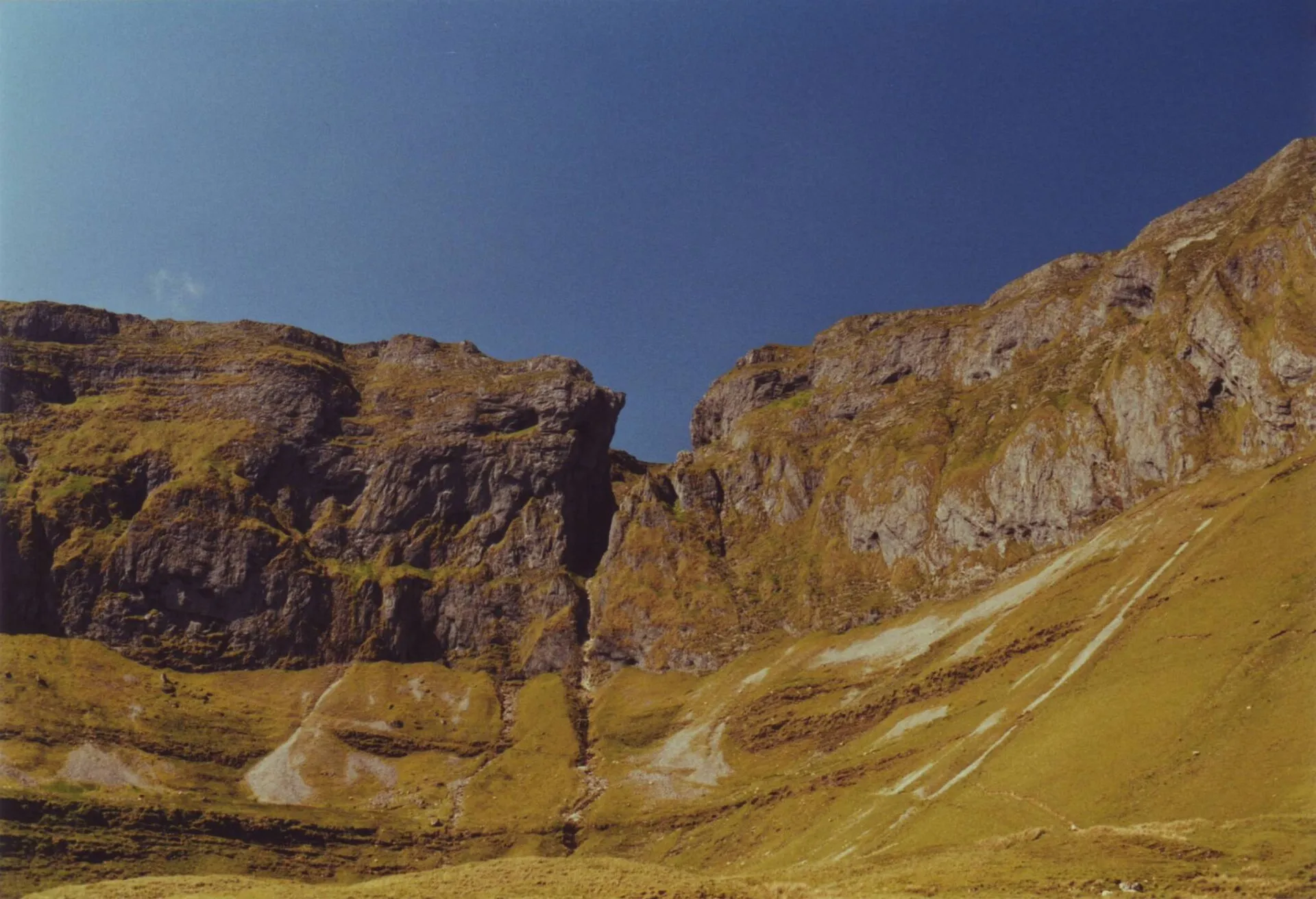
Ben BulbenBigBear_Martin, 2000. Public domain, Wikimedia Commons Ben Bulben (Benbulbin)
The flat-topped mountain above Drumcliffe dominates 'Yeats Country'. Yeats's grave lies in its shadow and his late testament is named for it.
Poems:Under Ben Bulben, On a Political Prisoner, Towards Break of Day
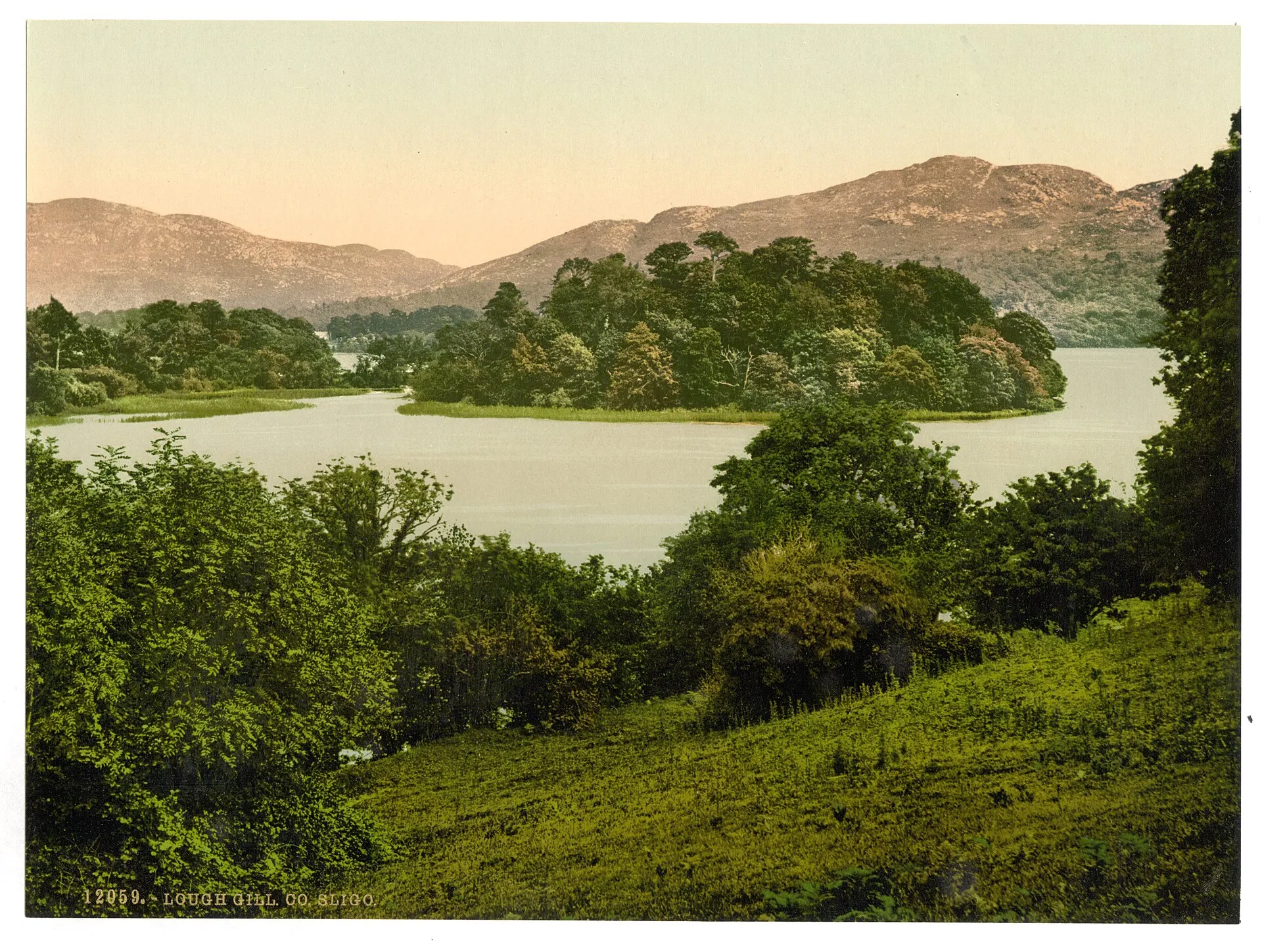
Lough Gill, photochrom (1890s)Detroit Publishing Co. / Photoglob (publisher), 1890-1900. Public domain, Wikimedia Commons Lough Gill
The lake east of Sligo town, fringed by Hazelwood, Dooney Rock and Slish Wood. Its island of Innisfree is the setting of his most famous early lyric.
Poems:The Lake Isle of Innisfree, The Fiddler of Dooney, The Song of Wandering Aengus
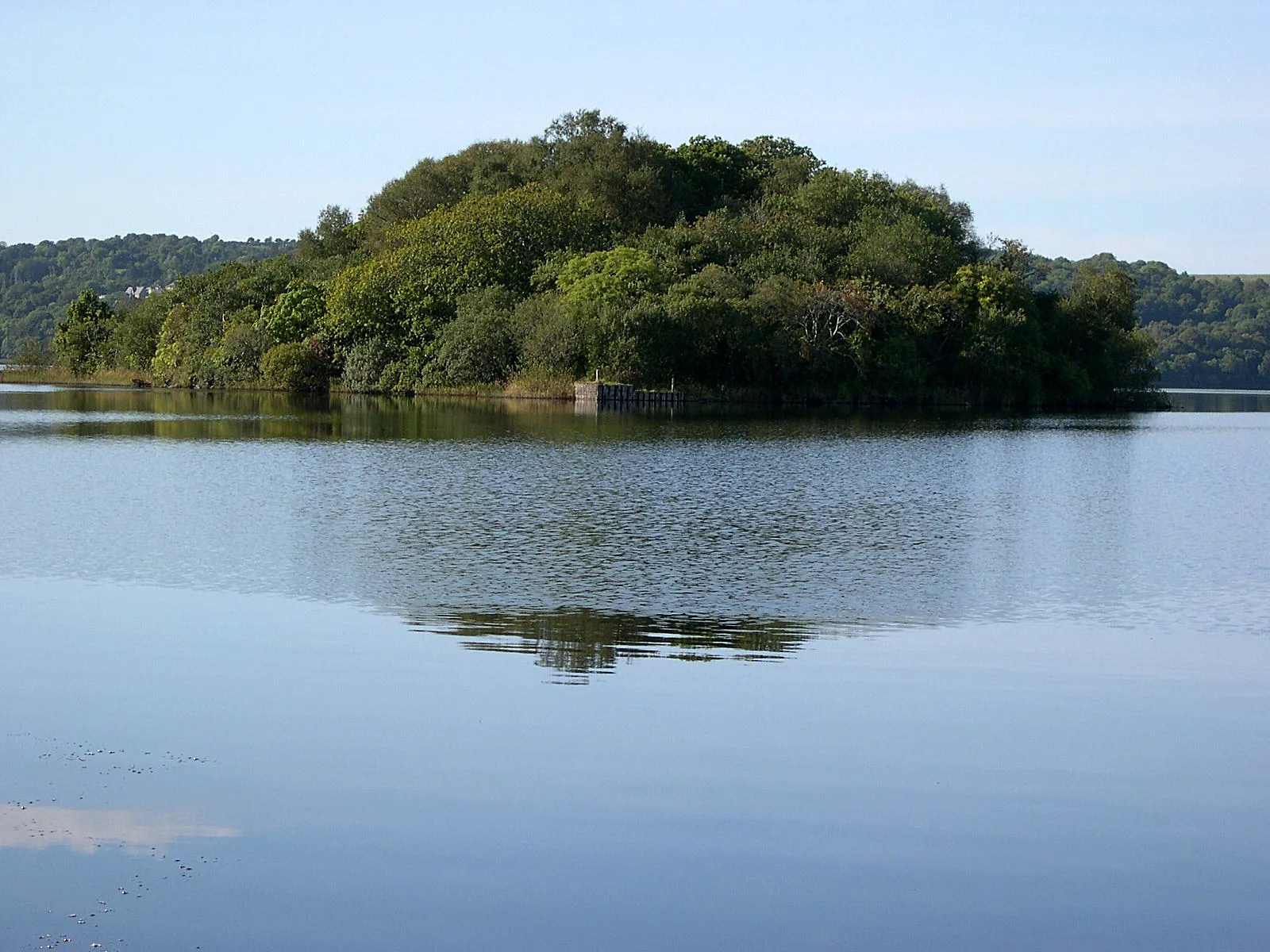
The Lake Isle of Innisfree, Lough GillJay Sturner, 2009. CC BY 2.0, Wikimedia Commons Innisfree, Lough Gill
A small wooded island in Lough Gill. As a boy Yeats dreamed of living there like Thoreau; the memory returned in Fleet Street in 1888 and became 'The Lake Isle of Innisfree'.
Dooney Rock
A wooded limestone outcrop on the south shore of Lough Gill, with a forest walk and views over the lake. It gave its name to Yeats's fiddler.
Slish Wood (Sleuth Wood)
Woodland on the south shore of Lough Gill, the 'Sleuth Wood' that dips down into the lake in 'The Stolen Child'.
Poem:The Stolen Child
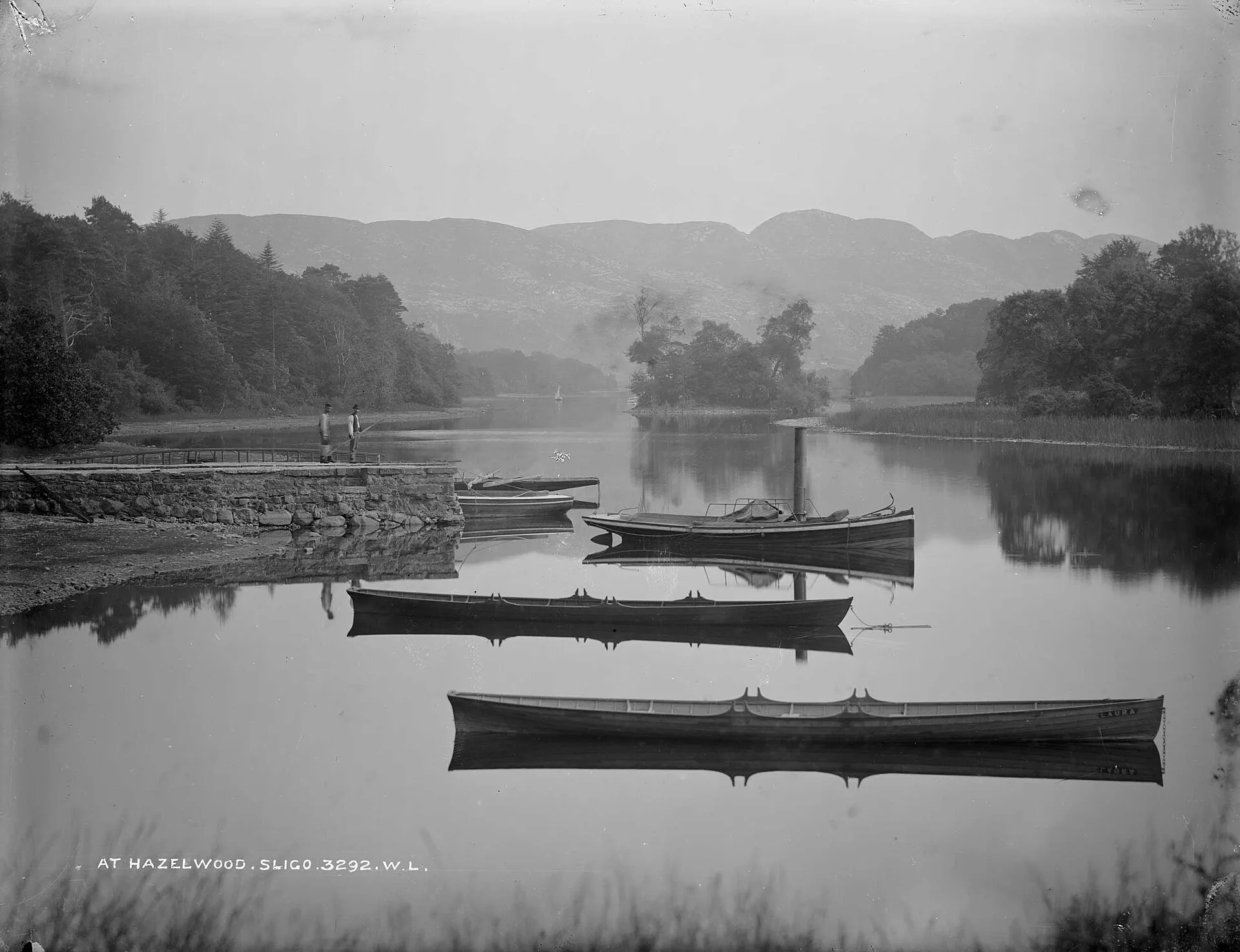
Hazelwood, Lough Gill (c. 1890)Lawrence Collection (probably Robert French), c. 1890. Public domain, Wikimedia Commons Hazelwood, Lough Gill
The Wynne family's demesne on the north-west shore of Lough Gill. Local tradition links its woods with 'the hazel wood' of 'The Song of Wandering Aengus'.
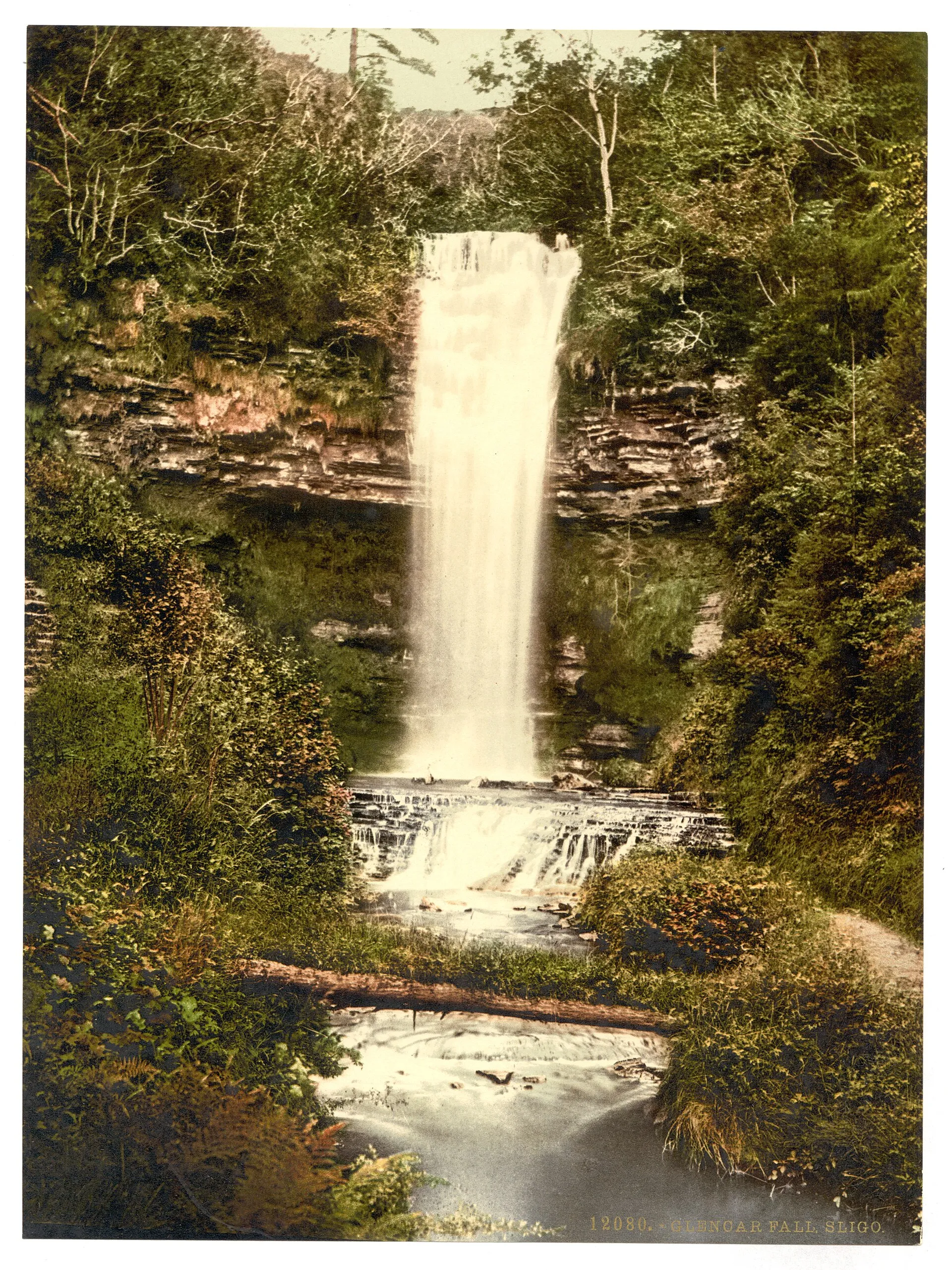
Glencar waterfall, photochrom (1890s)Detroit Publishing Co. / Photoglob (publisher), 1890-1900. Public domain, Wikimedia Commons Glencar Waterfall
The waterfall above Glencar Lough, on the Sligo-Leitrim border, is the place 'Where the wandering water gushes / From the hills above Glen-Car' in 'The Stolen Child'.
Poem:The Stolen Child
1894
Lissadell House
Home of the Gore-Booth family. Yeats stayed here in 1894 and later remembered Eva and Constance as 'Two girls in silk kimonos, both / Beautiful, one a gazelle'.
Poems:In Memory of Eva Gore-Booth and Con Markiewicz, On a Political Prisoner
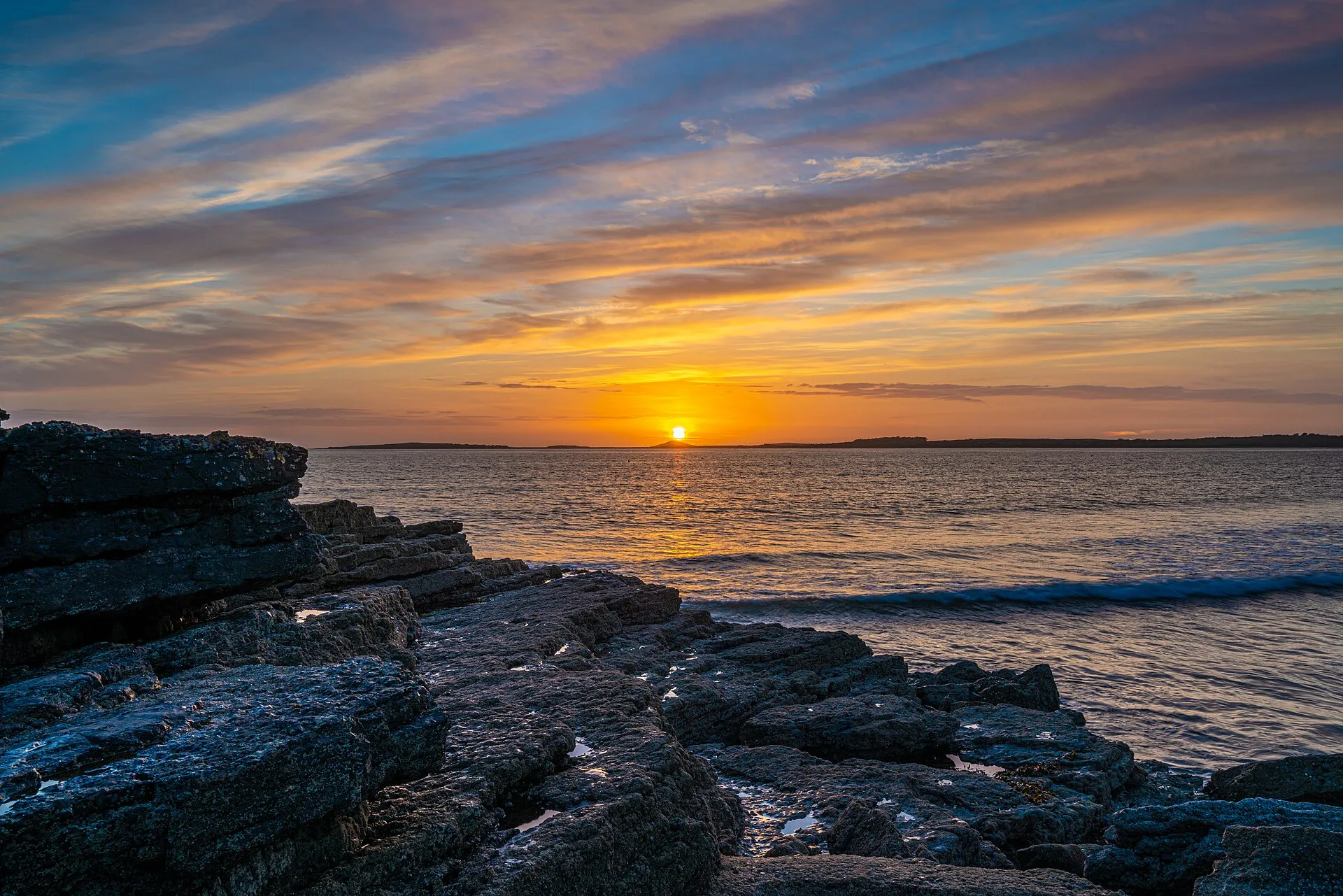
Rosses PointMiguel Mendez, 2022. CC BY 2.0, Wikimedia Commons 1870s-1880s
Rosses Point (and Elsinore House)
Seaside village at the mouth of Sligo harbour where W. B. and Jack Yeats spent summers with their Middleton cousins at Elsinore House, a smugglers' house now in ruins.
Poem:The Stolen Child
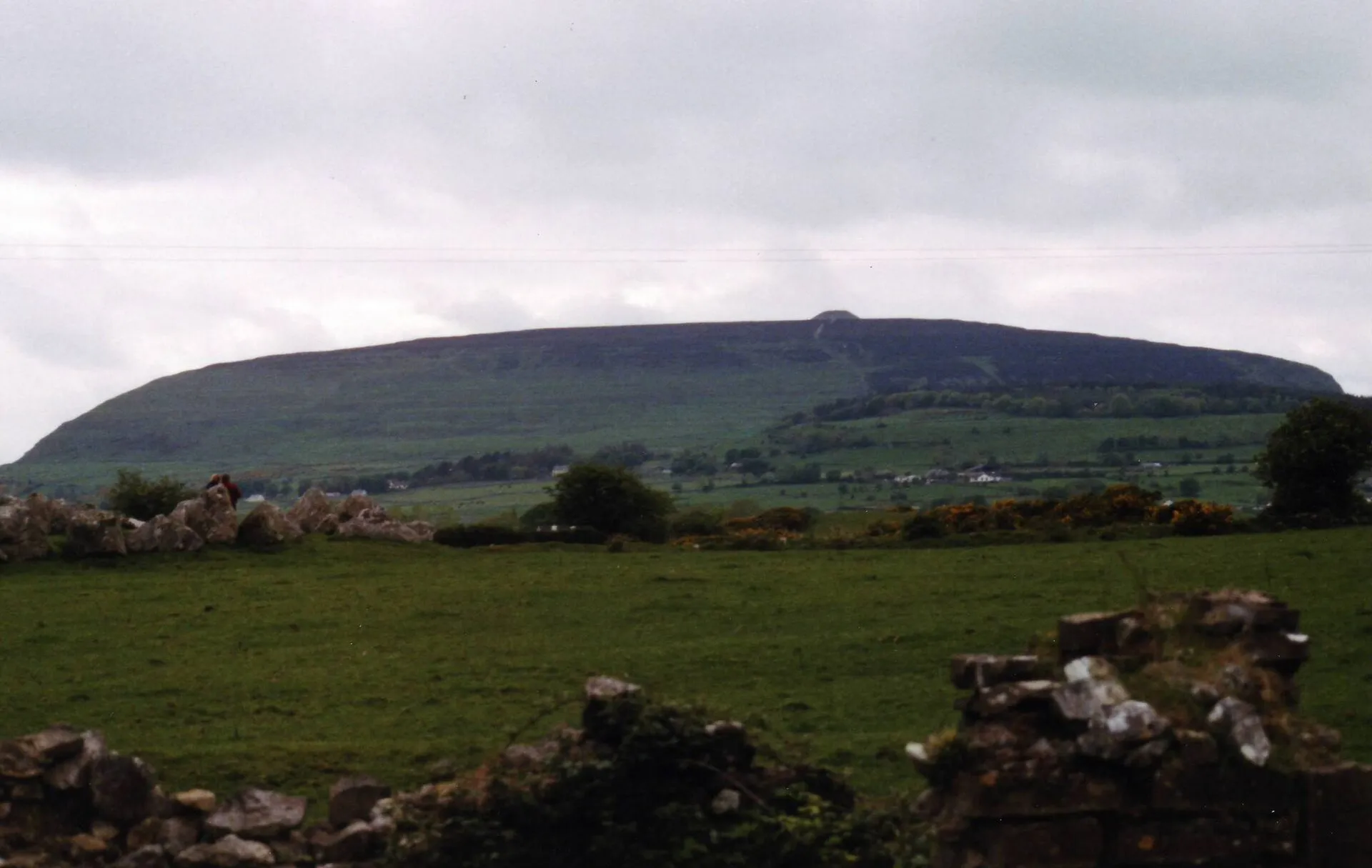
KnocknareaBigBear_Martin, 1999. Public domain, Wikimedia Commons Knocknarea
Hill west of Sligo topped by the great cairn traditionally called Queen Maeve's grave. It recurs in the early poems of the Sidhe.
Poems:The Hosting of the Sidhe, Red Hanrahan's Song about Ireland
.jpg)


.jpg)

.jpg)

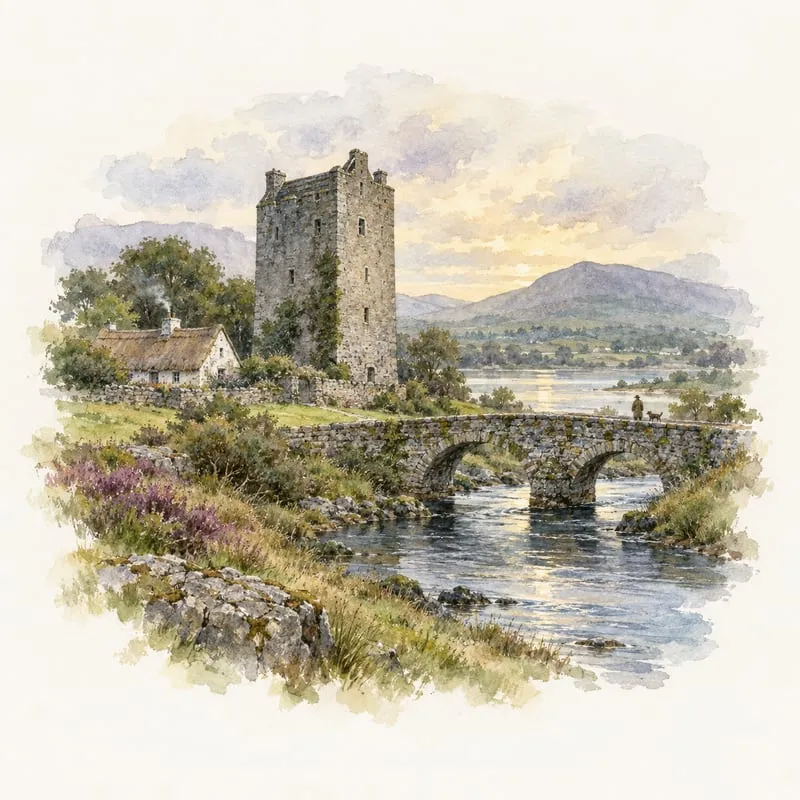
Galway: Coole and Ballylee
Lady Gregory's house at Coole, and the tower at Ballylee he bought in 1917.
1896
Tulira (Tillyra) Castle
Edward Martyn's house. Yeats and Arthur Symons stayed here in August 1896, and here Yeats met Lady Gregory, whose house at Coole was a few miles away.
1897-1932
Coole Park
Lady Gregory's estate and the workshop of the Irish Literary Revival. Yeats spent most summers here from 1897; the house was demolished in 1941 and only its foundations remain in what is now a nature reserve.
Poems:The Wild Swans at Coole, In the Seven Woods, Coole Park, 1929, Coole Park and Ballylee, 1931
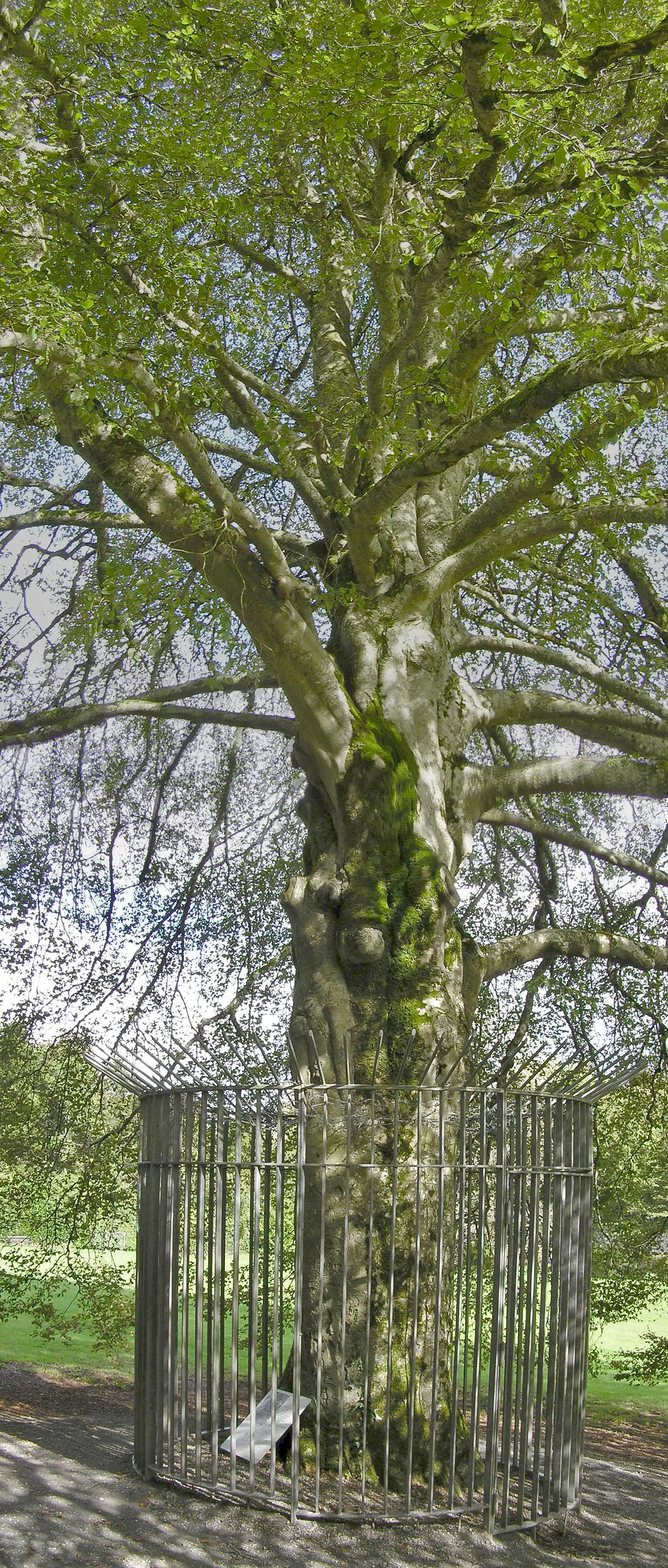
The Autograph Tree, Coole ParkThpohl, 2005. Public domain, Wikimedia Commons 1898-present
The Autograph Tree, Coole Park
A copper beech in the walled garden carved with the initials of Lady Gregory's guests, among them W. B. Yeats, Jack Yeats, Synge, Shaw, AE and O'Casey.
1916-1931
Coole Lough (the lake of the wild swans)
The turlough at Coole where Yeats counted 'nine-and-fifty swans' in 1916. Its whooper swans are still protected here.
Poems:The Wild Swans at Coole, Coole Park and Ballylee, 1931
1917-1929
Thoor Ballylee (Yeats's Tower)
A fifteenth-century de Burgo tower house that Yeats bought for 35 pounds in 1917, restored and used as a summer home until 1929. It gave him the central symbol of The Tower and The Winding Stair. It reopened as a museum in 1965 and again in 2015 after flood damage.
Poems:To be Carved on a Stone at Thoor Ballylee, Meditations in Time of Civil War, The Tower, Blood and the Moon, A Dialogue of Self and Soul, Coole Park and Ballylee, 1931, A Prayer for my Daughter
Kiltartan
The parish that includes Coole and Ballylee. Robert Gregory's airman says 'My country is Kiltartan Cross', and Lady Gregory wrote her 'Kiltartan' books in the local English.
1917-1929
Gort
The market town nearest Coole and Ballylee. The smithy work for the restoration of the tower came from 'the Gort forge'.

Dublin
Where he was born, studied art, founded a theatre and sat in the Senate.
1865-1867
Georgeville, 5 Sandymount Avenue (birthplace)
Yeats was born here on 13 June 1865, the eldest child of John Butler Yeats and Susan Pollexfen. The family left for London in 1867. A plaque marks the house.
1880-1883
Balscadden House, Howth
The family's cottage home on Howth Head after their return from London. The cliffs and sea here fed his early verse, and in 'Beautiful Lofty Things' he recalls Maud Gonne waiting for a train at Howth station.
1884-1886
Metropolitan School of Art (now NCAD), Thomas Street
Yeats studied here from 1884 to 1886 and met George Russell (AE). The school is now the National College of Art and Design.
1899
Antient Concert Rooms, Pearse Street
The Irish Literary Theatre gave its first production here on 8 May 1899: Yeats's The Countess Cathleen, which drew protests over its portrayal of Catholic peasants selling their souls.
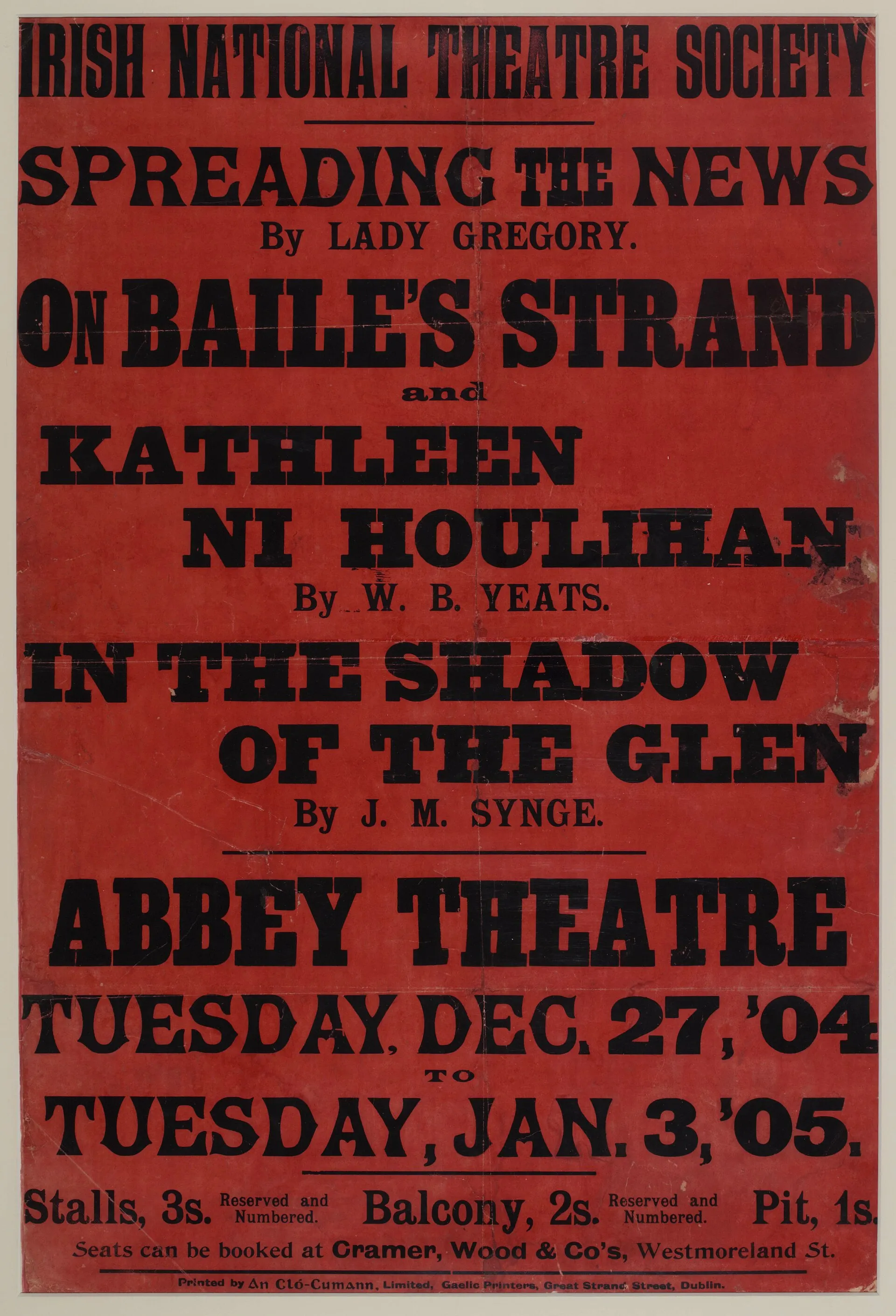
Poster for the opening of the Abbey Theatre (December 1904)Unknown (Irish National Theatre Society), 1904. Public domain, Wikimedia Commons 1904-1939
Abbey Theatre
The national theatre Yeats founded with Lady Gregory, Synge and Annie Horniman's money. It opened on 27 December 1904. Yeats sat on its board until his death and faced down the audiences at the Playboy riots (1907) and The Plough and the Stars (1926). The original building burned in 1951; the present one dates from 1966.
Poems:On those that hated 'The Playboy of the Western World', 1907, The Fascination of What's Difficult, Beautiful Lofty Things
1922-1928
82 Merrion Square
The Yeatses' Dublin town house during his years as a senator and Nobel laureate. George sold it in 1928 and the family moved to a flat in Fitzwilliam Square.
1928-1932
42 Fitzwilliam Square
The flat the family took in August 1928 after leaving Merrion Square. Yeats's brother Jack later lived at number 18 in the same square.
1932-1939
Riversdale, Rathfarnham
Yeats took a 13-year lease on this house in 1932 and it was his last Irish home. He had his last meeting with Maud Gonne here in 1938.
Poems:An Acre of Grass, What Then?
1922-1928
Leinster House (Seanad Éireann)
Seat of the Oireachtas, where Yeats sat as a senator of the Irish Free State from December 1922 to 1928. His speech against the ban on divorce on 11 June 1925 is his best-known intervention.
2006-present
National Library of Ireland
Holds the largest Yeats collection in the world, including manuscripts, his Nobel medal and family papers. Its exhibition 'Yeats: The Life and Works of William Butler Yeats' has run since 2006.
1908-present
Hugh Lane Gallery (Charlemont House)
The municipal gallery Yeats campaigned for during the Lane controversy of 1913. He visited it late in life and wrote 'The Municipal Gallery Revisited' about the portraits of his friends there.
Poems:The Municipal Gallery Revisited, To a Wealthy Man who promised a Second Subscription to the Dublin Municipal Gallery if it were proved the People wanted Pictures, September 1913, To a Shade
1916
General Post Office, O'Connell Street
Headquarters of the Easter Rising of April 1916. Yeats was in England at the time; the executions that followed produced 'Easter, 1916' and later poems on the leaders.
Poems:Easter, 1916, Sixteen Dead Men, The Rose Tree, The Statues
1916
Kilmainham Gaol
Where the leaders of the Rising were shot in May 1916, among them John MacBride, Maud Gonne's estranged husband, on 5 May.
Poems:Easter, 1916, Sixteen Dead Men

London and England
Where the family lived for much of his youth, and where he wrote the poems of the Nineties.
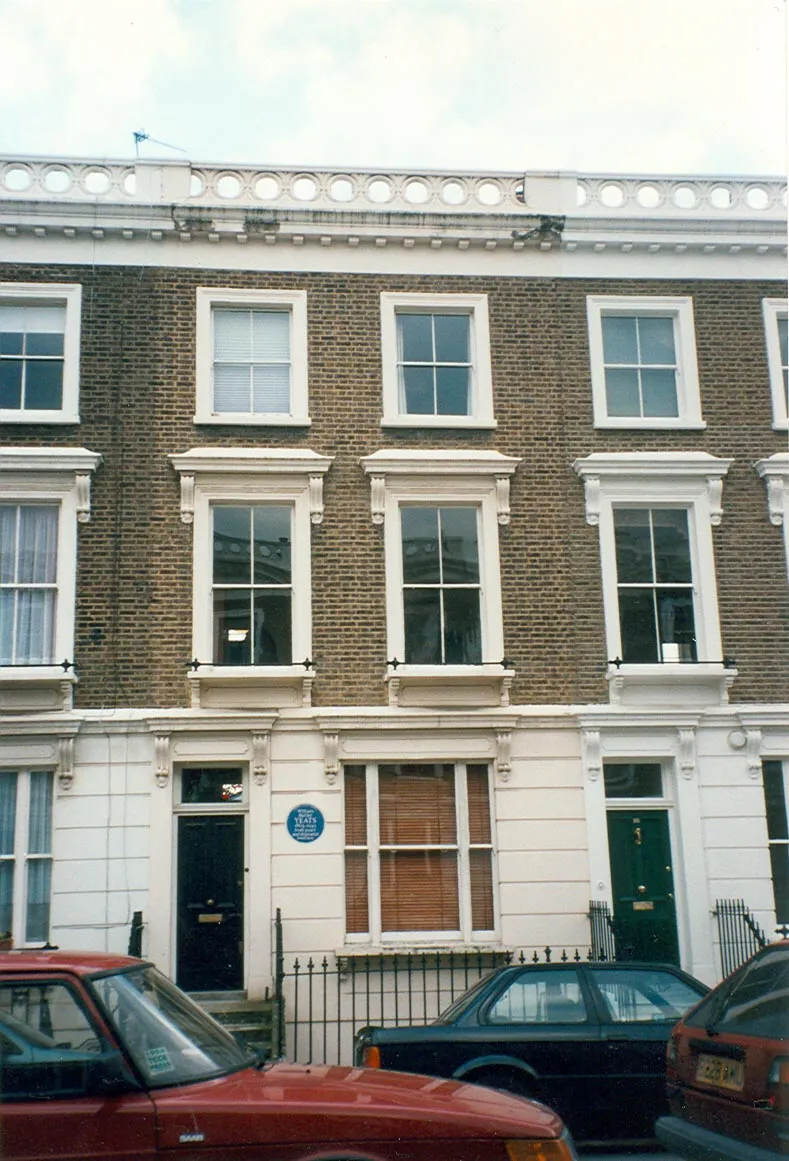
23 Fitzroy Road, Primrose HillAnosmia (Flickr), 1994. CC BY 2.0, Wikimedia Commons 1867-1873
23 Fitzroy Road, Primrose Hill
The family's first London home after leaving Dublin. A London County Council plaque was put up in 1957. Sylvia Plath later lived and died here.
1888-1902
3 Blenheim Road, Bedford Park
The Yeats family home in the garden suburb of Bedford Park from March 1888. Maud Gonne called here on 30 January 1889, the day Yeats said 'the troubling of my life began'. A Bedford Park Society plaque names John Butler Yeats and W. B. Yeats.
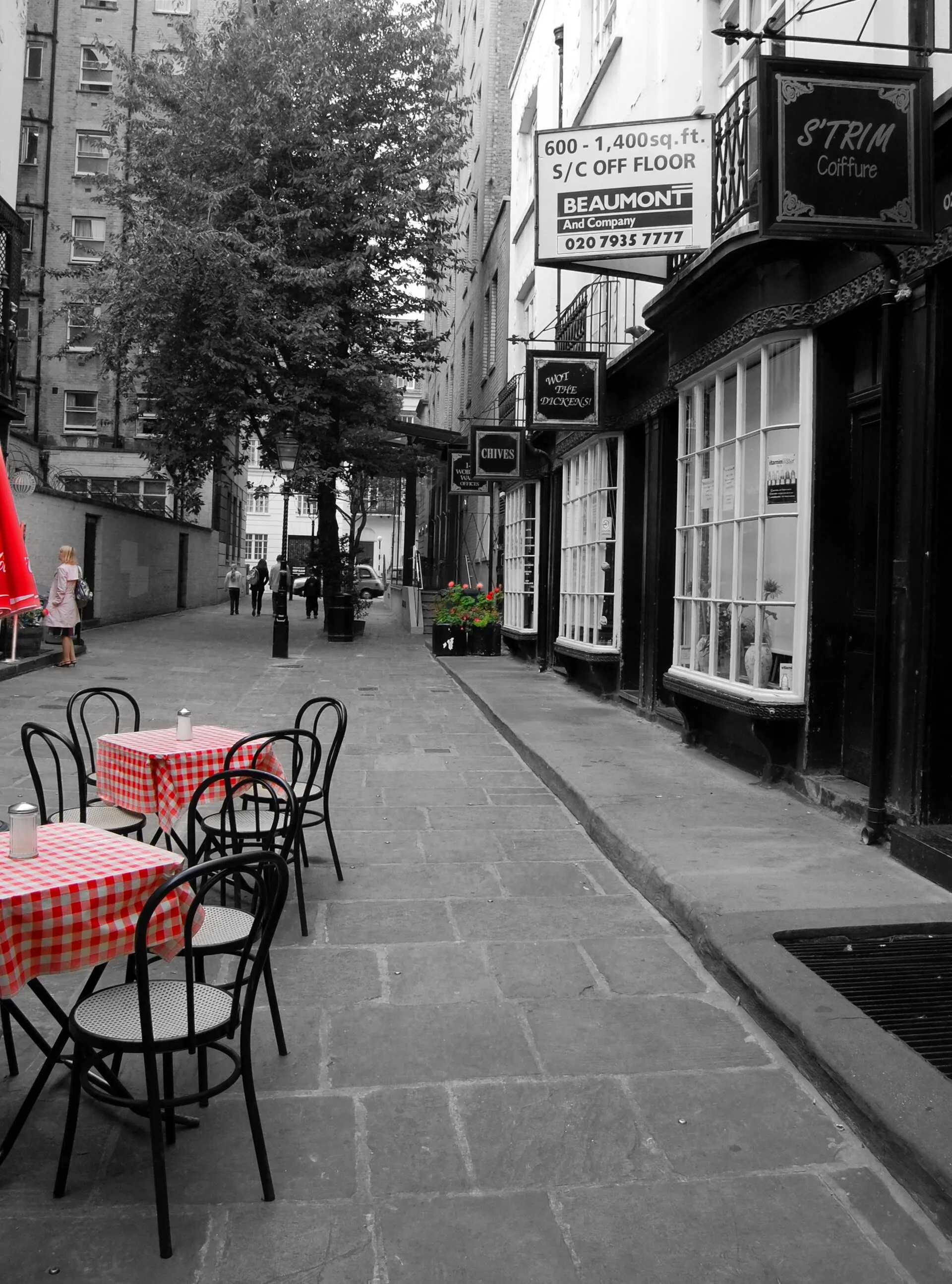
Woburn Walk, BloomsburyDncnH (Flickr), 2009. CC BY 2.0, Wikimedia Commons 1896-1919
18 Woburn Buildings (now 5 Woburn Walk)
Yeats's London rooms for more than twenty years, where he held Monday evenings for friends and where his affair with Olivia Shakespear began. Ezra Pound came here in 1909. A blue plaque marks the house.
1913-1916
Stone Cottage, Coleman's Hatch
The cottage on the edge of Ashdown Forest where Yeats spent three winters with Ezra Pound as his secretary, reading Japanese Noh plays. He brought George here in November 1917, weeks after their marriage.
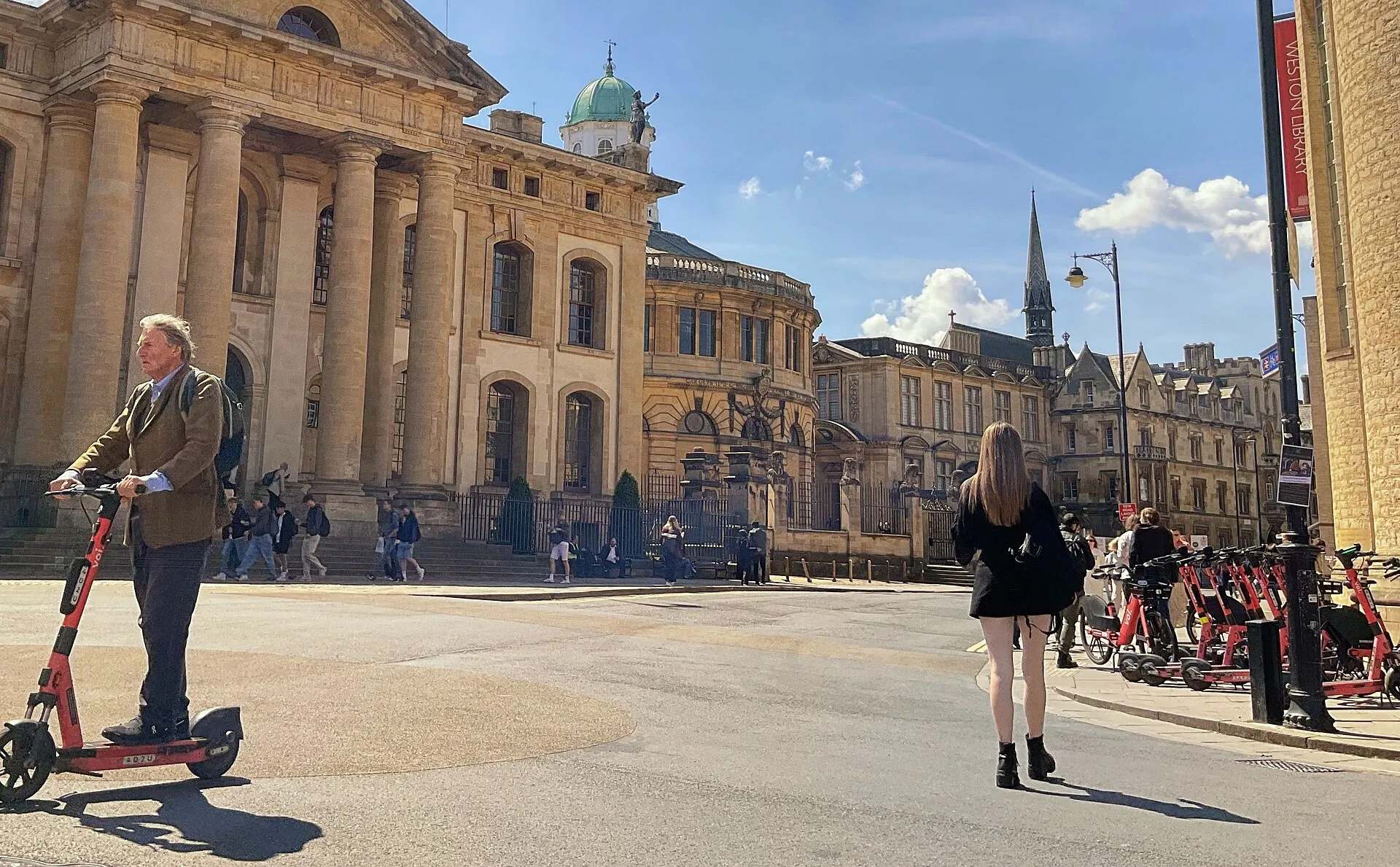
Broad Street, Oxford (2025)Honcques Laus, 2025. Public domain, Wikimedia Commons c.1918-1922
4 Broad Street, Oxford
The Yeatses' Oxford home during the early years of their marriage, while Ireland went through the War of Independence. Much of the automatic writing behind A Vision was done in Oxford.
Poem:All Souls' Night
1921
Cuttle Brook House, Thame
The house where the Yeatses' son Michael was born on 22 August 1921. A blue plaque was unveiled in 2011.
Poem:A Prayer for my Son
1935-1938
Penns in the Rocks, Withyham
Dorothy Wellesley's house in Sussex, where Yeats stayed often in his last years and worked with her on the Broadsides.
Poem:To Dorothy Wellesley


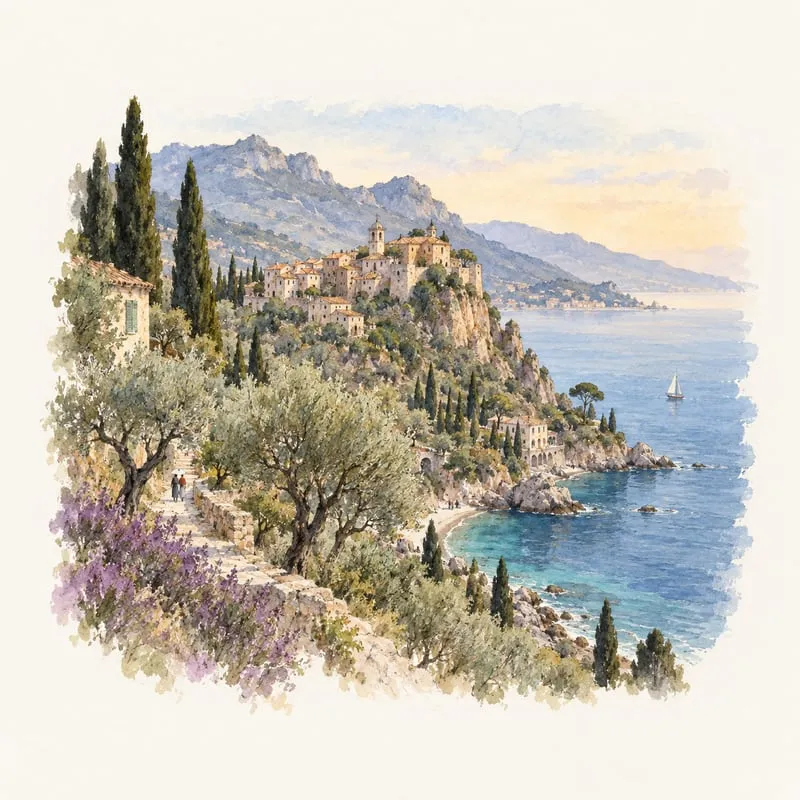
Abroad
Stockholm for the Nobel Prize, and the Mediterranean of his last winters.
1923
Stockholm (Nobel Prize, 1923)
Yeats received the Nobel Prize in Literature from King Gustaf V on 10 December 1923 and gave his lecture 'The Irish Dramatic Movement' on 15 December. He described the journey in The Bounty of Sweden (1925).
1928-1930
Rapallo
The Ligurian resort where the Yeatses wintered from 1928, near Ezra Pound. Yeats revised A Vision here and wrote the prose of A Packet for Ezra Pound.
1935-1936
Palma, Majorca
Yeats spent the winter of 1935-36 on Majorca working with Shri Purohit Swami on a translation of the Upanishads, and fell seriously ill there.
1938-1939
Hôtel Idéal Séjour (now Villa Louisiana), Cap Martin
The small hotel on Cap Martin where Yeats spent his last winter, finished his last poems and died on 28 January 1939.
1939-1948
Roquebrune cemetery
Yeats was first buried here after a private funeral. His remains were later moved to the ossuary, and those sent to Drumcliffe in 1948 may not all be his.
Plan a visit
Many of these places are open to visitors: the churchyard at Drumcliffe, the woods and lake at Coole Park, the tower at Ballylee (check its opening times first), and the lake shore at Lough Gill, where boats go out towards Innisfree in summer. Private houses on this page are private: look from the street.