Red Hanrahan's Song about Ireland
Earlier titled "The Song of Red Hanrahan"
Listen
Text: In the Seven Woods (Macmillan, New York, 1903). Public domain.
In brief
SummaryA wandering poet's song of storm, defeat and loyalty to Ireland.
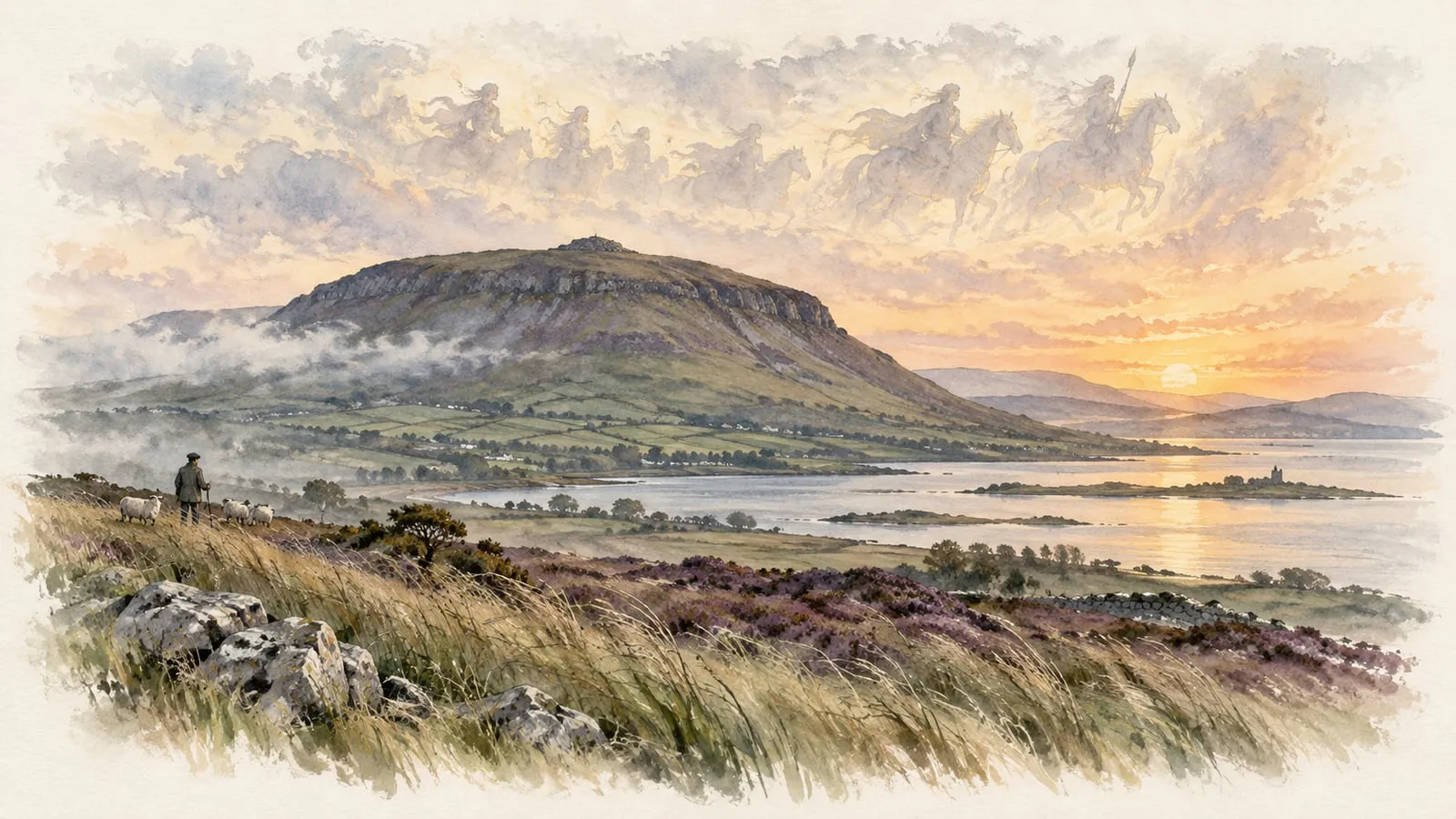
Red Hanrahan, the wandering poet of Yeats's stories, sings of Ireland as a woman, Cathleen the daughter of Houlihan. Each stanza begins in wild Sligo weather: thorn trees breaking on Cummen Strand, thunder thrown on Knocknarea, a pool overflowing on Clooth-na-Bare. Each time the storm becomes a picture of the people's own state, their courage broken, their hearts angry, their bodies heavy as floodwater. And each time a "But" turns the stanza towards Cathleen, whose flame they have hidden in their hearts and whose purity stands above all their troubles.
Lines to remember
Our courage breaks like an old tree in a black wind and dies;
Of Cathleen the daughter of Houlihan.
Line by line
Lines 1 to 5Broken courage
Old thorn trees snap on Cummen Strand under "a bitter black wind", and the people's courage breaks and dies like them. Then the turn: "we have hidden in our hearts" the flame from Cathleen's eyes. The loyalty is secret, kept alive under defeat.
Lines 6 to 10Thunder on Knocknarea
Wind piles the clouds over Knocknarea and hurls thunder on the stones, "for all that Maeve can say": even the legendary queen cannot stop it. The people's anger is as noisy as the clouds, but they have "bent low and low" to kiss Cathleen's "quiet feet", a gesture of devotion.
Lines 11 to 15Purer than a candle
Rain floods the high pool on Clooth-na-Bare, and the people feel their "bodies and our blood" grow heavy like flooded water. Against that weight Cathleen shines "purer than a tall candle before the Holy Rood", an image that makes her almost sacred.
Themes
Ireland as a woman
Cathleen the daughter of Houlihan is an old personification of Ireland from Gaelic song. The refrain names her at the end of every stanza, so each verse comes to rest on her. She is described by her eyes, her feet and her purity, never by anything she does: she is an ideal to be served, not a person.
Defeat and endurance
The poem admits a great deal of failure. "Our courage breaks like an old tree" and "dies"; the people's bodies are "like heavy flooded waters". Yet the storm never has the last word. Each stanza turns on "But", and the refrain shows a loyalty that survives the breaking, the anger and the weariness.
Landscape and legend
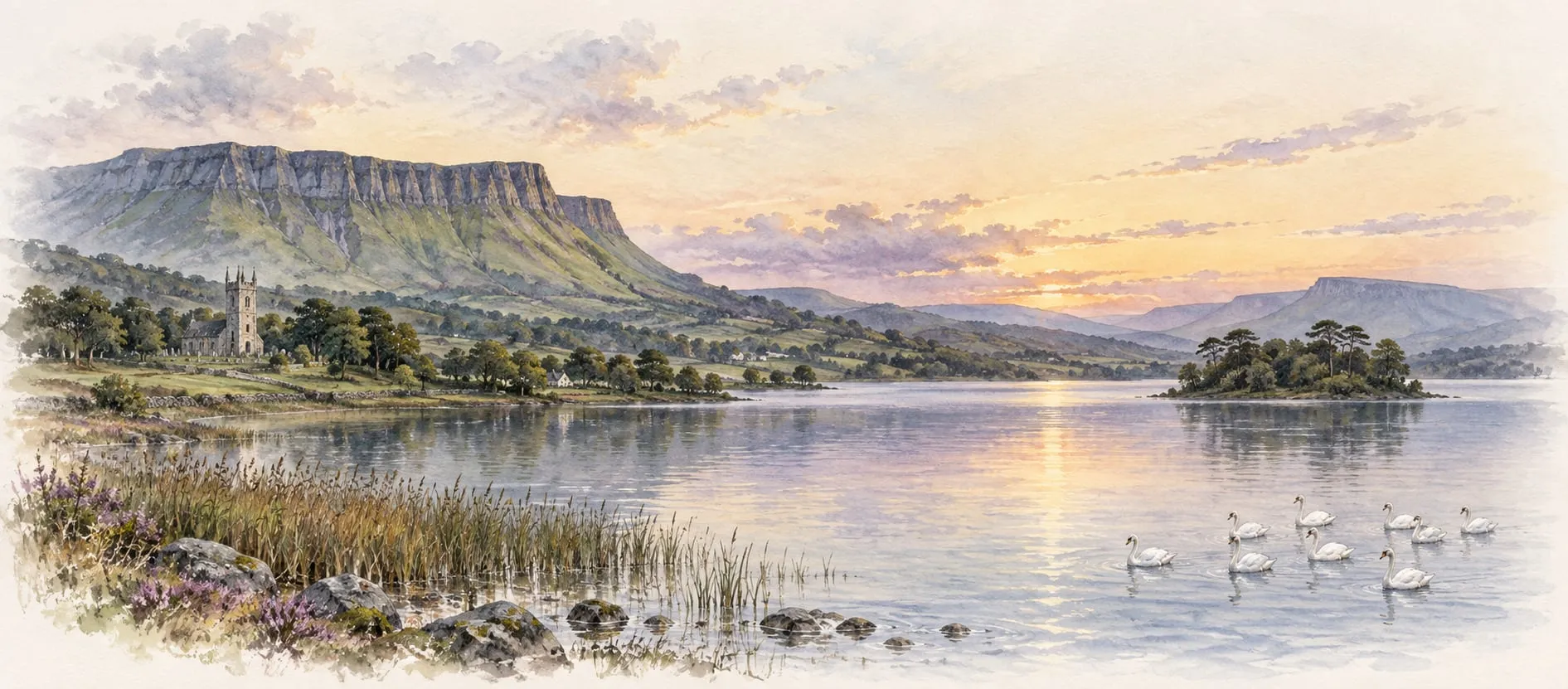
The storms are placed in real Sligo country: Cummen Strand, Knocknarea and Clooth-na-Bare. These are also places of legend, with Queen Maeve's name tied to Knocknarea. Wind, thunder and flood become the history of a people, so the land itself seems to suffer what they suffer.
Context
The poem was published in In the Seven Woods (1903) as "The Song of Red Hanrahan" and later took its present title. It was also printed inside the story collection Stories of Red Hanrahan. Hanrahan is Yeats's invented wandering poet and schoolmaster, a figure modelled on the Gaelic poets of the eighteenth century.
The figure of Cathleen ni Houlihan was in Yeats's mind at this time: his play Cathleen ni Houlihan, in which Ireland appears as a poor old woman who calls young men to die for her, was staged in Dublin in 1902 with Maud Gonne in the title role.
Form
Three five-line stanzas. The first four lines are very long, with seven beats each, rhymed in couplets ("Strand" and "hand", "dies" and "eyes"). The fifth line is the short refrain naming Cathleen. The long lines roll like a ballad sung aloud, and the fourth line always turns on "But", pulling the storm round towards the refrain.
Titled 'The Song of Red Hanrahan' in 1903; also printed inside the story collection Stories of Red Hanrahan. Not in Standard Ebooks Poetry.