Under the Moon
Listen
Text: Poetry, by W. B. Yeats (Standard Ebooks, 2024), from the collected editions of 1908 to 1928. Public domain.
In brief
SummaryA poet finds he can no longer bear to dream of legendary lands.
The poem is one long list of the dream-worlds of legend that once delighted the speaker: the Arthurian places of Brycelinde, Avalon and Joyous Isle, Ulster in the time of Naoise, and the Irish otherworlds of Land-under-Wave, Land-of-the-Tower and Wood-of-Wonders. They are full of queens and enchanted women, Branwen and Guinivere, Niamh and Fand, whose praise or sorrow he hears wherever he wanders in his dreams. Yet the first words are "I have no happiness" in any of it. The short final stanza gives the reason: after "something told" under the moon, even an old story of a beautiful woman in distress has become too painful to bear.
Lines to remember
I have no happiness in dreaming of Brycelinde,
To dream of women whose beauty was folded in dismay,
Even in an old story, is a burden not to be borne.
Line by line
Lines 1 to 4No joy in legend
He takes no happiness now in the forest of Brycelinde, in Avalon or Joyous Isle, where Lancelot was hidden in his madness, or in Ulster, where Naoise set sail. Every "Nor" shuts another door on a world he once loved.
Lines 5 to 10Dim otherworlds
Even lands "too dim to be burdens on the heart" give no comfort: Land-under-Wave, where seven old sisters spin the threads of the immortals, Land-of-the-Tower, opened by Aengus, and Wood-of-Wonders, where an ox killed at dawn lies on a golden bier by night.
Lines 11 to 16Queens of story
These worlds are crowded with women: queens like Branwen and Guinivere, shape-changers like Niamh, Laban and Fand, the wood-woman whose lover became a hawk. Wherever he goes in dreams, by wood, fort, shore or sea, he hears the harp praising them or their "mournful talk".
Lines 17 to 20The reason
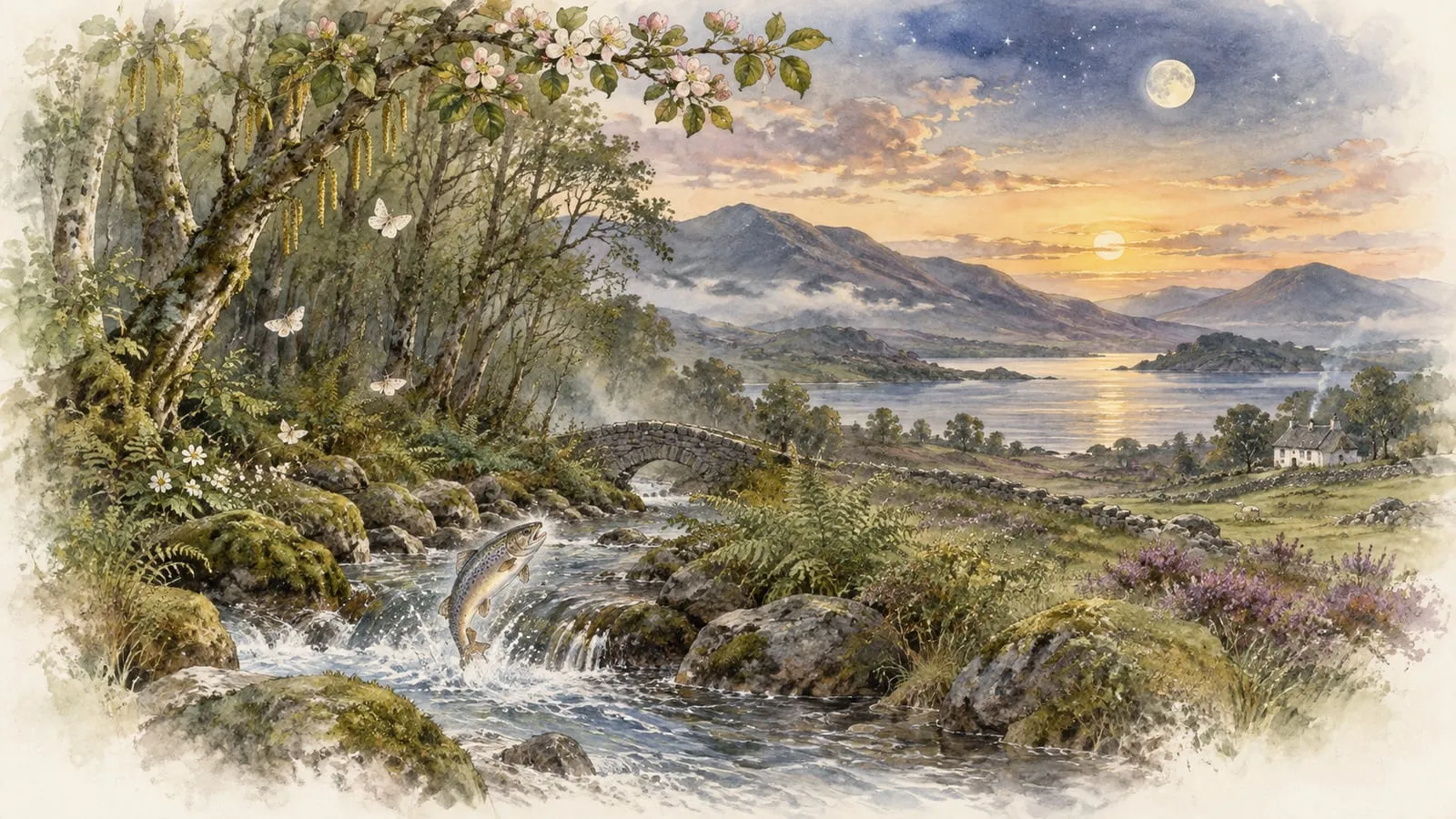
The last stanza explains. Because of "something told" under the thin horn of "the hunter's moon", to dream of "women whose beauty was folded in dismay" has become unbearable, "Even in an old story". What was told is never said.
Themes
Dreams and legend
For most of its length the poem is a catalogue of legend, Welsh, Arthurian and Irish, and the names themselves are rich and musical. It reads like a farewell to the imaginative world of Yeats's early poetry. The worlds are still vivid, but the speaker says plainly, "I have no happiness in dreaming" of them.
Private grief
The poem hides its cause. "Something told" under the moon has changed everything, but we never learn what. The effect is that a personal sorrow spreads backwards over all the old stories: any beautiful woman "folded in dismay" now reminds him of it, and becomes "a burden not to be borne".
Beauty and sorrow
The women of legend are praised by the harp but also heard in "mournful talk". Beauty in this poem is always shadowed. By the close, beauty and dismay are folded together in one phrase, and the speaker cannot separate the pleasure of the old tales from their pain.
Context
The poem was published in In the Seven Woods (Dun Emer Press, 1903). It draws on the legends Yeats knew well: the Arthurian romances, the Welsh Mabinogion (the source of Branwen), and the Irish sagas of Deirdre and Naoise, Niamh and Fand. The book marks a turn in his writing, and this poem reads as a poet's goodbye to the dreamy legendary world of his earlier verse, though it does not say why.
Form
A sixteen-line stanza followed by a four-line one, all in long, flowing lines. The rhymes are enclosed, abba, in each group of four ("Brycelinde", "Isle", "while", "wind"). The first stanza is a single sentence piling up names, and the short second stanza stops that flow with a blunt explanation.