The Wanderings of Oisin
Earlier titled "The Wanderings of Usheen"
“Give me the world if thou wilt, but grant me an asylum for my affections.”
Tulka
To Edwin J. Ellis
Book I
S. Patric
Usheen
S. Patric
Usheen
S. Patric
Usheen
S. Patric
Usheen
Book II
Usheen
S. Patric
Usheen
Book III
Usheen
S. Patric
Usheen
S. Patric
Usheen
Text: Poetry, by W. B. Yeats (Standard Ebooks, 2024), from the collected editions of 1908 to 1928. Public domain.
In brief
SummaryAn old Fenian hero tells St Patrick of three centuries in fairyland.
Oisin, son of Finn, now old, bald and blind, tells St Patrick the story of his three hundred years among the immortals. Out hunting with the Fenians, he met Niam, a fairy princess who had fallen in love with his fame, and rode away with her over the sea. Book I takes them to an island of endless dancing and joy, Book II to an island where he fights a shape-changing demon for a hundred years, and Book III to an island of sleep where giants doze under a bell-branch. Each time, a scrap of the human world (a broken lance, a beech bough, a starling) wakes his old sadness. At last he rides home, finds the Fenians long dead and Ireland Christian, and falls from the horse into sudden old age. Patrick tells him his friends are in hell; Oisin chooses to join them there.
Lines to remember
You who are bent, and bald, and blind,
For joy is God and God is joy.
And dwell in the house of the Fenians, be they in flames or at feast.
Line by line
Lines 1 to 31Book I: The hunt
Patrick taunts the "bent, and bald, and blind" old man for his "dalliance with a demon thing". Oisin (spelt Usheen in this text) remembers the Fenian hunt with Caolte, Conan and Finn, past the cairn where "passionate Maive is stony still", and the "pearl-pale, high-born lady" they met on the shore, riding a horse bridled with findrinny.
Lines 32 to 131Book I: Niam's wooing
The lady is Niam, daughter of Aengus, and she has come to marry Oisin, whose fame the poets sang. She promises a land "Where broken faith has never been known", with a hundred hounds, robes, youths and maidens. He mounts behind her, the Fenians weep, and they ride "out from the human lands". His lament for his companions draws Patrick's rebuke.
Lines 132 to 246Book I: Island of dancing
They gallop over the sea past phantoms, a hornless deer and a white hound with "one red ear", to an island of trembling trees and birds. Laughing immortals in yellow silk lead them inland. When Oisin sings "of human joy" they weep, and a boy flings away the harp as the "saddest harp in all the world".
Lines 247 to 342Book I: Aengus's song
Aengus sits dreaming in a house of wattles, holding a flashing sceptre, and sings that joy drives all growth and change: "For joy is God and God is joy." The immortals dance through the woods, singing to the roses and the stars that they fear neither death nor "the grey wandering osprey Sorrow".
Lines 343 to 429Book I: The broken lance
The refrain "O Patric! for a hundred years" sums up a century of hunting, wrestling, fishing and marriage. Then a piece of "some dead warrior's broken lance" washes up, and he weeps for the Fenians. Niam knows the old life is over. As they ride on, the immortals sing that mortal things grow old while their own love lasts.
Lines 430 to 531Book II: The chained lady
Niam's songs are now troubled by tears. They reach dark towers in the surf, "the Isle of many Fears", and climb endless moonlit stairs past giant statues. A lady "with soft eyes like funeral tapers", chained to two ancient eagles, sings of her grief. Niam has brought Oisin to free her, and despite every warning he bursts the chain.
Lines 532 to 643Book II: Sword of Mananan
In the hall built by the sea-god Mananan, the lady brings Oisin a shining sword bearing the god's name. He fights the demon from dawn to night as it turns into an eel, a roaring fir tree and a drowned body, then throws it into the sea. His scorn for "the lying clerics" brings a thunderous warning from Patrick.
Lines 644 to 689Book II: Endless war
Every fourth morning the demon returns, healed, and for a hundred years Oisin lives in "an endless feast" of fighting. Then a beech bough floats up, reminding him of Finn at Allen, and Niam leads him away. The demon's chant says man's purpose "drifts and dies", and no one knows which island is "the Island of Content".
Lines 690 to 765Book III: The sleepers
The lines lengthen as they ride through milky foam to a grey, dripping island of hazel and oak where nothing lives. In a valley lie huge sleepers with bird claws, owls nesting in their hair. Their king sways a bell-branch, whose music drowns Oisin's memories, and he and Niam lie down under creeping ivy.
Lines 766 to 825Book III: The starling
For a century he forgets battle and craft, though heroes of legend drift through his dreams. Then a starling falls into the meadow, like the birds of old Fenian mornings, and "the ancient sadness of man" wakes in him. Niam, grown "white as the waters", lets him go, warning that if his foot touches earth he can never return.
Lines 826 to 889Book III: Home to Ireland
He rides back to find "bell-mounted churches", a small, stooping people, and a voice telling him "The Fenians a long time are dead." Near Maive's resting place he leans from the saddle to lift a sack of sand; the girth breaks, he falls, and three hundred years fall on him. Patrick answers that the Fenians burn in hell.
Lines 890 to 913Book III: Oisin's choice
Oisin imagines leading the Fenians to storm hell and batter its "gateway of brass". Patrick tells him to kneel and pray for his lost soul. The old man mourns his helpless age, throws down his prayer beads, "the chain of small stones", and chooses to join his companions, "be they in flames or at feast".
Themes
Dream and action
The poem sets the life of the Fenians, hunting, fighting and feasting, against the immortal islands. Each island offers one thing forever: joy in Book I, battle in Book II, sleep in Book III. None can hold him, because a scrap of the mortal world, a lance, a bough, a bird, wakes "the ancient sadness of man". Human life, with all its loss, proves stronger than paradise.
Pagan and Christian
The frame is a quarrel between Oisin and Patrick. The old hero hates "Fasting and prayers" and "the lying clerics"; Patrick answers with thunder and hell's "burning stones". Returning home, Oisin finds "bell-mounted churches" and a "small and a feeble populace". His final choice, to join the Fenians "be they in flames or at feast", puts loyalty and pride before salvation.
Time and age
Three hundred years pass as if in a dream ("I know not if days passed or hours"), and the poem opens and closes on an old man. The immortals sing of the hare that "grows old as she plays in the sun", but they never age themselves. When Oisin falls to earth, time strikes all at once: "my years three hundred fell on me".
Love
Niam's love runs through all three books. She chooses Oisin for his songs and battles, soothes him with song and "her white arms", and each time lets him go with deeper grief, until she grows "white as the waters are white". His love for her is real, but it cannot outweigh his longing for his own kind: two worlds that cannot join.
Context
This is Yeats's first long poem and the title poem of his first collection, The Wanderings of Oisin and Other Poems, published in January 1889. It is drawn from the Fenian tales of Finn and his warriors, in which Oisin, Finn's son, goes to the Land of Youth with Niam and returns centuries later to find St Patrick in Ireland. It stands first in the Narrative and Dramatic section of the collected poems.
Yeats revised the poem heavily. For Poems (1895) he reworked it as "The Wanderings of Usheen", revised it again in 1899, and changed "two or three pages" in 1912; the title became "Oisin" again from 1908. The text printed here keeps the spelling "Usheen" in most places. The dedication is to Edwin J. Ellis, the painter and poet with whom Yeats edited the works of William Blake.
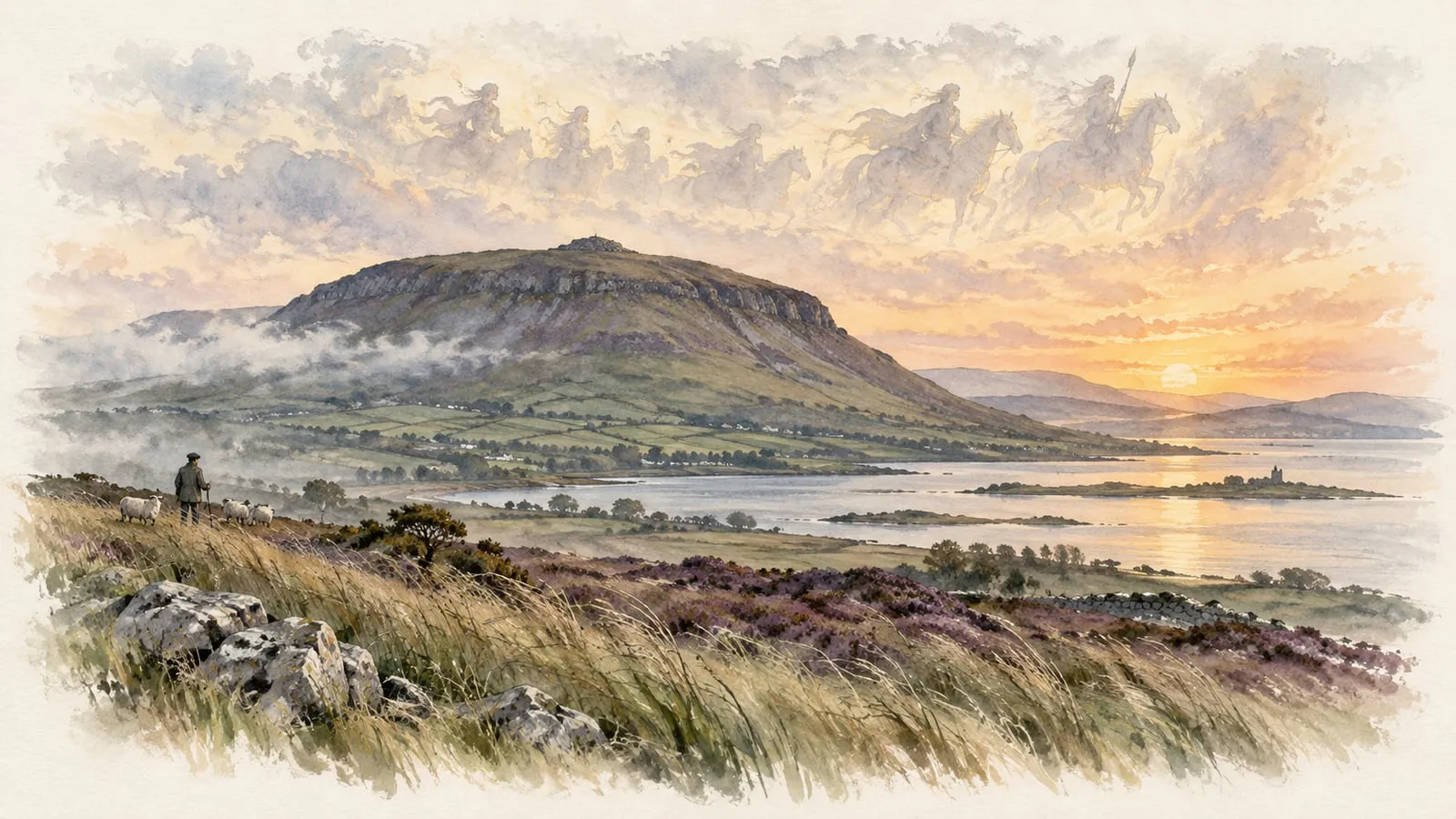
The cairn of "passionate Maive" in line 18 is usually taken to be the great cairn on Knocknarea, near Sligo, traditionally Queen Maeve's grave. Late in life, in "The Circus Animals' Desertion", Yeats looked back on Oisin's three enchanted islands as the first of the dream images of his early work.
Form
Each book has its own music. Book I is in short lines of four beats, mostly rhyming couplets, quick and songlike. Book II moves to longer five-beat couplets, weightier for battle, with the chained lady's song in short six-line stanzas. Book III stretches to long, rolling lines of six or seven beats rhyming alternately, whose slow sway suits sleep, dream and the long ride home.
HEAVILY REVISED. 1889 first text; extensively revised for Poems (1895) as 'The Wanderings of Usheen', again in 1899, and 'two or three pages' changed in 1912 (Yeats's 1912 preface in Gutenberg 38877). Titled 'Oisin' again from 1908 (Gutenberg 49608) and in Collected Poems 1933.