Baile and Aillinn
Argument. Baile and Aillinn were lovers, but Aengus, the Master of Love, wishing them to be happy in his own land among the dead, told to each a story of the other’s death, so that their hearts were broken and they died.
Text: Poetry, by W. B. Yeats (Standard Ebooks, 2024), from the collected editions of 1908 to 1928. Public domain.
In brief
SummaryTwo lovers tricked into dying of grief are united among the immortals.
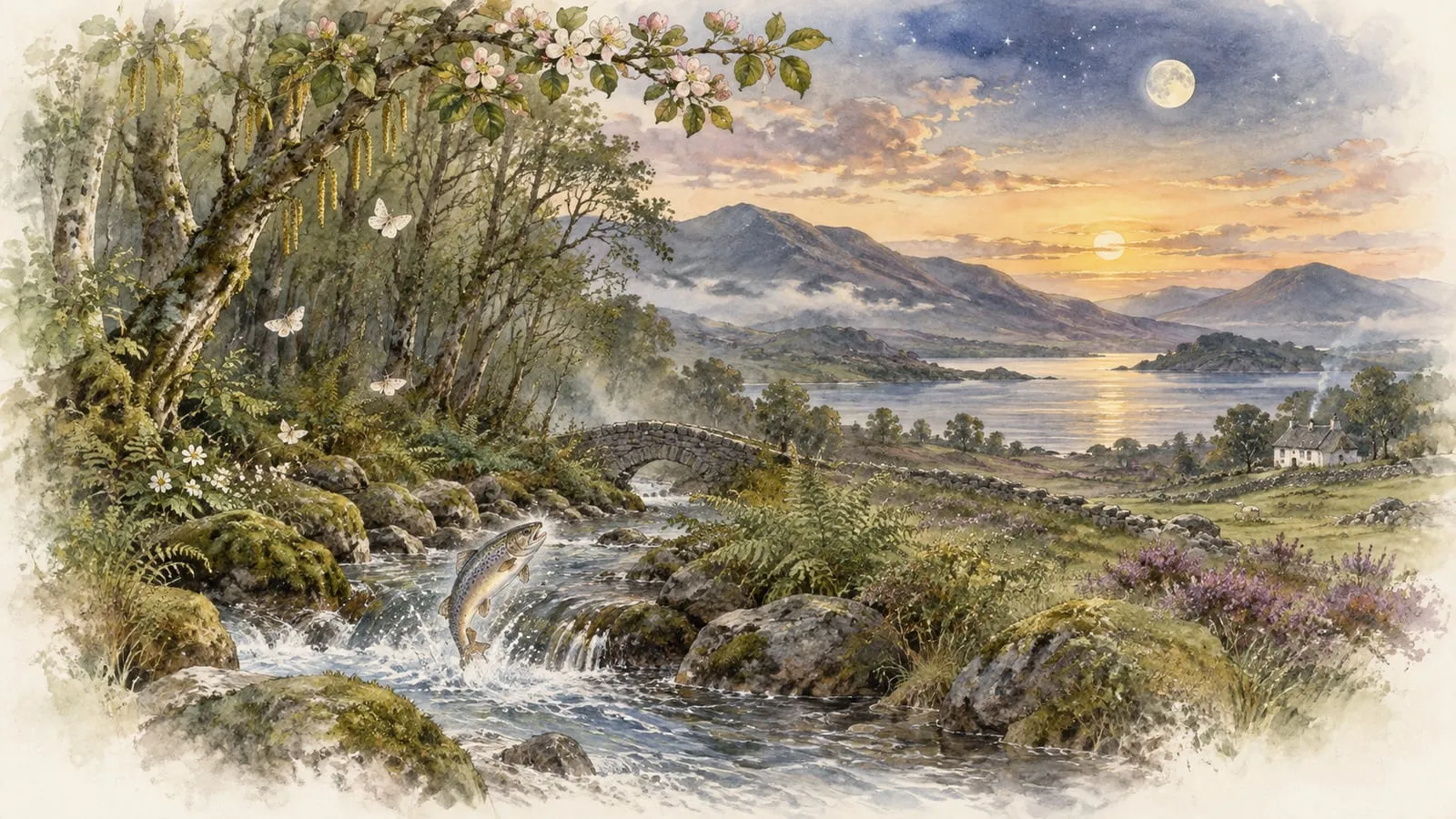
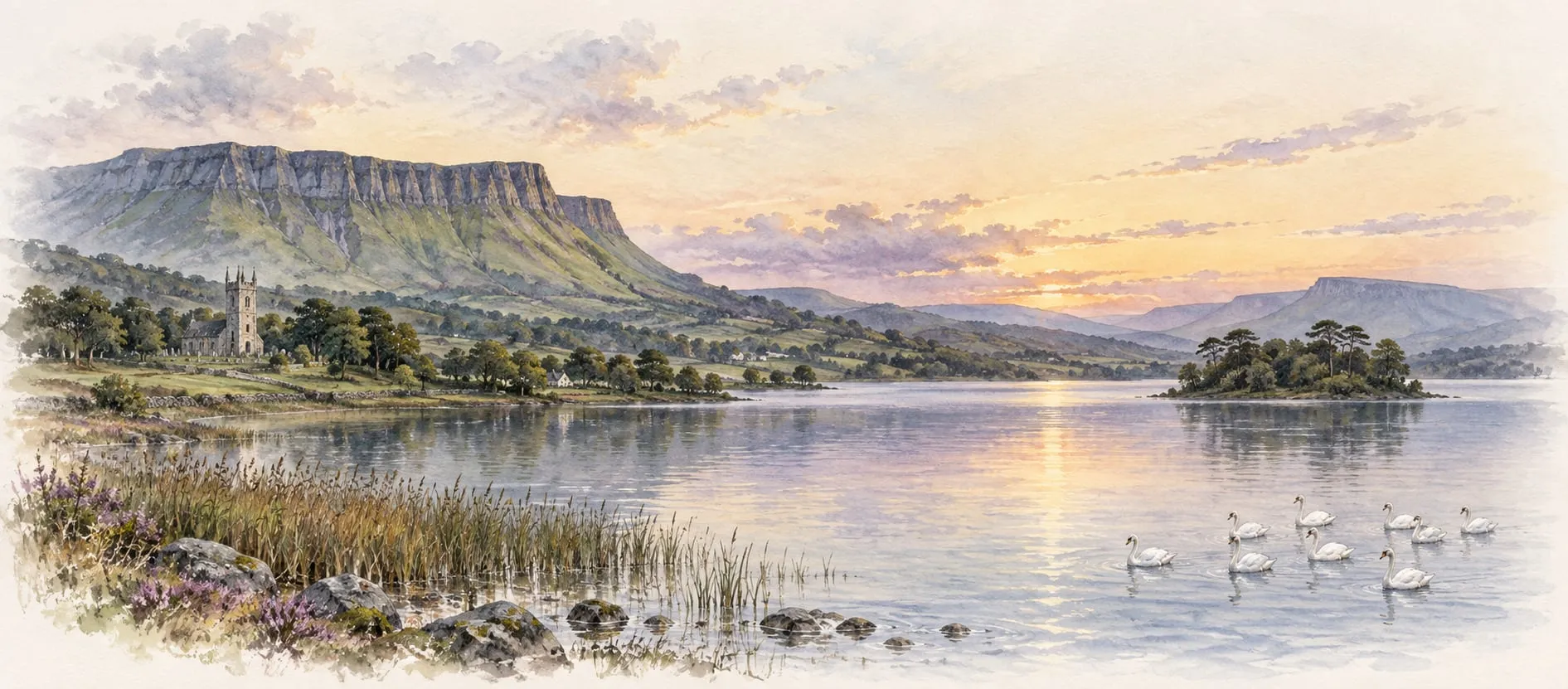
The cry of the curlew sets the poet thinking of Baile Honey-Mouth, heir of Ulster, and Aillinn, a king's daughter from the south, who were forbidden to marry on earth. Baile rides south for their wedding, but a ragged old runner tells him that Aillinn has died of a broken heart. Baile's heart breaks too, and he is buried under a cairn. The runner then carries news of Baile's death to Aillinn, and she dies at once. Climbing a hill, the old man takes his true shape: he is Aengus, the god of love, and the lovers come to him as two swans linked by a golden chain, to live on happily in the otherworld. Again and again the poet steps out of the tale to speak of his own love, and he ends by telling his beloved that she is greater than any heroine of legend.
Lines to remember
I hardly hear the curlew cry,
They blossomed to immortal mirth.
Ah! wise, my heart knows well how wise.
Line by line
Lines 1 to 12The curlew's cry
The sounds of the wild, the curlew and the "grey rush", set the poet thinking of Baile, "who had the honey mouth", and Aillinn, "that mild woman of the south". The stanza gives the ending away at once: forbidden to marry on earth, "They blossomed to immortal mirth." What follows is how.
Lines 13 to 30The ride south
About the time of Christ's birth, Baile rides out of Emain with harpers and young men, sure he will be married at Muirthemne. They meet a strange runner, drawn in a comic list of rags: grass-coloured hair, knees through his hose, "puddle water in his shoes", and a sharp "squirrel's eye".
Lines 31 to 46The poet's aside
The poet turns to the "wandering birds and rushy beds" that fill our heads with folly. Their crying makes ordinary love seem small beside the loves of legend, though the wise know that all life gives is "A child's laughter, a woman's kiss." He wonders who put such scorn into reeds and birds.
Lines 47 to 64The false news
The runner says Aillinn set out to marry Baile, but an old man seized her horse's head and ordered her home, and a young man begged her to wed one of her own people. When no face grew kind, "She fell and died of the heart-break." None of it is true.
Lines 65 to 84Baile's death
A lover's heart will believe anything "That is bad enough to be true", and Baile's breaks in two. He is carried to the house of the Hound of Ulad, Cuchulain, who every year on this day weeps for "the harper's daughter and her friend", Deirdre and Naoise. Baile's cairn only renews that older grief.
Lines 85 to 99Deirdre remembered
People forget quickly, but "the grey rush under the wind" and the curlew, "the grey bird with crooked bill", still remember Deirdre and her man. Walking with "Kate or Nan", we hear them scold us for being content with less. The stanza ends on a private sigh: "Ah! wise, my heart knows well how wise."
Lines 100 to 125The second lie
The old man runs to Aillinn, riding with her waiting maids and harpers towards the marriage bed. He cries that Baile is dead and buried in Muirthemne under Ogham letters, and adds, almost in passing, that the gods have decreed the pair should "clip and clip again" on the Great Plain, not in any earthly bed.
Lines 126 to 143The god revealed
Aillinn's "love-worn heart" breaks at once. Laughing, the runner races to the Hill Seat of Leighin, where two swans "Linked by a gold chain" fly up to him. His body changes, "Tall, proud and ruddy", with wings hovering over his harp. He is Aengus, god of love, and the swans are the lovers.
Lines 144 to 159Two made one
The poet searches for images of two lives become one: fish swimming "Scale rubbing scale", mice in a single sheaf, "the eyelids of one eye", or "the two strings that made one sound". The lovers are happy without end, because they have "so good a friend" in Aengus.
Lines 160 to 186Among the immortals
They pass the gates of the four magic cities, Gorias, Findrias, Falias and Murias, wander "where earth withers away", and at night drift in "a glass boat" under the birds of Aengus. They eat "Quiet's wild heart, like daily meat": the lists and strange names give their happiness a jewelled richness.
Lines 187 to 197Yew and apple
On earth, poets found a yew growing where Baile lay and a wild apple over Aillinn. In a better time after the wars, they cut tablets from the two trees and wrote on them "All the love stories that they knew", so that the lovers' graves become the very book of love.
Lines 198 to 207To his beloved
The poet turns to his "Beloved". Let rush and bird cry about Deirdre, "the harper's daughter": he is "not afraid of her", because his beloved is "more high of heart". Still, he would have the birds forget the old lovers, since every lover longs to marry as they did, and they are dead.
Themes
Love beyond death
The lovers are "forbid to marry on earth", and their earthly story ends in two broken hearts. Yet the poem is not a tragedy. The old man's lies are a god's trick to bring them sooner to the otherworld, where they "Have happiness without an end". The images of lines 144 to 156, one eye, one house, one shadow, one sound, show two lives made one.
Legend and real love
Again and again the poet steps out of the tale. The rushes and curlews, full of old stories, make "our poor Kate or Nan" seem less than the heroines of legend, and he knows that this is "folly". The ending answers the problem: his own beloved is not less than Deirdre but "more high of heart than she".
Nature's memory
The curlew and the "grey rush" frame the poem. They are the voices through which old stories reach the present: people forget, but reeds and birds "Have such long memories" that they still remember Deirdre. At the end the yew and the apple on the lovers' graves become writing tablets, as if nature itself kept the record of love.
Context
The poem first appeared in a book in 1903, in In the Seven Woods, and Yeats revised it in later editions. It retells an old Irish tale of two lovers who die of grief at false news of each other's death, with a yew growing from his grave and an apple tree from hers. Yeats set it in the world of the Ulster tales, with Cuchulain as "the Hound of Ulad" and the memory of Deirdre, who fled over the sea with Naoise.
Aengus, the love god, links the poem to "The Old Age of Queen Maeve", published with it in 1903, and his harp recalls "The Harp of Aengus", in which Edain weaves harp strings from his hair. The "Beloved" of the last lines is usually read as Maud Gonne, whom Yeats often set beside the heroines of legend.
Form
Rhyming couplets in lines of four beats, the brisk measure of ballad and folk tale ("cry" and "high", "run" and "son"). The seventeen verse paragraphs vary in length, and the story is broken up by the poet's asides. The quick couplets keep the long tale moving and suit both its comedy, like the runner's "puddle water", and its songlike otherworld passages.
Revised between 1903 (Gutenberg 30652) and later texts.