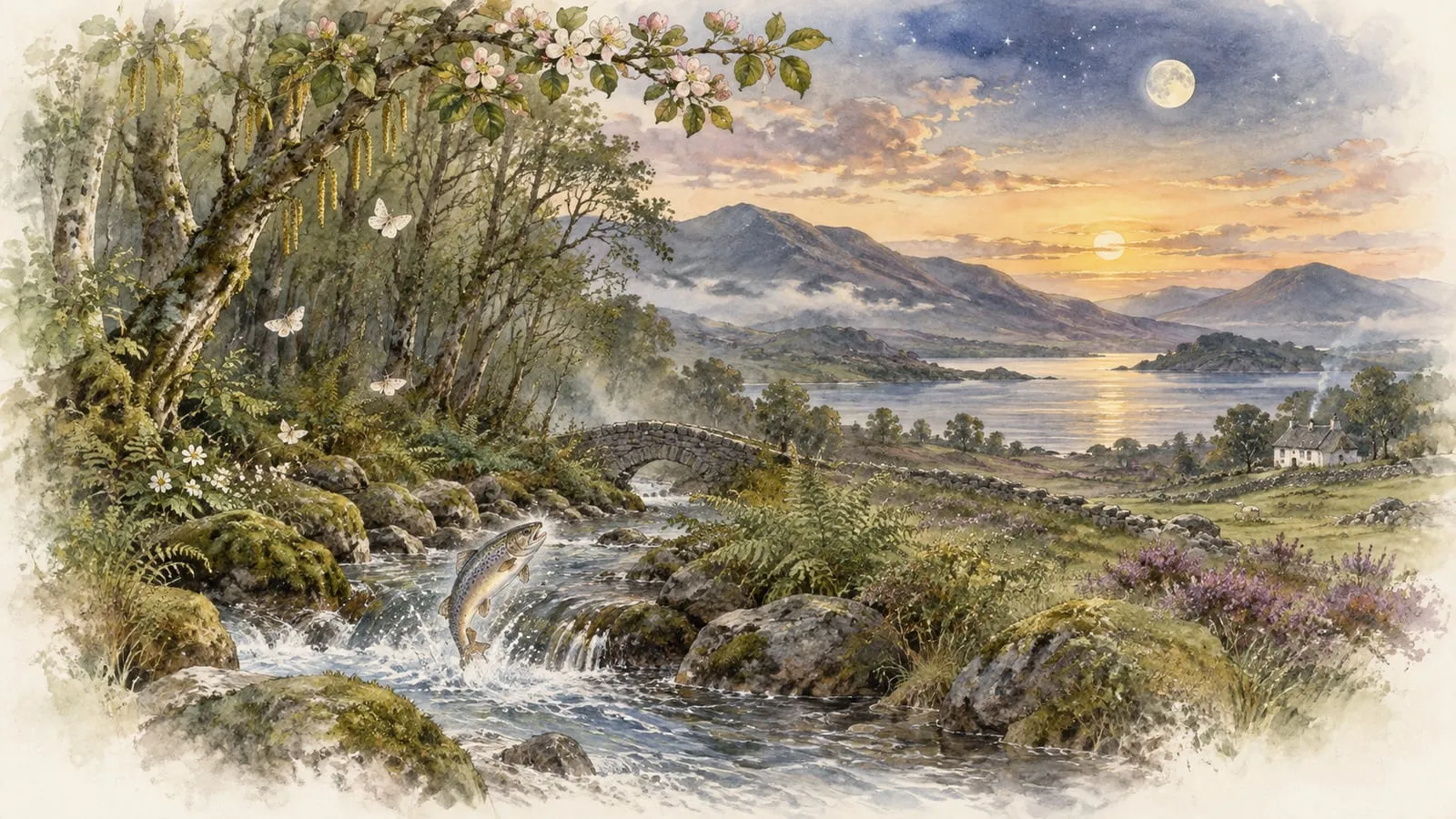
The Harp of Aengus
Text: Poetry, by W. B. Yeats (Standard Ebooks, 2024), from the collected editions of 1908 to 1928. Public domain.
In brief
SummaryThe god of love makes a harp for his lost beloved.
A short myth told in two sentences. Edain leaves Midher's hill and lies beside the young god Aengus in his tower of glass, a place outside time, full of scented winds and apples made of jewels. Wild with love, she weaves seven harp strings from his long hair. When Midher's wife turns her into a fly, Aengus makes a harp of "druid apple wood" so that, blown about on the winds, she may know he weeps for her. Since then he has watched over only faithful lovers.
Lines to remember
Where time is drowned in odour-laden winds
Because her hands had been made wild by love.
But faithful lovers.
Line by line
Lines 1 to 9The tower of glass
Edain comes out of "Midher's hill", a fairy mound, to lie beside Aengus. His "tower of glass" stands outside time, which is "drowned in odour-laden winds", and its apples are made "Of opal and ruby and pale chrysolite". From his hair she weaves "seven strings", because her hands are "made wild by love".
Lines 10 to 14The harp
Midher's wife turns Edain into a fly, lost among the winds. Aengus answers with a harp of "druid apple wood", so that wherever she drifts she "might know he wept". The short last line, "But faithful lovers.", closes the story like a blessing.
Themes
Faithful love
The poem is a love story in miniature that ends by making Aengus the guardian of "faithful lovers". His answer to loss is not anger but music: a harp to tell Edain, wherever she is blown, that he still weeps for her. Love outlasts both transformation and separation.
Music from love
Both lovers make things. Edain weaves harp strings from Aengus's hair; Aengus builds a harp from apple wood. When speech is impossible, music carries the message. That suits a poem placed before The Shadowy Waters, a play in which a magic harp is at the centre of the action.
Context
In the collected poems this piece stands, with the lines beginning "I walked among the seven woods of Coole", as a prelude to The Shadowy Waters, Yeats's dramatic poem about the sea-rover Forgael and the queen Dectora, in the Narrative and Dramatic section.
The myth comes from the old Irish tale of the wooing of Etain. Etain, wife of the fairy king Midir, was turned into a fly by his jealous first wife, and Aengus, the god of love, sheltered her in a house of glass. Yeats used the same story in "Baile and Aillinn", where Aengus carries the harp strings "That Etain, Midhir's wife, had wove".
Form
Fourteen lines of blank verse (unrhymed lines of five beats) in two sentences. The first runs for nine lines, heaping up clauses joined by "And" as the tower's drowsy beauty builds. The poem ends on a half line, "But faithful lovers.", which stops the music short and gives the ending its weight.