The Shadowy Waters (Introductory Lines)
Earlier titled "Introductory Lines", "The Shadowy Waters"
September 1900.
Text: Poetry, by W. B. Yeats (Standard Ebooks, 2024), from the collected editions of 1908 to 1928. Public domain.
In brief
SummaryWalking Coole's seven woods, the poet salutes the unseen immortal shadows.
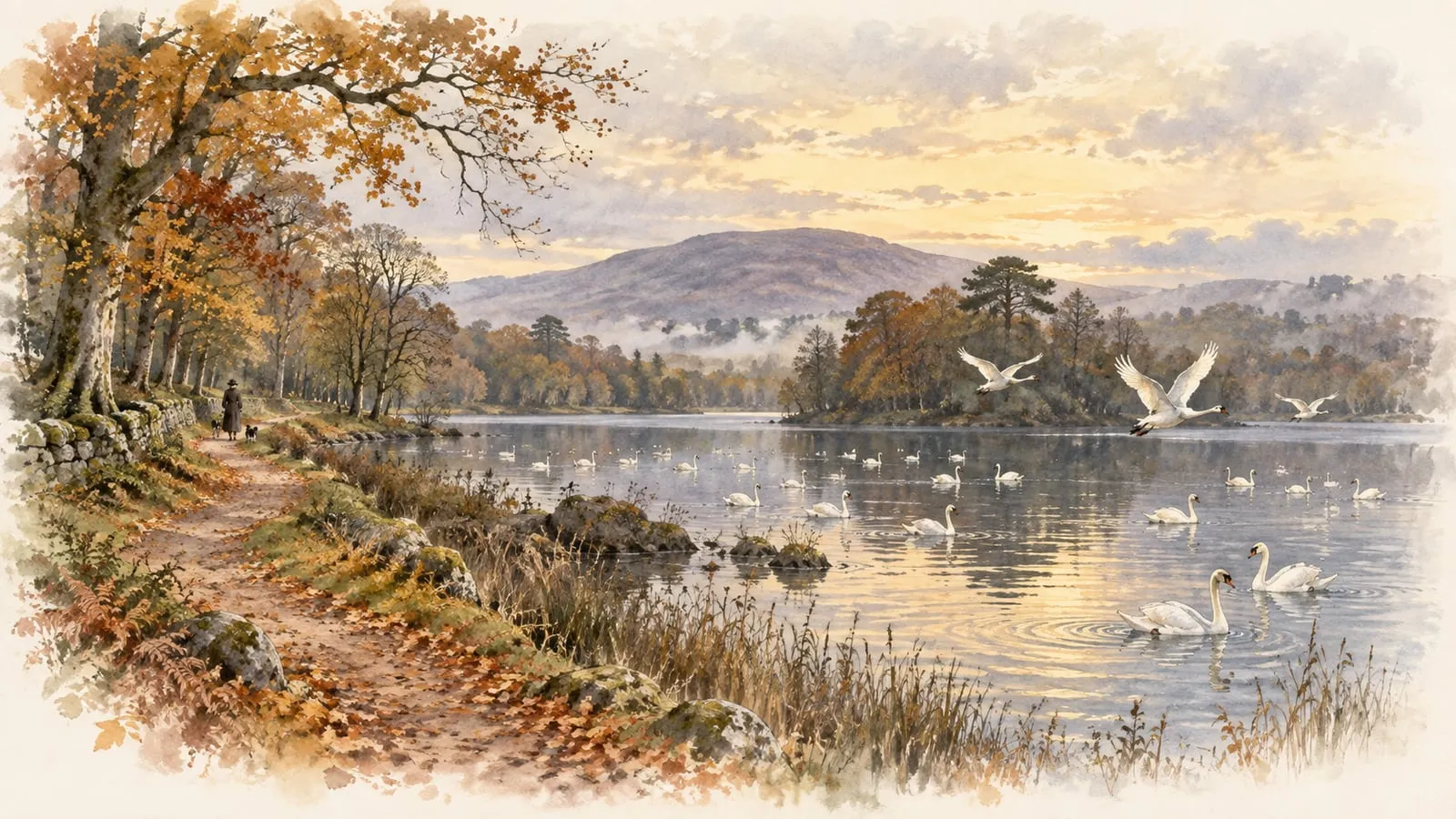
The poet walks through the seven woods of Coole, naming each with a single detail: wild duck on a pond, squirrels, wild bees, badger and fox, and the "wicked wood" of Biddy Early. He has never seen the "immortal, mild, proud shadows" that enchanted eyes have seen there, but he has dreamed of them, and his dreams gave him the story of Forgael and Dectora. He asks where these beings come from, whether Eden is far away or hidden inside our own woods, and ends by offering the poem to them, like wine poured out for invisible gods.
Lines to remember
I walked among the seven woods of Coole,
Seven odours, seven murmurs, seven woods.
Is Eden out of time and out of space?
Line by line
Lines 1 to 16The seven woods
A roll-call of the woods at Coole, each given its Irish name and one living detail: the pond that "Gathers the wild duck", squirrels hidden from old age, bees that "fling Their sudden fragrances". The repeated "Dim" deepens the mood, and line 16 gathers everything into one chant: "Seven odours, seven murmurs, seven woods."
Lines 17 to 26Dreams of the shadows
He lacks the "enchanted eyes" that have seen the immortals, yet dreams of "beings happier than men", and at night his dreams are "cloven by voices and by fires". Those dreams gave him the images of his play. More he cannot say: the dreamers' wisdom is "half silence" and makes the tongue "Heavy like stone".
Lines 27 to 40Where is Eden?
A run of questions to the shadows. All knowledge comes from them, and they come "from Eden on flying feet". Perhaps Eden hides close by, like hares and mice in "the last ridge of the barley" before the reaping-hook, or inside our own woods and ponds. Perhaps they gather whenever light on water and "the green quiet" lift the heart.
Lines 41 to 44An offering
The last four lines dedicate the poem to the shadows. Like men of old who "Poured out wine for the high invisible ones" before the harps began to play, he sets these lines in front of his play as an offering before the story.
Themes
Seen and unseen
The poem sets real woods, named and full of creatures, against an invisible world within them. The poet cannot see the "immortal, mild, proud shadows", but he believes they move "round me in the shadows". His questions in lines 30 to 36 suggest that the other world may not be far off at all, but folded inside this one, in "more quiet woods" and "star-glimmering ponds".
Inspiration
The poem is also about where poems come from. "All we know comes from you", he tells the shadows, and the images of his play came to him in dreams, among "the voices and the fires". The poet is a receiver rather than an inventor, and even so he cannot tell everything, since the dreamers' wisdom is "half silence". The closing offering repays the debt.
Coole
The seven woods are real, and naming them (Shan-walla, Kyle-dortha, Pairc-na-lea) roots the vision in one estate in County Galway. Nature is closely observed, from privet that blinds the paths to the wood that "hides badger and fox". The mystical questions grow out of that loving attention to a particular place.
Context
The poem is dated September 1900 and introduces The Shadowy Waters, Yeats's dramatic poem about Forgael, a sea-rover sailing in search of an immortal love, and Dectora, the queen he takes captive. In the collected poems it stands, with "The Harp of Aengus", before the 1906 text of the play in the Narrative and Dramatic section.
Coole Park, near Gort in County Galway, was the home of Lady Gregory, and from 1897 Yeats spent long summers there. Its seven woods gave their name to his next collection, In the Seven Woods (1903). Biddy Early was a famous wise woman, or folk healer, of County Clare in the nineteenth century, and stories about her were gathered by Lady Gregory and Yeats.
Form
Forty-four lines of blank verse (unrhymed lines of five beats) in two paragraphs, of forty lines and four. The first sixteen lines are a list, held together by "Where" clauses and the repeated "Dim", and closed by the chant of line 16. The middle section is built from questions, which keep the tone searching rather than certain.