The Song of Wandering Aengus
Listen
Text: Poetry, by W. B. Yeats (Standard Ebooks, 2024), from the collected editions of 1908 to 1928. Public domain.
In brief
SummaryA man glimpses a magical girl once and searches for her all his life.
Aengus, the Irish god of love, tells his own story. Restless, with "a fire" in his head, he goes to the hazel wood at dusk, cuts a rod and catches a little silver trout. At home the trout turns into "a glimmering girl" who calls his name and vanishes. Now old from wandering, he still vows to find her, kiss her and walk with her through long grass, picking "The silver apples of the moon, / The golden apples of the sun" until the end of time. The poem moves from a real evening to a vision, and from a vision to a lifelong quest.
Lines to remember
Because a fire was in my head,
The silver apples of the moon,
The golden apples of the sun.
Line by line
Lines 1 to 8Fishing at dusk
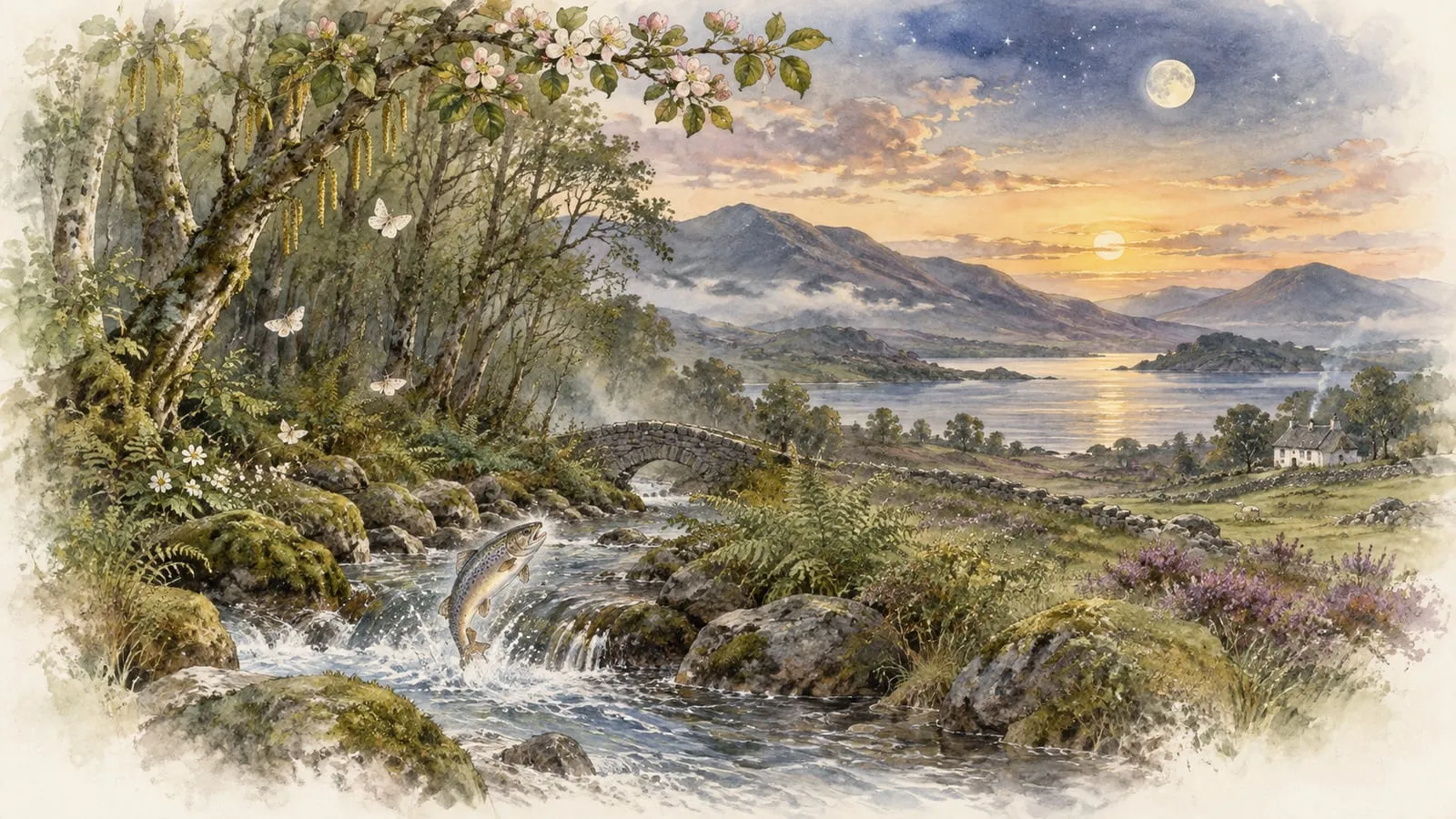
He goes to the hazel wood "Because a fire was in my head", a restlessness he does not explain. He makes a rod, baits it with a berry and, as moths fly and "moth-like stars" flicker out, catches "a little silver trout". Everything is quiet and precise, as if he is remembering each step.
Lines 9 to 16The glimmering girl
He lays the trout down and turns to blow up the fire, and something rustles on the floor. The fish has become "a glimmering girl / With apple blossom in her hair". She calls him by his name, runs, and fades "through the brightening air", as dawn comes up or as a dream dissolves.
Lines 17 to 24The lifelong search
The last stanza leaps across a lifetime: he is "old with wandering / Through hollow lands and hilly lands" and has not found her. Yet the tense turns to "I will". He imagines finding her and picking, forever, "The silver apples of the moon, / The golden apples of the sun", a closing pair as bright and balanced as a spell.
Themes
Longing
One glimpse of the "glimmering girl" shapes a whole life. The speaker is "old with wandering" but not bitter; his desire has only grown into a promise, "I will find out where she has gone". The poem is about a longing that cannot be satisfied and does not fade, the kind of love that becomes a life's purpose.
The otherworld
The poem draws on Irish legend, where people and animals change shape and the otherworld breaks into ordinary life. A trout becomes a girl, a kitchen floor becomes the scene of a vision, and the lovers' future lies in a place where the apples of "the moon" and "the sun" can be picked. Ordinary things become doorways.
Time and eternity
The poem runs through a single night, then a whole life, then "till time and times are done". The "silver apples of the moon" and "golden apples of the sun" join night and day, silver and gold, as if the lovers will gather time itself. The ending imagines a love beyond ageing.
Context
The poem was published in The Wind Among the Reeds (Elkin Mathews, London, 1899). Aengus is the Irish god of love and youth, and in Irish tradition the hazel is a tree of wisdom and poetic inspiration, which is thought to be why the poem begins in a hazel wood.
The poem belongs to Yeats's Sligo world, and local tradition links "the hazel wood" with Hazelwood on the shore of Lough Gill. Its closing lines have been borrowed many times by later writers and musicians, and are among the most quoted in all his early verse.
Form
Three stanzas of eight lines in iambic tetrameter, with rhymes on the even lines ("head" and "thread", "out" and "trout"). The steady four-beat line has the pace of a ballad or a told story. The last two lines, parallel in shape, give the ending the feel of a chant.