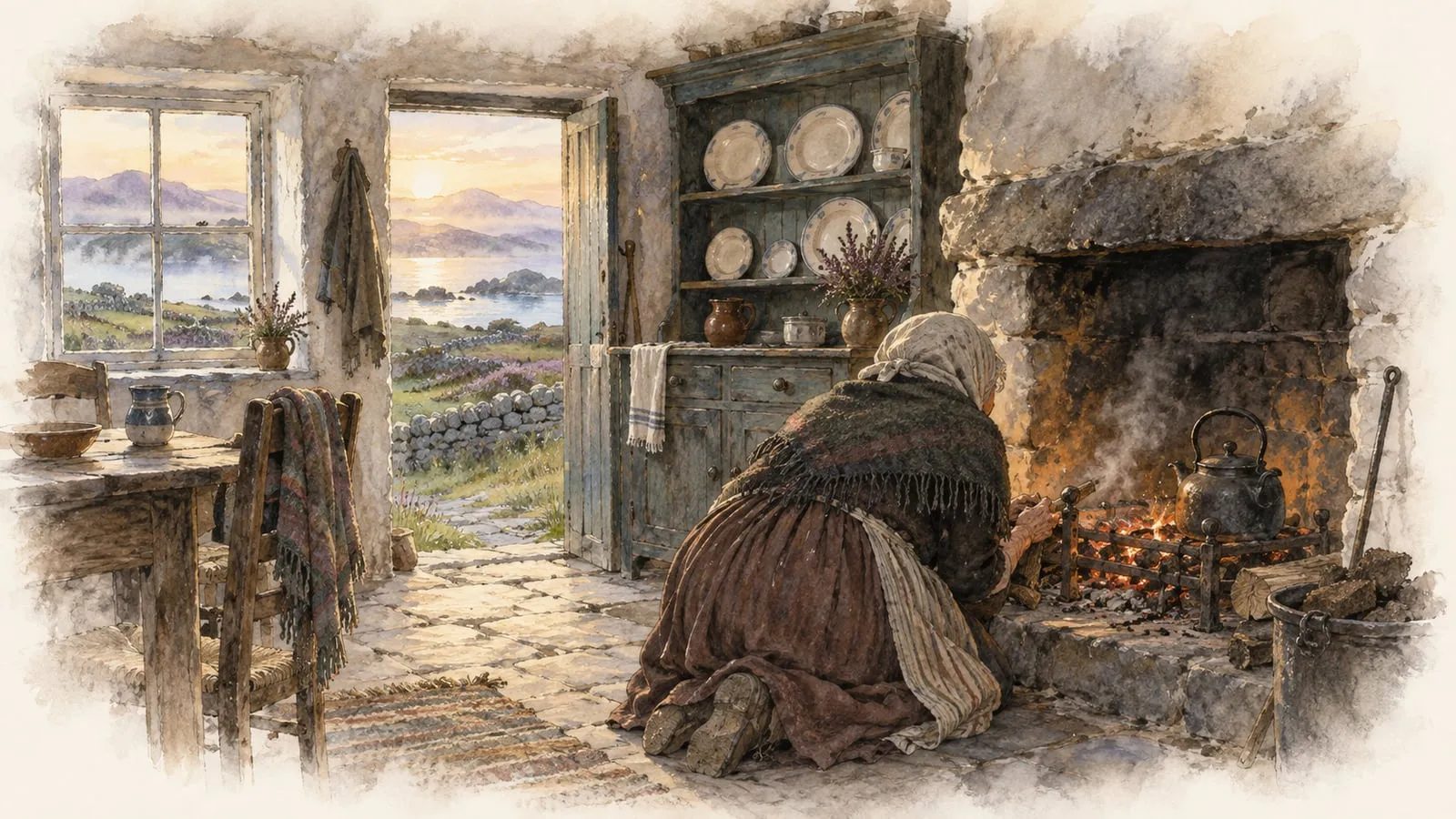
The Song of the Old Mother
Listen
Text: Poetry, by W. B. Yeats (Standard Ebooks, 2024), from the collected editions of 1908 to 1928. Public domain.
In brief
SummaryAn old woman works from dawn to dark while the young dream idly.
An old woman describes her day. She rises at dawn, kneels to blow the embers back to life, then scrubs, bakes and sweeps until the stars come out. Meanwhile the young lie in bed dreaming of matching ribbons, and sigh at the least breath of wind in their hair. The poem ends with her reason and her fear: she must work "because I am old", and the fire she tends is growing "feeble and cold". It is a short, plain-spoken complaint, with a hint of something larger in that fading fire.
Lines to remember
While I must work because I am old,
And the seed of the fire gets feeble and cold.
Line by line
Lines 1 to 4Dawn to dark
Her day runs from dawn, kneeling to blow "the seed of the fire" into flame, to nightfall, when the stars "blink and peep". The list "scrub and bake and sweep" is joined by "and"s, so the work sounds endless and unbroken.
Lines 5 to 8The idle young
The young stay in bed dreaming "Of the matching of ribbons for bosom and head". Their day "goes over in idleness", and their only trouble is a sigh "if the wind but lift a tress". Their worries look tiny beside hers.
Lines 9 to 10The fading fire
The last couplet gives the cause, "I must work because I am old", and a closing image. The fire she coaxed at dawn is now "feeble and cold", like her own strength, so the poem ends with a quiet picture of age.
Themes
Youth and age
The poem sets two ways of living side by side. The young "lie long and dream", fussing over ribbons and a lifted tress; the old woman is up at dawn and working till the stars appear. She sees no fairness in it, only necessity: "I must work because I am old". Age means duty and endurance, and youth means dreams that cost nothing.
Work
Nearly every line of her half is a verb of labour: "rise", "kneel", "blow", "scrub", "bake", "sweep", "work". Heaped together with "and", they give the rhythm of a long, repeated day. She complains of no single task, only the weight of all of them, and her life seems always to have been like this.
The fire
"The seed of the fire" opens and closes her story. At dawn she blows it into a flicker and glow; at the end it "gets feeble and cold". The hearth was the centre of a country home, and here it also stands for her own life, so its fading makes the last line both practical and sad.
Context
The poem was collected in The Wind Among the Reeds (Elkin Mathews, London, 1899). Most of that book is dreamy and mystical, full of lovers, faery hosts and symbolic roses, so this plain monologue by an old countrywoman stands out. Its homely detail, the kept fire, the scrubbing and baking, recalls the country people and folk songs that Yeats drew on throughout his early work.
Form
Ten lines in rhyming couplets ("blow" and "glow", "sweep" and "peep"), each with four strong beats. Half the lines begin with "And", so the chores follow one after another in a steady round. The rhythm is close to a folk song, which suits a speaker who is a countrywoman rather than a poet.