The Lamentation of the Old Pensioner
Listen
Text: Poetry, by W. B. Yeats (Standard Ebooks, 2024), from the collected editions of 1908 to 1928. Public domain.
In brief
SummaryAn old man, once admired, spits in the face of Time.
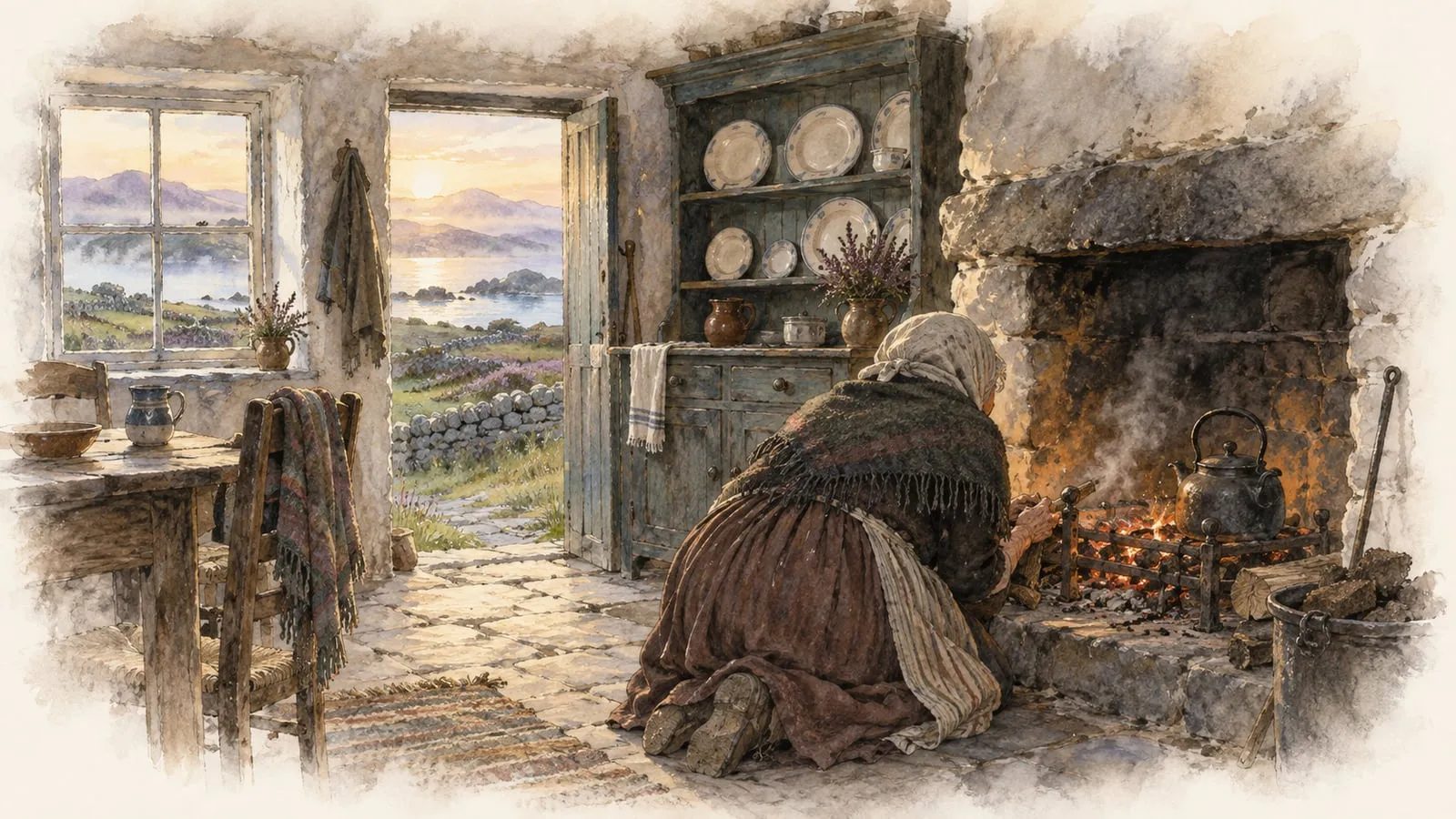
An old man shelters from the rain under a broken tree. Once his chair was "nearest to the fire" in any company that talked of love or politics. Now young men are making pikes for another conspiracy, and hotheads rage against tyranny, but he thinks only of time and what it has done to him. No woman looks at him, though he remembers the beauties he loved. The poem builds to a last defiant gesture: "I spit into the face of Time". Each stanza ends on the same words, "transfigured me", and they grow angrier each time.
Lines to remember
I spit into the face of Time
That has transfigured me.
Line by line
Lines 1 to 6Then and now
He shelters "Under a broken tree", an image of himself, but remembers being at the centre of every company "That talked of love or politics". "Ere time transfigured me" brings in the refrain: time has changed him utterly, and not for the better.
Lines 7 to 12The young rebels
Lads are "making pikes again" for "some conspiracy", and "crazy rascals" rage at tyranny. The word "again" suggests he has seen it all before. Politics no longer holds him: "My contemplations are of time", the one tyrant nobody can overthrow.
Lines 13 to 18Spitting at Time
No woman now "turns her face" towards a broken tree, yet "the beauties that I loved" live on in his memory. The final refrain turns from sorrow to fury: "I spit into the face of Time". Time now has a capital letter and a face, and the old man insults it.
Themes
Old age
The poem is a portrait of age as a loss of place. He has gone from the chair "nearest to the fire" to shelter "Under a broken tree", out in the rain. The "broken tree" appears in the first and last stanzas, so the old man and the image become one. What survives is memory, and memory sharpens the loss.
Time as enemy
To be "transfigured" usually means to be changed into something glorious; here it means to be ruined. Time starts as a force ("Ere time transfigured me") and ends as a face to spit into. The pensioner cannot beat it, but he refuses to accept it quietly, a defiance that looks forward to Yeats's own later poems about age.
Politics and passion
Talk of "love or politics" once made him somebody. Now the young take up pikes and rage "At human tyranny", and he watches without joining. The poem does not mock the rebels, but it sets their urgency beside the old man's larger quarrel with time, which makes every conspiracy look brief.
Context
A poem with this title first appeared in book form in The Countess Kathleen and Various Legends and Lyrics (1892), among the lyrics Yeats later grouped as "The Rose". That early version began "I had a chair at every hearth". In 1925 Yeats rewrote it so thoroughly that the two texts share only a handful of words, and the version printed here is the later one.
The pikes of line 7 recall the home-made weapons of the 1798 rebellion, a sign that plotting is an old story in Ireland. The bare, harsh diction of the rewrite, as in "I spit into the face of Time", belongs to the Yeats of the 1920s rather than to the dreamier lyrics around it.
Form
Three six-line stanzas in ballad measure, with lines of four and three beats alternating. Only the short even lines rhyme, all on one sound ("tree", "company", "me"), and every stanza ends with "transfigured me". The longer odd lines stay unrhymed, so the returning "me" sounds like a tolling bell.
HEAVILY REVISED; effectively two poems. The 1890/1892 text begins 'I had a chair at every hearth' (Gutenberg 38877; Standard Ebooks prints it separately among early poems). The 1925 rewrite begins 'Although I shelter from the rain' (Standard Ebooks 'The Rose' section, Collected Poems 1933). Word overlap between the two is about 6 per cent.