Sailing to Byzantium
Listen
I
II
III
IV
Text: Poetry, by W. B. Yeats (Standard Ebooks, 2024), from the collected editions of 1908 to 1928. Public domain.
In brief
SummaryAn old man leaves the world of the body for the eternity of art.
The speaker is an old man who no longer belongs in a country given over to youth, love and breeding, where every creature is caught up in "sensual music" and no one attends to lasting works of the mind. An old man is nothing, "A tattered coat upon a stick", unless his soul learns to sing, and it can learn only by studying great art. So he has sailed to Byzantium, where he calls on the sages in the gold mosaics to burn away his heart, "fastened to a dying animal", and gather him "Into the artifice of eternity". Once out of nature, he says, he will become a golden bird, singing to the court of past, present and future.
Lines to remember
That is no country for old men.
An aged man is but a paltry thing,
Of what is past, or passing, or to come.
Line by line
Lines 1 to 8No country for old men
The poem opens by turning away from the natural world, a land of lovers, singing birds, leaping salmon and "mackerel-crowded seas". All of them are "dying generations", and everything there is "begotten born and dies". Caught in "that sensual music", they neglect "Monuments of unaging intellect", the art and thought that outlast the body.
Lines 9 to 12A tattered coat
An old man is "a paltry thing", a scarecrow, "A tattered coat upon a stick". The only escape is for the soul to "clap its hands and sing", and sing louder for every tear in its "mortal dress", the body. Age becomes a reason for more song, not less.
Lines 13 to 16The voyage
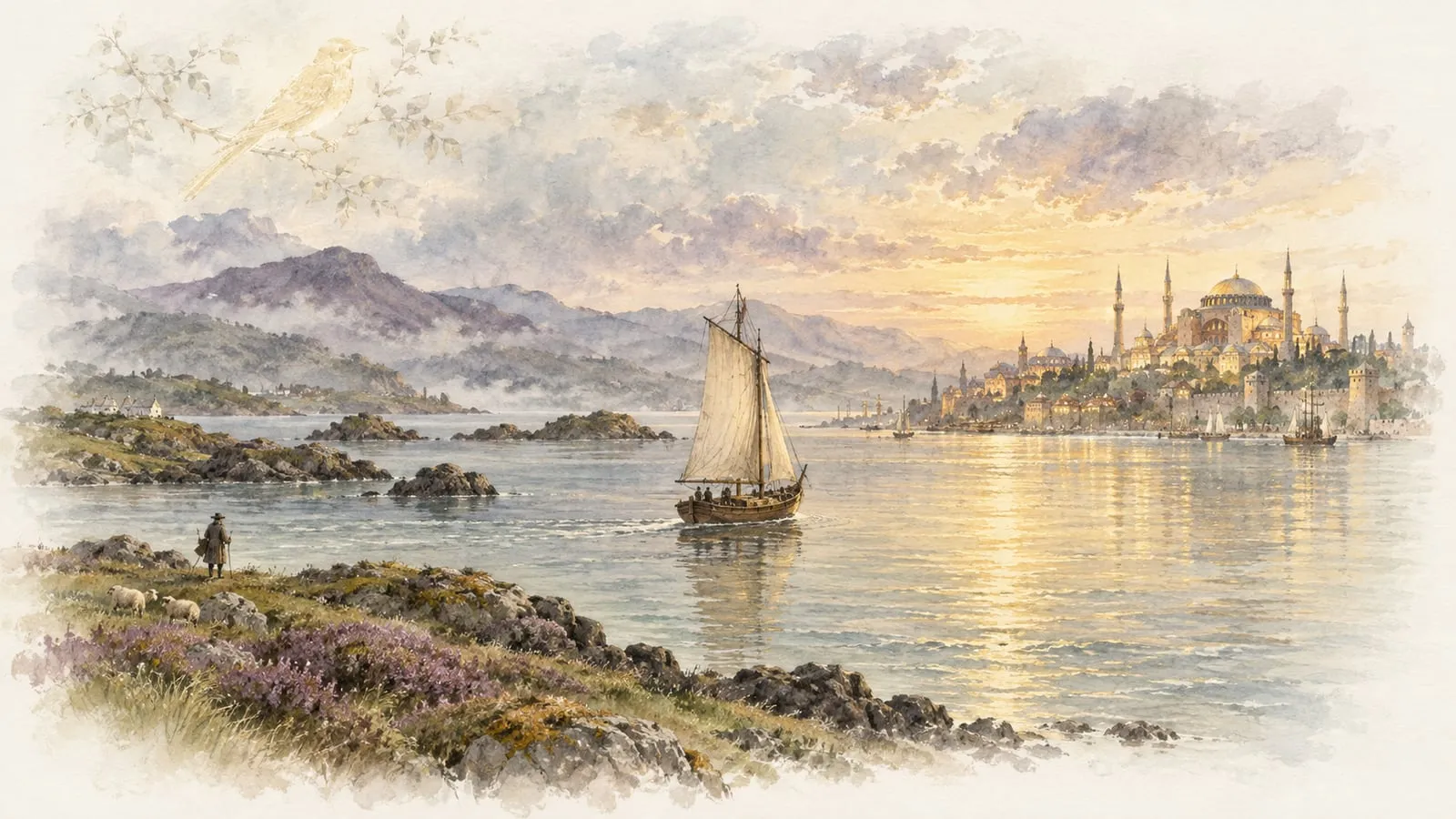
The only school for the soul's singing is the study of great art, "Monuments of its own magnificence". "And therefore" he has "sailed the seas and come" to the holy city. By the end of the stanza the journey in the title is already complete.
Lines 17 to 20Sages in the fire
He speaks to the holy men pictured in gold mosaic, standing in "God's holy fire". He asks them to come down out of the fire, spinning in a spiral ("perne in a gyre"), and be "the singing masters of my soul". The fire here purifies rather than destroys.
Lines 21 to 24A dying animal
He asks them to burn away his heart, which is "sick with desire" yet tied to a body he calls "a dying animal". The heart "knows not what it is". He wants to be gathered "Into the artifice of eternity", where "artifice" means both skilled craftsmanship and something made, not natural.
Lines 25 to 32The golden bird
Once "out of nature" he will never again take a body from "any natural thing", but the form of a bird made by "Grecian goldsmiths", set on a golden bough to keep "a drowsy emperor awake". Its song, "Of what is past, or passing, or to come", covers all time, yet echoes the "begotten born and dies" of stanza 1.
Themes
Ageing
Old age is described without mercy: "a paltry thing", "A tattered coat upon a stick", a heart "fastened to a dying animal". The pain is that desire has not aged with the body: the heart is still "sick with desire". The poem is a search for a way to live with that split, and its answer is the soul's song.
Art and permanence
Against the "dying generations" the poem sets "Monuments of unaging intellect": mosaics, songs and golden birds that do not decay. The speaker wants to become such an object, gathered "Into the artifice of eternity". Art is the only thing in the poem that escapes time, though the golden bird still sings of time.
Body and soul
The body belongs to "that sensual music" of nature; the soul must learn another music at a "singing school". The poem pulls them apart: the body is "mortal dress" and "a dying animal", the soul something that can "clap its hands and sing". The prayer to "Consume my heart away" asks to be freed from the body entirely.
Nature and artifice
Stanza 1 is crowded with living things: birds, salmon, mackerel, lovers. Stanza 4 replaces them with "hammered gold and gold enamelling", a bird that is made, not born. "Once out of nature" states the choice directly. Yet the golden bird sings to "lords and ladies" of time passing, so nature is never entirely left behind.
Context
The poem opens The Tower (Macmillan, 1928), the collection in which Yeats wrote about old age with his fullest force. He was in his early sixties, a senator of the Irish Free State and a Nobel laureate (1923), yet the poems of The Tower keep returning to the gap between an ageing body and a mind still full of passion.
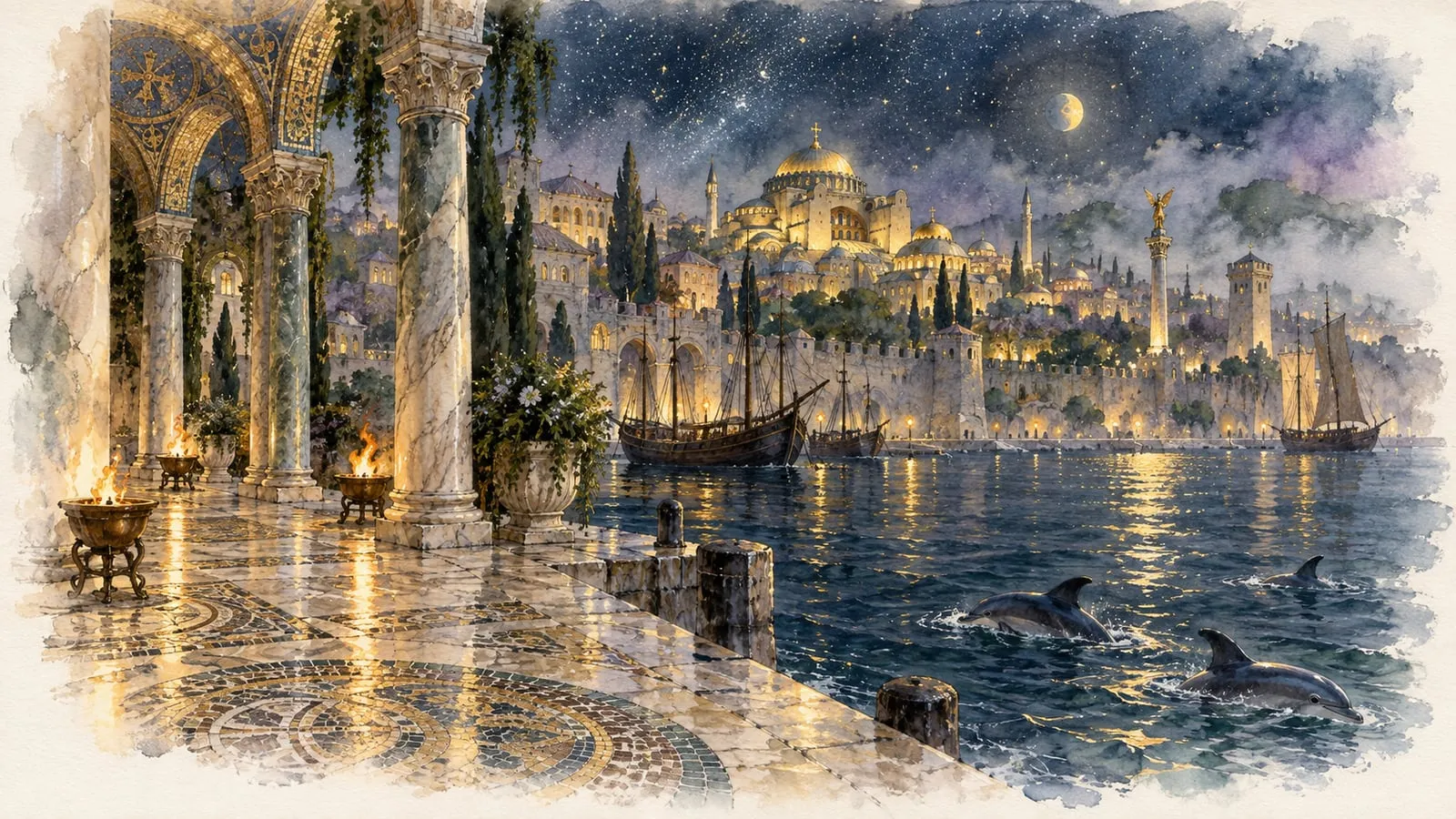
Byzantium, later Constantinople and now Istanbul, was the capital of the eastern Roman Empire and a great centre of Christian art, famous for its gold mosaics of saints and emperors. For Yeats it stood for a civilisation in which art, religion and daily life were one. His own note explains the golden bird: he had read that in the Emperor's palace there was a tree of gold and silver, with "artificial birds that sang".
Form
Four eight-line stanzas in iambic pentameter rhyming ABABABCC, the Italian form called ottava rima. The alternating rhymes carry the argument forward and each closing couplet seals it. Stanzas 2 and 4 both end by rhyming "come" with "Byzantium", so the journey and its destination are locked together in sound.
Yeats's own note
I have read somewhere that in the Emperor’s palace at Byzantium was a tree made of gold and silver, and artificial birds that sang.
Studying this poem
What to focus on
- The contrast between the natural, sensual world of stanza 1 and the permanent world of art in Byzantium.
- Yeats's treatment of old age, and whether the poem finds real consolation or only a longing for it.
- The symbolism of Byzantium, the sages in the holy fire and the golden bird.
- How the ottava rima stanza and the images of music and singing carry the poem's argument.
- The irony of the ending, where the golden bird still sings of time and change.
Key quotations
That is no country for old men.
The blunt opening sets the speaker apart from the world of youth. "That" already places the country at a distance, as if he has left it behind.
Caught in that sensual music all neglect
"Caught" makes nature a snare. The music of the body drowns out the life of the mind, so the young ignore the monuments that last.
A tattered coat upon a stick, unless
A scarecrow image of the ageing body, ragged and pitiful. The line ends on "unless", turning towards hope: the soul can still sing.
And fastened to a dying animal
A brutally frank image of the body. The heart is chained to flesh that is dying, which explains the urgency of his prayer to the sages.
Into the artifice of eternity.
The central paradox: eternity is something made, a work of art. "Artifice" suggests both great skill and something cold and unnatural.
Of what is past, or passing, or to come.
The golden bird's song covers all time, but it echoes "begotten born and dies": even in eternity, the subject of art is the world of change.