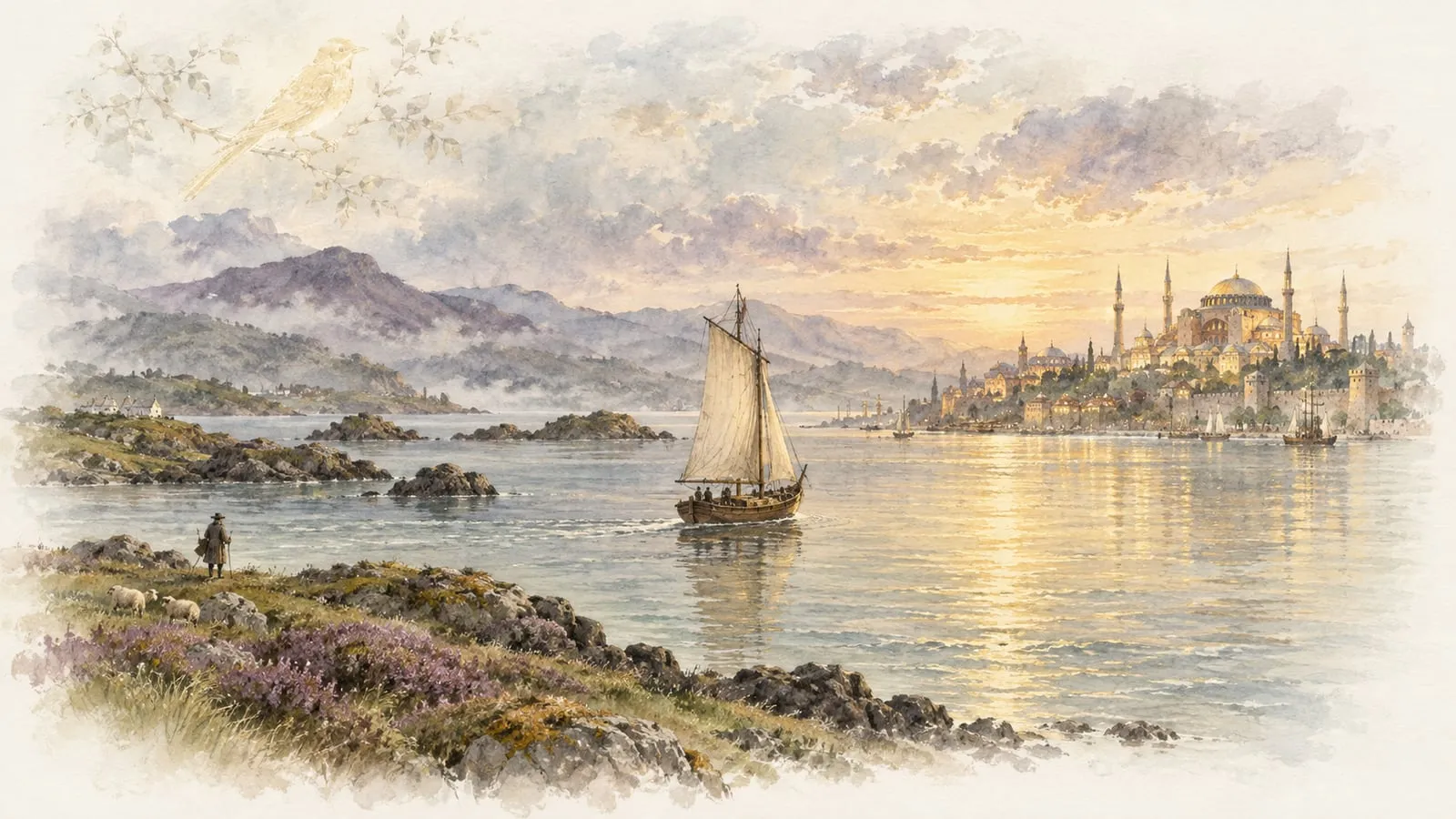
Byzantium
About the text
Yeats first published this poem in 1932. It is out of copyright in Ireland and the EU, but in the United States it stays in copyright until the start of 2028, and this site is served partly from American servers. So for now we give the notes without the full text; it will appear here in 2028.
It begins: The unpurged images of day recede
In brief
SummaryAt midnight in Byzantium, restless human spirits are purged into art.
A companion to "Sailing to Byzantium", set at midnight in the holy city. The noise of day fades, and a dome lit by moon or stars looks down in scorn on everything human, all the fury and mud of the blood. A ghostly image floats before the poet, a guide from the underworld whom he hails as superhuman. A golden bird on a golden bough crows like the cocks of Hades or mocks at living things. On the Emperor's pavement, spirits of the dead arrive and are purged in a flame that cannot burn, dying into a dance. In the last stanza more spirits come riding dolphins across the sea of life; the Emperor's goldsmiths and the marble floor break the flood, yet the sea goes on breeding new images.
Lines to remember
The fury and the mire of human veins.
That dolphin-torn, that gong-tormented sea.
Line by line
Lines 1 to 8Night falls on the city
The unpurged images of day recede: the Emperor's drunken soldiers are in bed, the cathedral gong has sounded and the night-walkers' song dies away. A dome lit by stars or moon disdains everything human, all mere complexity, all "The fury and the mire" of the blood.
Lines 9 to 16The superhuman image
An image floats before him, more shade than man, more image than shade. Like a bobbin wound in mummy-cloth, it can unwind the winding path from the world of the dead. A mouth with no breath can summon the breathless dead, and he hails it as superhuman, both death-in-life and life-in-death.
Lines 17 to 24The golden bird
Next comes a golden bird, more miracle than bird or handiwork, set on a starlit golden bough. It can crow like the cocks of Hades, heralds of rebirth, or, embittered by the moon, scorn common birds and petals and all the complexities of mud and blood, in the glory of changeless metal.
Lines 25 to 32Dying into a dance
At midnight on the Emperor's pavement flit flames that no wood feeds, no steel lit and no storm disturbs, flames born of flame. Spirits born of blood come there, leave their fury behind and die into a dance, an agony of trance, in a fire that cannot singe a sleeve. This is purgation: suffering that purifies without destroying.
Lines 33 to 40The gong-tormented sea
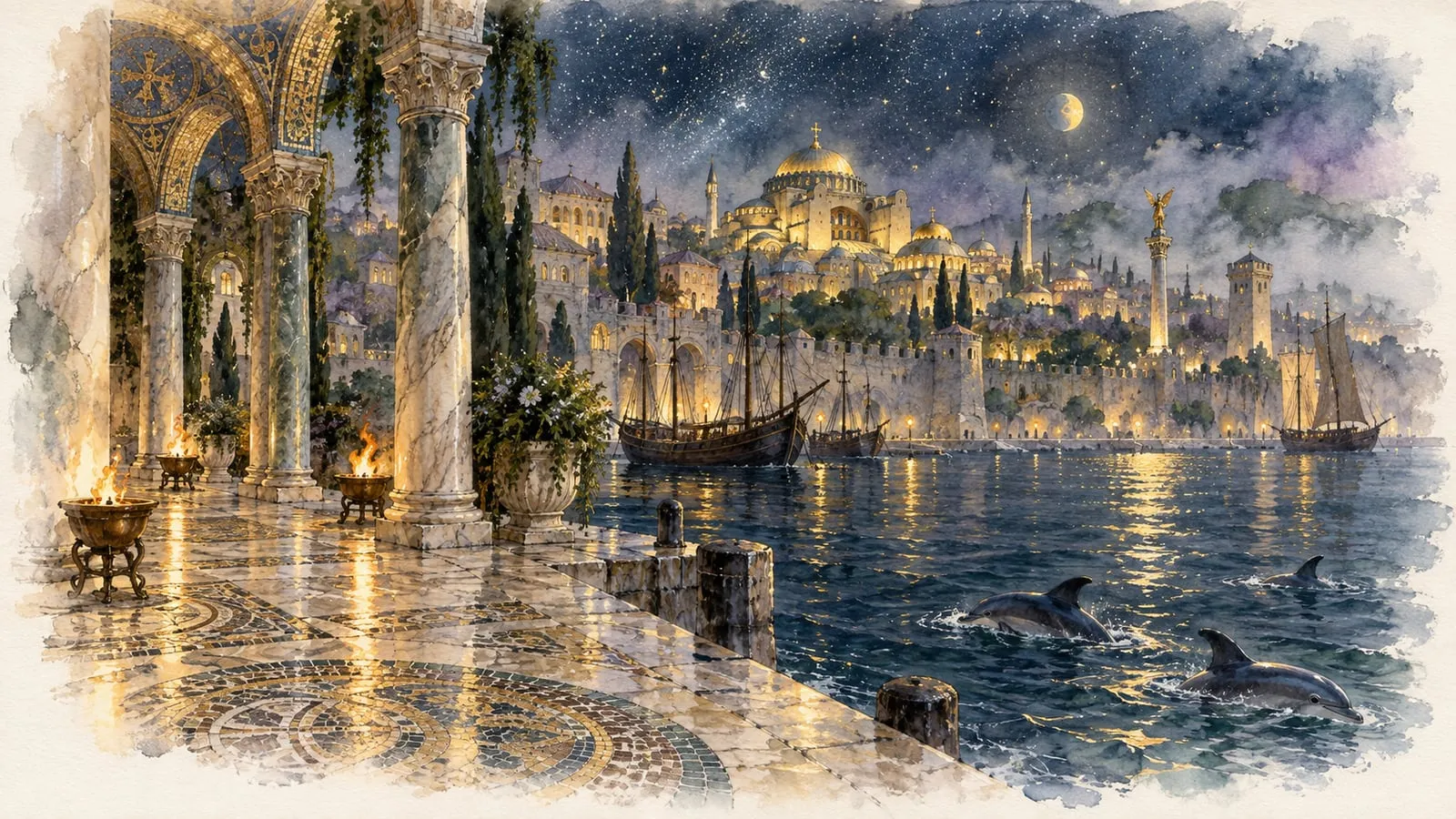
Spirit after spirit arrives astride a dolphin through the mire and blood of the sea. The Emperor's golden smithies and the marble dancing floor break the flood and its bitter complexity. Yet images keep begetting fresh images, and the poem ends on the teeming sea itself: life will not stop generating.
Themes
Art and eternity
Byzantium stands for a world of perfected art: the dome, the golden bird, the marble floor, the golden smithies. These are "changeless" and scorn the natural world of birds and petals. As in "Sailing to Byzantium", art is the way out of time. But here the escape is harder and stranger, a passage through ghostly guides and purging flame.
Purgation
The fourth stanza imagines souls cleansed after death. The flames are not natural (no faggot feeds them) and cannot burn a sleeve, yet they cause "An agony of trance". The dead leave their fury behind and die into a dance. Suffering purifies rather than destroys, and the self is remade as pattern and movement.
Life's complexity
The word "complexities" recurs, always tied to "mire" and "blood" and "fury": the mess of physical, passionate life. The city tries to break it, but in the last stanza the sea of life keeps surging, dolphin-torn and gong-tormented, and images go on begetting images. The poem ends not in stillness but with life's energy still pouring in.
Context
The poem returns to the city of "Sailing to Byzantium", which had opened The Tower (Macmillan, 1928). Yeats wrote it in 1930, after a serious illness, and it was collected in The Winding Stair and Other Poems (Macmillan, 1933). Byzantium, later Constantinople and now Istanbul, was the capital of the eastern Roman Empire, famous for its gold mosaics and for an art in which religion and craft were one.
Yeats's friend Thomas Sturge Moore had objected that the golden bird of the earlier poem was still a thing of nature. The new poem goes further and makes the purging of the natural its whole subject. In ancient art dolphins were said to carry the souls of the dead to the Islands of the Blessed, which explains the riders of the last stanza.
Form
Five eight-line stanzas rhyming AABBCDDC, mixing long five-beat lines with very short ones of two or three beats. The short lines land like drumbeats or gong strokes, and heavy repetition (image, flame, complexity, blood) builds a chanting, incantatory music suited to a vision. The final stanza piles up exclamation and apposition as the flood breaks in.