A Dialogue of Self and Soul
I
II
Text: The Winding Stair and Other Poems (Macmillan, London, 1933). Public domain.
In brief
SummaryThe Soul urges escape from life; the Self chooses to live again.
Two voices argue. In part I the Soul summons the speaker to climb the tower's winding stair and fix his mind on the dark heaven where all thought ends, free of "the crime of death and birth". The Self answers by looking at what lies across his knees: an old Japanese sword wrapped in a scrap of silk embroidery, emblems of love and war and of life on earth. The Soul falls silent, its tongue turned to stone. Part II belongs to the Self alone. He looks squarely at the humiliations of growing up, the malice of enemies and the folly of loving "A proud woman not kindred of his soul", and declares himself "content to live it all again". Forgiving himself, he feels a flood of sweetness, and the poem ends in blessing.
Lines to remember
I am content to live it all again
Measure the lot; forgive myself the lot!
Everything we look upon is blest.
Line by line
Lines 1 to 8The Soul's summons
The Soul calls the speaker to "the winding ancient stair" and the "broken, crumbling battlement" of the tower, then beyond it to the star that marks the pole and the "quarter where all thought is done". Its question, "Who can distinguish darkness from the soul?", makes the goal a dark, wordless union.
Lines 9 to 16The sword
The Self replies with an object, not an argument. Across his knees lies "Sato's ancient blade", still "razor-keen" after centuries, its wooden scabbard bound in a torn piece of a court lady's dress. Tattered and faded, the silk can still protect and adorn.
Lines 17 to 24Scorn the earth
The Soul asks why an ageing man should remember things "Emblematical of love and war". Better to think of "ancestral night", which, if imagination scorns the earth, can free him from "the crime of death and birth", the endless round of being born again.
Lines 25 to 32A soldier's right
The Self names the maker, Montashigi, five hundred years ago. He sets the sword and its "Heart's purple" silk as emblems of day against the tower, emblem of night, and claims "as by a soldier's right" a charter to commit the crime of living once more.
Lines 33 to 40The Soul falls silent
The Soul describes a fullness pouring from heaven into the mind until the knower and the known are one and man is "stricken deaf and dumb and blind". But "Only the dead can be forgiven", and at that thought its tongue turns to stone. It never speaks again.
Lines 41 to 48Growing up
Part II gives the Self the floor. "A living man is blind and drinks his drop", and it hardly matters if he must live everything again: the toil and "ignominy of boyhood", and the clumsy, unfinished young man facing his own awkwardness.
Lines 49 to 56Among enemies
The finished man fares no better. Malicious eyes cast on him a "defiling and disfigured shape" until he comes to believe it is his own. Even escape seems worthless if honour only finds him "in the wintry blast".
Lines 57 to 64Content to live again
Yet the Self is "content to live it all again", even if life means pitching into "the frog-spawn of a blind man's ditch" or the most "fecund ditch" of all, the folly of wooing "A proud woman not kindred of his soul", usually read as a glance at Maud Gonne.
Lines 65 to 72Forgiveness and blessing
He will trace every act and thought to its source: "Measure the lot; forgive myself the lot!" Casting out remorse lets a great sweetness flow in, and the poem closes in laughter, song and blessing: "Everything we look upon is blest."
Themes
Soul and self
The two voices stand for two ways of living. The Soul wants to climb out of time, to the dark "quarter where all thought is done", and treats birth and death as a crime to escape. The Self holds on to things: a sword, a strip of silk, the whole untidy history of a life. The debate is unequal by design, since the Soul is silenced halfway.
Self-forgiveness
The turn of part II comes with "forgive myself the lot!" The Self does not deny his failures; he lists them, from boyhood shame to hopeless love. Forgiveness does not come from heaven, where "Only the dead can be forgiven", but from the living man himself, and it brings joy rather than peace.
Love and war
Sato's sword and the court lady's silk are the poem's emblems of "love and war". The blade stays "Unspotted by the centuries"; the silk is torn but still protects. Together they stand for the active, passionate life the Self refuses to give up, set against the tower, "Emblematical of the night" and of thought.
Context
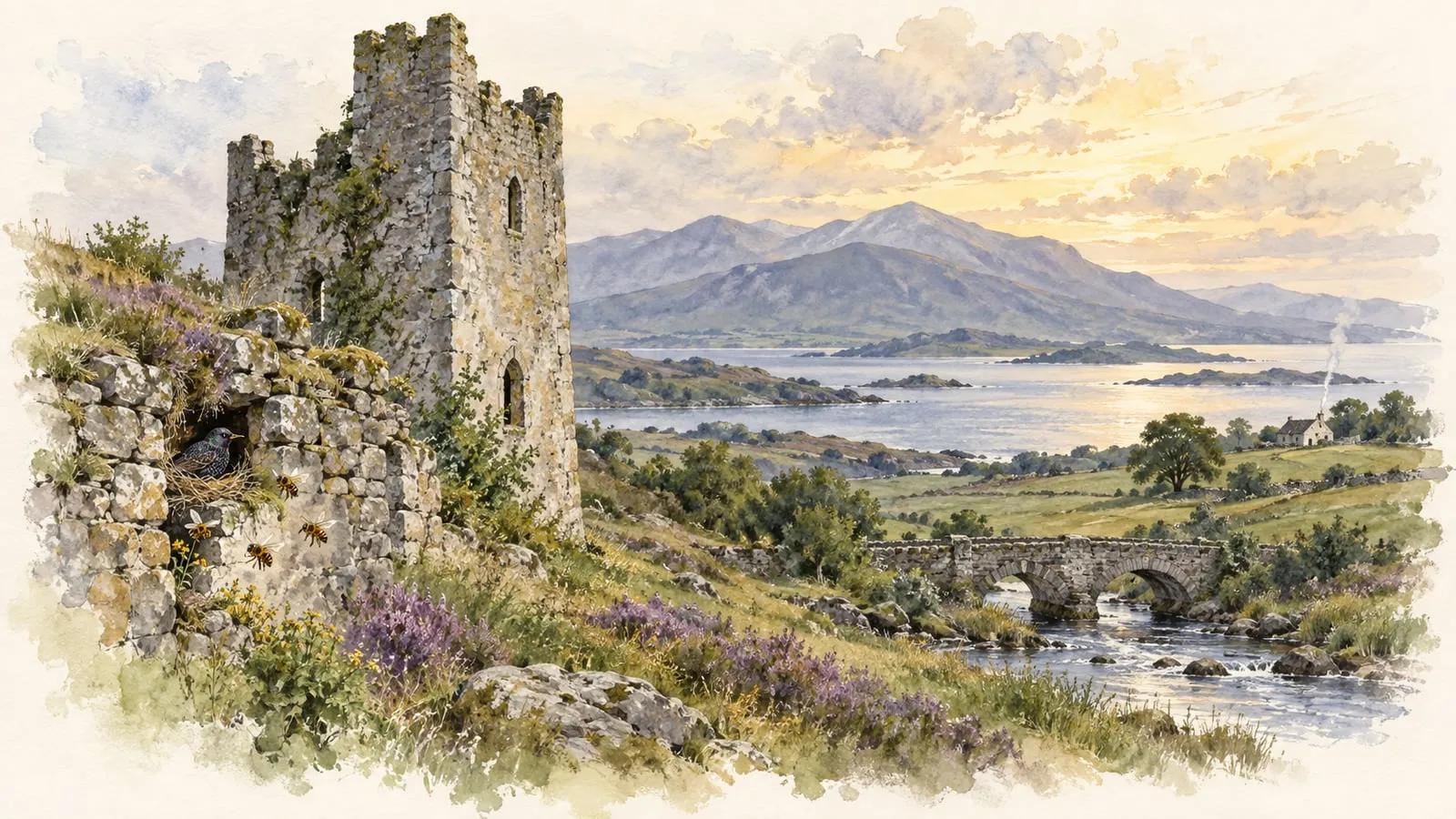
The poem was first published in The Winding Stair (New York, 1929) and collected in The Winding Stair and Other Poems (1933). The stair and battlement are those of Thoor Ballylee, the fifteenth-century tower house in County Galway that Yeats bought in 1917 and used as a summer home until 1929, the central symbol of both The Tower and The Winding Stair.
The sword was real. It was given to Yeats in 1920 by a Japanese admirer, Junzo Sato, and it appears again in "Meditations in Time of Civil War". The poem's argument, whether to escape the cycle of lives or to embrace it, belongs to the thinking Yeats set out in A Vision.
Form
Eight-line stanzas rhymed ABBACDDC, mixing five-beat lines with shorter four-beat ones. Part I is laid out like a play, with "My Soul" and "My Self" speaking alternate stanzas. Part II drops the speaker labels: the Soul has no more lines, and the layout itself shows who has won the argument.