In Memory of Eva Gore-Booth and Con Markiewicz
Text: The Winding Stair and Other Poems (Macmillan, London, 1933). Public domain.
In brief
SummaryAn elegy for two sisters, remembered young at Lissadell and worn down by time.
The poem opens on a memory: evening light at Lissadell, the Gore-Booth house in Sligo, and two girls in silk kimonos, "both / Beautiful, one a gazelle." Then autumn strikes. The older sister, Constance, was condemned to death, pardoned, and spent lonely years "Conspiring among the ignorant"; the younger, Eva, dreamed of "Some vague Utopia" and grew "withered old and skeleton-gaunt". The poet often thinks of seeking them out to talk of the old days, and the stanza closes by repeating its opening picture. In the second stanza both sisters are dead and he speaks to them as "Dear shadows". Now, he says, they know the folly of their fights. The innocent and the beautiful have only one enemy, time, and the poem ends with a defiant wish to strike a match and set time itself alight.
Lines to remember
Two girls in silk kimonos, both
The innocent and the beautiful
Have no enemy but time;
Line by line
Lines 1 to 4Evening at Lissadell
The poem begins with a picture held in memory: evening light, "Great windows open to the south", and two young women in silk kimonos. The line break after "both" makes us wait for "Beautiful", and "one a gazelle" catches a slender, graceful girl in a single image.
Lines 5 to 9The older sister
"But" breaks the spell. A "raving autumn" cuts the blossom from summer's wreath, and in a few blunt lines the older sister's life is told: condemned to death, "Pardoned", then lonely years "Conspiring among the ignorant". The hard verbs, "condemned", "drags out", "Conspiring", are joyless beside the gentle opening.
Lines 10 to 13The younger sister
Of Eva he admits "I know not what the younger dreams", and guesses at "Some vague Utopia". Old age has left her "withered old and skeleton-gaunt", and he sees her worn body as "An image of such politics": thin and abstract. It is a harsh judgement, softened a little by his confessed ignorance.
Lines 14 to 20Talk of youth
He often thinks of seeking one of them out to speak of "that old Georgian mansion" and recall "the talk of youth". The stanza then ends by repeating its own opening lines, as if memory keeps returning to the one picture that time has not spoiled.
Lines 21 to 25Speaking to the dead
Both sisters are now dead, and he addresses them as "Dear shadows" who "know it all": the folly of fighting over "a common wrong or right". Then comes the poem's central claim, that "The innocent and the beautiful" have "no enemy but time".
Lines 26 to 29Setting time alight
He asks the ghosts to rise and bid him strike match after match "till time catch", as though time were a building that could burn. If the "conflagration" climbs, they must run and tell the sages. The repeated "strike" and the quickening lines give the stanza a sudden, reckless energy.
Lines 30 to 33The great gazebo
"We the great gazebo built": the poet joins the sisters as builders of something grand, ornamental and perhaps foolish, which the world has judged guilty. The poem ends on a command, "Bid me strike a match and blow", and is dated October 1927, the year Constance died.
Themes
Time and ageing
Time is the poem's true enemy. The opening picture of two beautiful girls is broken by "a raving autumn", and the younger becomes "withered old and skeleton-gaunt". The lines "The innocent and the beautiful" and "Have no enemy but time" turn grief into a general truth, and the closing wish to burn time down with a match is defiance, half serious and half absurd.
Politics and idealism
Yeats is openly hostile to the politics that consumed the sisters. Constance's years "Conspiring among the ignorant" and Eva's "vague Utopia" are set against their youthful beauty, as if politics had withered them. Yet in the second stanza he includes himself in the folly: "We the great gazebo built". From death's side, every fight over "a common wrong or right" looks small.
Memory and the Big House
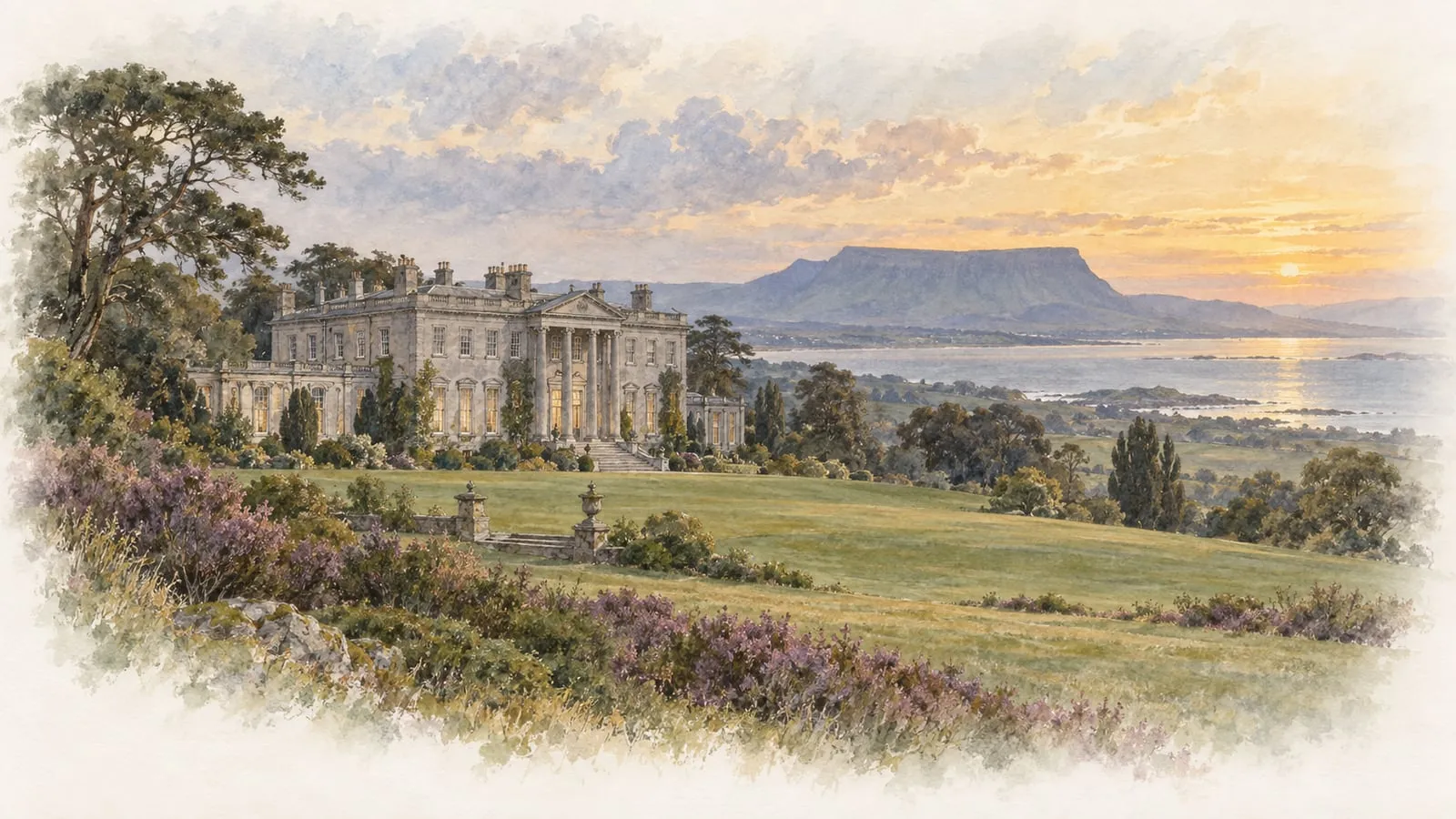
Lissadell stands for a lost world of grace and leisure: evening light, great south windows, silk kimonos, "That table and the talk of youth". Repeating the opening lines at the close of the first stanza keeps this picture whole against everything that followed. The "old Georgian mansion" becomes a place memory can return to, though its people are gone.
Context
Eva Gore-Booth died in 1926 and her sister Constance Markievicz in 1927; the poem is dated October 1927, months after the second death. It was first printed in The Winding Stair (New York, 1929) and collected in The Winding Stair and Other Poems (1933). The sisters grew up at Lissadell House in County Sligo, the Gore-Booth family home, where Yeats stayed in 1894 and encouraged Eva's early verse.
Constance fought in the 1916 Rising and was sentenced to death; the sentence was commuted and she was later released. She became the first woman elected to Westminster and a minister in the first Dáil. Eva settled in Manchester, where she worked as a suffragist and labour organiser and kept writing poetry. Yeats had written of Constance before, in "Easter, 1916" and "On a Political Prisoner", with the same mix of admiration and regret.
Form
Two stanzas, of 20 and 12 lines, in short lines of mostly four beats. The rhymes are enclosed, abba ("Lissadell", "south", "both", "gazelle"), and many are half-rhymes, such as "south" and "both" or "ignorant" and "gaunt". The slightly off rhymes suit a poem about spoiled beauty, while the repeated opening lines give the first stanza a closed, circular shape.
Studying this poem
What to focus on
- How the poem sets the remembered beauty of Lissadell against the sisters' later decline, and what that contrast says about time.
- Yeats's attitude to the sisters' politics: his harsh judgements in the first stanza and his admission of shared folly in the second.
- The shift from memory and narrative in the first stanza to direct address to the dead in the second.
- The imagery of autumn, fire and the gazebo, and whether the closing match-striking reads as defiance, despair or both.
- How repetition, short lines and half-rhyme shape the poem's tone of affection mixed with regret.
Key quotations
Beautiful, one a gazelle.
The image of youthful grace that the poem keeps returning to. Repeated at the end of the first stanza, it becomes a picture memory protects from time.
But a raving autumn shears
The turn from memory to decline. "Raving" makes time violent and almost mad, and "shears" suggests beauty cut off suddenly rather than fading gently.
Conspiring among the ignorant.
Yeats's harshest judgement on Constance's political life: lonely, secretive and wasted on people he dismisses. Useful for any question on his attitude to politics.
Some vague Utopia
His dismissive view of Eva's ideals. "Vague" suggests dreams without shape, though he admits in the same breath that he does not know what she dreams.
Have no enemy but time;
The poem's central claim. It lifts the elegy from personal grief to a general truth: politics and quarrels matter less than the ageing that destroys beauty.
We the great gazebo built,
"We" includes Yeats in the folly. The gazebo, grand but ornamental, suggests their shared ideals were beautiful yet impractical, and the world "convicted us of guilt".