Blood and the Moon
Listen
I
II
III
IV
Text: The Winding Stair and Other Poems (Macmillan, London, 1933). Public domain.
In brief
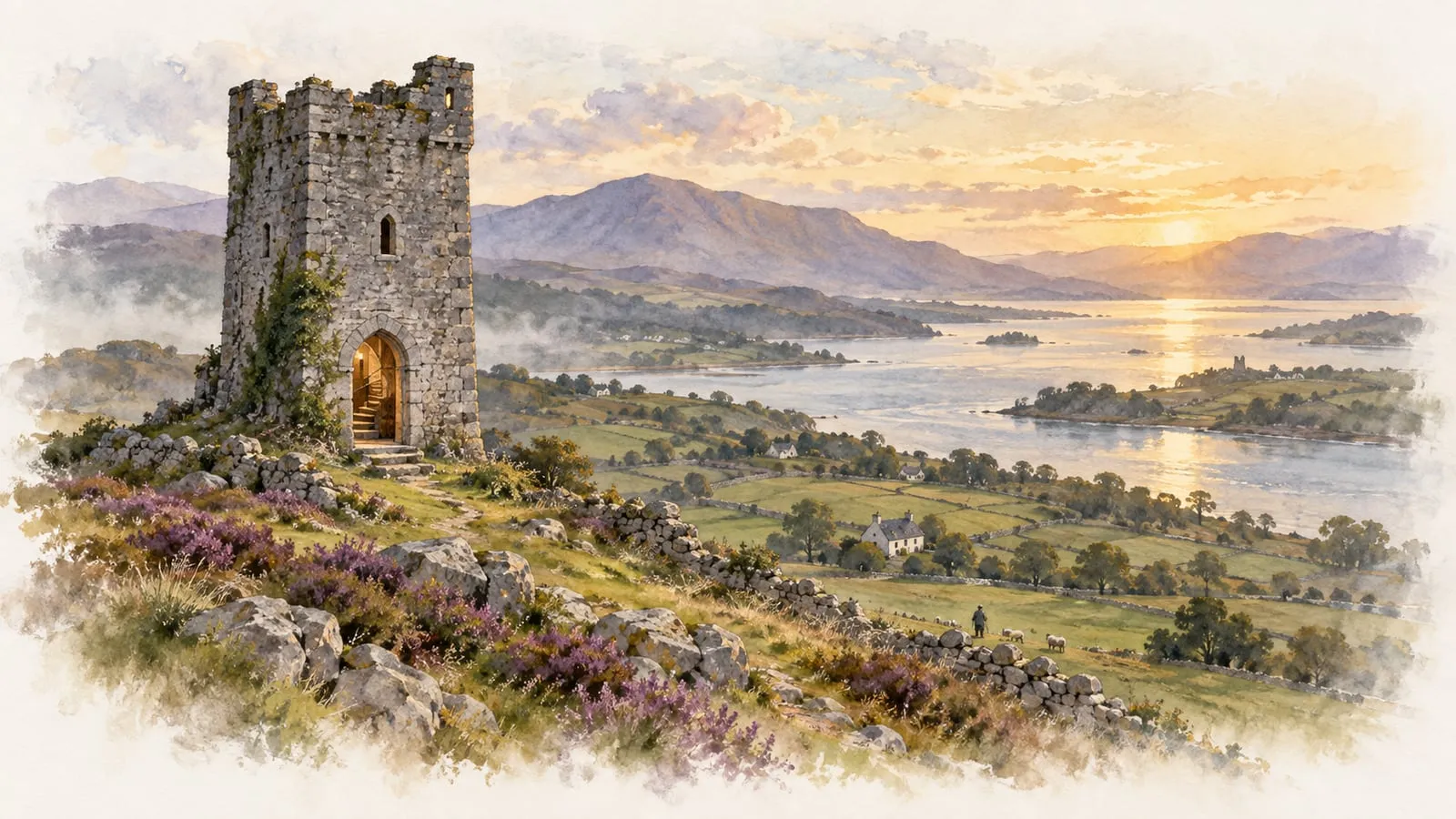
SummaryYeats's tower becomes a symbol of Irish tradition, violence and pure moonlight.
Yeats blesses his tower and sets it up as "A powerful emblem" in mockery of an age "Half dead at the top". In part II he compares it with the great towers of history and claims its winding stair as his "ancestral stair", climbed in spirit by four eighteenth-century Irish writers: Swift, Goldsmith, Burke and Berkeley. Each gets a line or two of portrait, and the section ends in "intellectual fire". Part III turns to moonlight falling on the tower floor. Seven centuries of soldiers, assassins and executioners have soaked the ground in blood, yet none of it can stain the moon. In the last part butterflies cling to the moonlit windows, and the poet sets out the division at the poem's heart: wisdom belongs to the dead, and power, always stained with blood, to the living.
Lines to remember
Half dead at the top.
I declare this tower is my symbol; I declare
For wisdom is the property of the dead,
Line by line
Lines 1 to 7Blessing the tower
The poem opens like a benediction, "Blessed be this place", then turns darker. A "bloody, arrogant power" rose out of the people, just as the tower rose above the "Storm-beaten cottages" around it.
Lines 8 to 12A mocking emblem
He has set up the tower as "A powerful emblem" and sings it "rhyme upon rhyme" in mockery of his own time, which he calls "Half dead at the top". The phrase suggests a society whose leaders, or whose highest faculties, have withered.
Lines 13 to 15Towers of history
Part II begins with a roll of famous towers: the beacon of Alexandria, the star-watching tower of Babylon, and the towers of Shelley's poems, which he called "thought's crowned powers". The long, loping lines give the section a public, declaiming sound.
Lines 16 to 18My ancestral stair
Yeats claims the tower as "my symbol" and its "winding, gyring, spiring treadmill of a stair" as his ancestry. The ancestors are writers, not blood relations: Goldsmith, Swift ("the Dean"), Berkeley and Burke.
Lines 19 to 21Swift and Goldsmith
Swift beats his breast "in sibylline frenzy blind", dragged down into mankind by the passion in his blood. Goldsmith, by contrast, sips "deliberately" at the "honey-pot of his mind", a picture of easy, unhurried genius.
Lines 22 to 24Burke
Burke "proved the State a tree": a living thing that grows over centuries, a "labyrinth of the birds" that cannot be flattened into "mathematical equality". The lines glance at Burke's attack on the abstract reasoning of the French Revolution.
Lines 25 to 27Berkeley
Berkeley, the philosopher bishop, "proved all things a dream": this "pragmatical, preposterous pig of a world", with its litter of piglets, would vanish "if the mind but change its theme". The snorting alliteration makes the solid world sound absurd.
Lines 28 to 30Intellectual fire
The section gathers its themes: Swift's "Saeva Indignatio", "the labourer's hire", and a strength that gives blood and state a generosity freely chosen. It ends with "Everything that is not God consumed with intellectual fire".
Lines 31 to 34The pure moon
Part III turns from history to moonlight. The "unclouded moon" throws its "arrowy shaft" across the tower floor, and after seven centuries it is still pure: "The blood of innocence has left no stain."
Lines 35 to 42Blood on the ground
The ground has been soaked by "Soldier, assassin, executioner", killing for pay, from fear or "out of abstract hatred", yet none could cast a drop on the moon. The poet and his kind, who have shed no blood, still gather on the stair to "clamour in drunken frenzy for the moon".
Lines 43 to 46Butterflies at the window
Part IV begins with a quiet image. Tortoiseshell and peacock butterflies cling to the "dusty, glittering windows", seeming to cling to the moonlit sky itself, while "A couple of night-moths are on the wing".
Lines 47 to 54Wisdom and power
He asks whether every modern nation is like the tower, then waves the question away. Wisdom "is the property of the dead", while power, like everything stained with blood, belongs to the living. The moon's face stays clean when it looks "in glory from a cloud".
Themes
Tradition
The tower gives Yeats a lineage. By naming Swift, Goldsmith, Burke and Berkeley as climbers of his "ancestral stair", he claims an Anglo-Irish intellectual tradition as his inheritance. Each is honoured for a different gift: passion, sweetness, political wisdom and philosophical daring.
Violence and purity
Blood runs through the poem, from the "bloody, arrogant power" of line 3 to the "blood-saturated ground" of part III. Against it stands the moon, whose light no violence can stain. Human history is soaked in blood, while the ideal stays untouched and out of reach, the object of drunken, hopeless clamour.
Wisdom and power
The poem ends with a hard division. Wisdom is "A something incompatible with life", owned by the dead; power belongs to the living and carries "the stain of blood". The living can have one or the other, not both, and the mocking emblem of the opening becomes a sober statement about the price of acting in the world.
Context
The poem was first published in The Winding Stair (New York, 1929) and collected in The Winding Stair and Other Poems (1933). The tower is Thoor Ballylee, the fifteenth-century tower house in County Galway that Yeats bought for 35 pounds in 1917 and used as a summer home until 1929. It gave him the central symbol of both The Tower and The Winding Stair.
Jonathan Swift, Oliver Goldsmith, Edmund Burke and George Berkeley were Anglo-Irish writers of the eighteenth century, and in these years Yeats increasingly presented them as the great tradition behind Irish thought. "Saeva Indignatio" (savage indignation) comes from Swift's Latin epitaph in St Patrick's Cathedral, Dublin, which Yeats later translated. "Half dead at the top" is usually traced to Swift, who is said to have looked at a withered tree and predicted he would die like it, at the top.
Form
Four numbered parts in different forms. Part I has twelve short lines rhymed in enclosing patterns (ABBA). Part II is six stanzas of three long lines, each held on a single rhyme ("tree", "century", "equality"). Parts III and IV return to twelve five-beat lines each, loosely rhymed. The shifting forms follow the poem's move from blessing to rhetoric to meditation.