The Tower
Listen
I
II1
III2
Text: Poetry, by W. B. Yeats (Standard Ebooks, 2024), from the collected editions of 1908 to 1928. Public domain.
In brief
SummaryAn old poet rages at age, calls up ghosts, and writes his will.
The poem is in three parts. In the first the speaker rages at the "Decrepit age" tied to him like a kettle to a dog's tail, when his imagination has never been wilder; perhaps he must give up poetry for philosophy. In the second he paces the battlements of his tower at evening and summons the ghosts and legends of the district: Mrs French and her servant's grisly gift, a peasant beauty and the blind poet who praised her, his own creation Red Hanrahan, a bankrupt former owner, old soldiers at dice. He asks whether they too raged against old age, then keeps Hanrahan back to ask about love won and lost. In the third part he writes his will. He leaves his pride to young fishermen, declares that man made death and life "Out of his bitter soul", and resolves to school his soul until the worst losses of age seem as light as clouds or "a bird's sleepy cry".
Lines to remember
What shall I do with this absurdity
Decrepit age that has been tied to me
Translunar Paradise.
Line by line
Lines 1 to 16Tied to old age
Part I opens with an outburst. Age is an "absurdity", a "caricature", a "battered kettle at the heel", while his imagination is more "fantastical" than when he fished on "Ben Bulben's back" as a boy. Perhaps he must "bid the Muse go pack" and settle for the abstract comfort of Plato and Plotinus.
Lines 17 to 24On the battlements
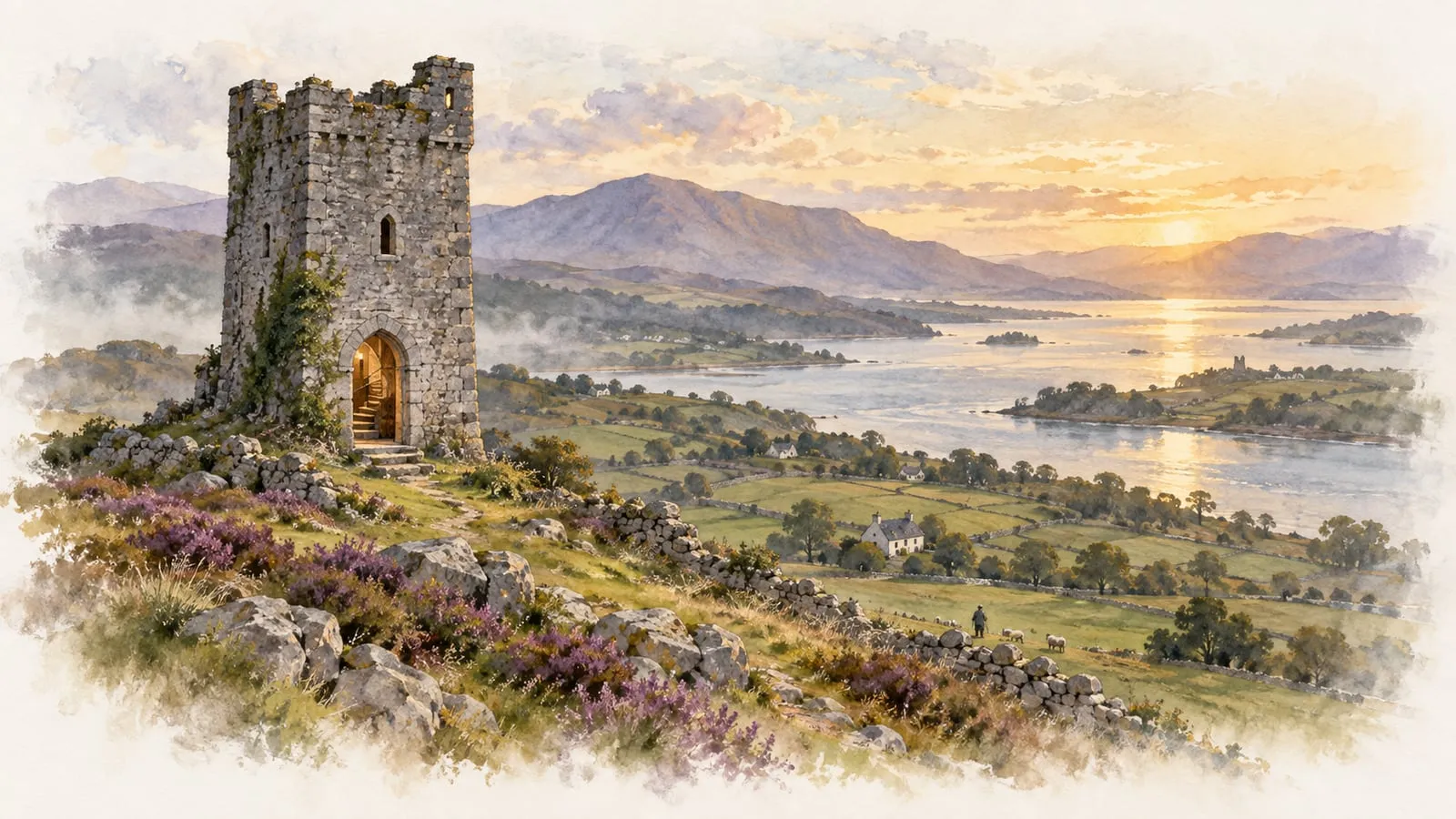
In part II he paces the top of the tower at sunset and sends his imagination out over ruins and old trees, calling up "Images and memories". He has "a question" for them all, but holds it back, so the ghosts arrive one by one before we learn what it is.
Lines 25 to 32Mrs French
The first story is from the eighteenth century. At Mrs French's candlelit table, a servant so eager that he could "divine" her every wish went out with the garden shears, clipped an insolent farmer's ears, and "brought them in a little covered dish". The horror is told as polished gossip.
Lines 33 to 56Beauty, song and madness
A peasant girl was so praised in a song that farmers jostled to see her at the fair. Men maddened by the rhymes set out by moonlight, and one "was drowned in the great bog of Cloone". The singer was blind, which leads him to Homer and Helen, and to a startling wish: "For if I triumph I must make men mad."
Lines 57 to 72Red Hanrahan
Now he recalls a character of his own making, Hanrahan, driven "drunk or sober through the dawn". In an old bawn a juggler turns a pack of cards into "A pack of hounds" and one card into a hare, and Hanrahan follows in a frenzy. The stanza breaks off in mid-chase on "towards".
Lines 73 to 88Ghosts of the house
He cuts himself off ("enough!") and turns to the tower's own ghosts: an "ancient bankrupt master of this house" whom nothing could cheer, and the men-at-arms who once climbed its narrow stairs. Their images, stored in "the Great Memory", still wake sleepers with the beat of their wooden dice.
Lines 89 to 104The question
He summons them all together and at last asks his question: did every old man and woman who "trod upon these rocks" rage against age as he does? He reads the answer in their eyes, "impatient to be gone", and dismisses them, but keeps Hanrahan for "his mighty memories".
Lines 105 to 120Love won or lost
Hanrahan, the "Old lecher", knows all about the plunge "Into the labyrinth of another's being". The poet asks whether imagination dwells more on "a woman won or woman lost". If lost, it was pride, cowardice or conscience that turned him aside, and the memory puts the sun "Under eclipse".
Lines 121 to 144Pride for an heir
Part III begins: "It is time that I wrote my will". He leaves his pride to young fishermen who climb the streams at dawn. It is the pride of the Anglo-Irish tradition, "The people of Burke and of Grattan", and of the morning, the sudden shower and the dying swan singing "his last song".
Lines 145 to 165A declaration of faith
He mocks Plotinus and cries "in Plato's teeth" that man made up death and life, "sun and moon and star", "Out of his bitter soul", and that the dead dream and so create "Translunar Paradise". He has made his peace with Italian art, Greek stones, poems and "memories of love".
Lines 166 to 180The jackdaws' nest
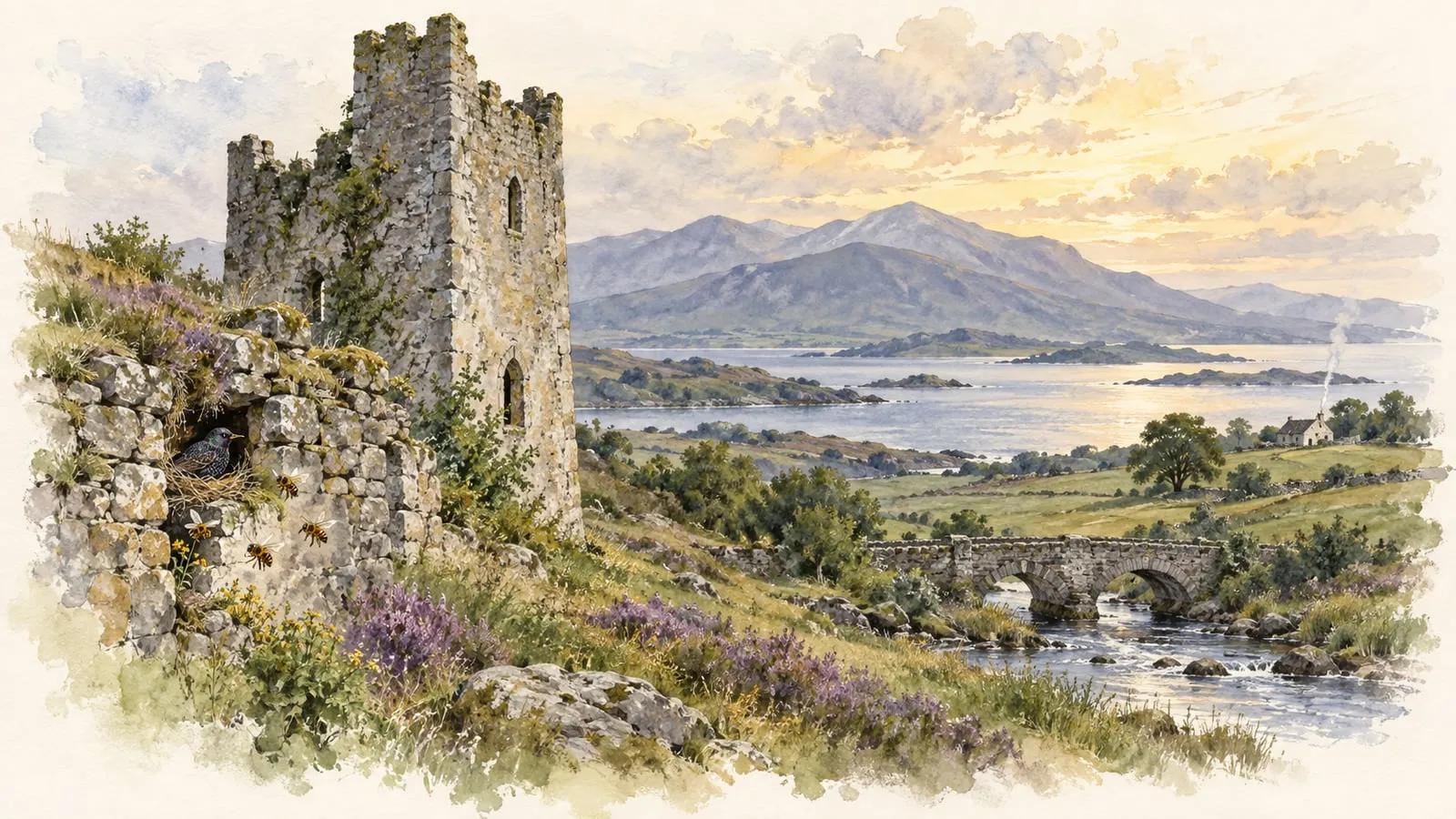
A small image breaks in: jackdaws at the tower's loophole drop twig on twig until the mother bird can warm her nest. Then he repeats the bequest, faith and pride to young men "Climbing the mountain side", as he once did before "This sedentary trade" broke him.
Lines 181 to 195Making the soul
The poem ends in resolve. He will send his soul to "a learned school" until bodily wreck, "Testy delirium" and even the death of friends seem no heavier than clouds when the horizon fades, or "a bird's sleepy cry" in the gathering dark.
Themes
Old age
The poem begins in fury at the gap between a failing body and a mind that "more expected the impossible" than ever. Age is grotesque, a "caricature" and a kettle tied to a dog's tail. The question he puts to the ghosts is whether others raged "As I do now against old age". By the end rage gives way to a plan: to train the soul until decay and loss seem as slight as "the clouds of the sky".
Imagination and memory
Part II shows imagination at work. From the tower he summons stories of the district, Mrs French, the beauty in the song, Hanrahan, the dicing soldiers, until legend and his own inventions mix. "I myself created Hanrahan" admits that the poet adds to the Great Memory he draws on. The question about "a woman won or woman lost" turns that power on his own life.
Pride and legacy
The will in part III passes on pride, not property. It is a pride "Bound neither to Cause nor to State", linked to Burke and Grattan and to images of dawn, sudden rain and the swan's last song. The heirs are "upstanding men" who fish mountain streams. The jackdaws building their nest layer by layer suggest the slow way a tradition is made and handed on.
Context
Yeats's own note says the poem was written at Thoor Ballylee, the fifteenth-century tower house near Gort which he bought for 35 pounds in 1917 and used as a summer home until 1929, and that its people are "associated by legend, story and tradition" with the neighbourhood. It first appeared in a book in October Blast (Cuala Press, 1927), then gave its title to The Tower (Macmillan, 1928), whose cover by Thomas Sturge Moore shows the tower.
The note names the peasant beauty and the blind poet as Mary Hynes and Raftery, says the drowning in Cloone bog is recorded in his Celtic Twilight, and that Hanrahan's hare and hounds come from his Stories of Red Hanrahan. Mrs French lived at Peterswell in the eighteenth century, and the ghosts at dice were seen "in what is now my bedroom". He added that the swan passage unconsciously echoes Sturge Moore's poem "Dying Swan".
Yeats turned sixty in 1925. He had won the Nobel Prize in 1923 and was a senator of the Irish Free State, yet the poem shows him fighting age with a harder, plainer style. Edmund Burke and Henry Grattan were eighteenth-century Irish statesmen he claimed as ancestors of that independent pride.
Form
Three parts in three forms. Part I is sixteen pentameter lines rhymed ABAB. Part II has thirteen eight-line stanzas mixing long and short lines, rhymed AABBCDDC. Part III switches to short three-beat lines, loosely rhymed in alternate lines, running on in long sentences. The move from the heavy lines of rage to the brisk, light lines of the will mirrors his change of mood.
Yeats's own note
The persons mentioned are associated by legend, story and tradition with the neighbourhood of Thoor Ballylee or Ballylee Castle, where the poem was written. Mrs. French lived at Peterswell in the eighteenth century and was related to Sir Jonah Barrington, who described the incident of the ear and the trouble that came of it. The peasant beauty and the blind poet are Mary Hynes and Raftery, and the incident of the man drowned in Cloone Bog is recorded in my Celtic Twilight. Hanrahan’s pursuit of the phantom hare and hounds is from my Stories of Red Hanrahan. The ghosts have been seen at their game of dice in what is now my bedroom, and the old bankrupt man lived about a hundred years ago. According to one legend he could only leave the Castle upon a Sunday because of his creditors, and according to another he hid in the secret passage.
In the passage about the Swan I have unconsciously echoed one of the loveliest lyrics of our time—Mr. Sturge Moore’s “Dying Swan.” I often recited it during an American lecturing tour, which explains the theft.
When I wrote the lines about Plato and Plotinus I forgot that it is something in our own eyes that makes us see them as all transcendence. Has not Plotinus written: “Let every soul recall, then, at the outset the truth that soul is the author of all living things, that it has breathed the life into them all, whatever is nourished by earth and sea, all the creatures of the air, the divine stars in the sky; it is the maker of the sun; itself formed and ordered this vast heaven and conducts all that rhythmic motion—and it is a principle distinct from all these to which it gives law and movement and life, and it must of necessity be more honourable than they, for they gather or dissolve as soul brings them life or abandons them, but soul, since it never can abandon itself, is of eternal being.”