Meditations in Time of Civil War
Listen
I Ancestral Houses
II My House
III My Table
IV My Descendants
V The Road at My Door
VI1 The Stare’s Nest by My Window
VII I See Phantoms of Hatred and of the Heart’s Fullness and of the Coming Emptiness
Text: Poetry, by W. B. Yeats (Standard Ebooks, 2024), from the collected editions of 1908 to 1928. Public domain.
In brief
SummaryAt his tower during the Civil War, Yeats weighs violence, inheritance and hope.
A sequence of seven poems set at Yeats's tower, Thoor Ballylee, during the Irish Civil War. It begins with the great houses of the rich, asking whether their beauty was built by the very violence and bitterness it was meant to soften. Yeats then turns to his own tower, his writing table with its old Japanese sword, and his hopes and fears for his children. In section V the war comes to his door, in the shape of soldiers from both sides. Section VI, "The Stare's Nest by My Window", is the emotional centre: shut in by rumour and killing, he calls on the honey-bees to build in the starling's empty nest, a prayer for sweetness and new life in a hardened time. The last section is a nightmare vision of hatred and emptiness seen from the tower top, which ends with Yeats accepting the solitary life of the imagination.
Lines to remember
Come build in the empty house of the stare.
We had fed the heart on fantasies,
The heart's grown brutal from the fare;
Line by line
Lines 1 to 16I: The fountain
"Ancestral Houses" imagines a rich man's estate where life overflows like a fountain that "rains down life until the basin spills". Then doubt sets in: these are "Mere dreams". Perhaps the true symbol of inherited glory is not a fountain but "some marvellous empty sea-shell", beautiful but hollow.
Lines 17 to 40I: Greatness and violence
The great houses were built by "Bitter and violent men" who paid artists to make in stone the gentleness they never knew, and their heirs may dwindle to "but a mouse". The last two stanzas ask whether peacocks, terraces and ancestral portraits "take our greatness with our violence", softening away the energy that made the family great.
Lines 41 to 70II: My House
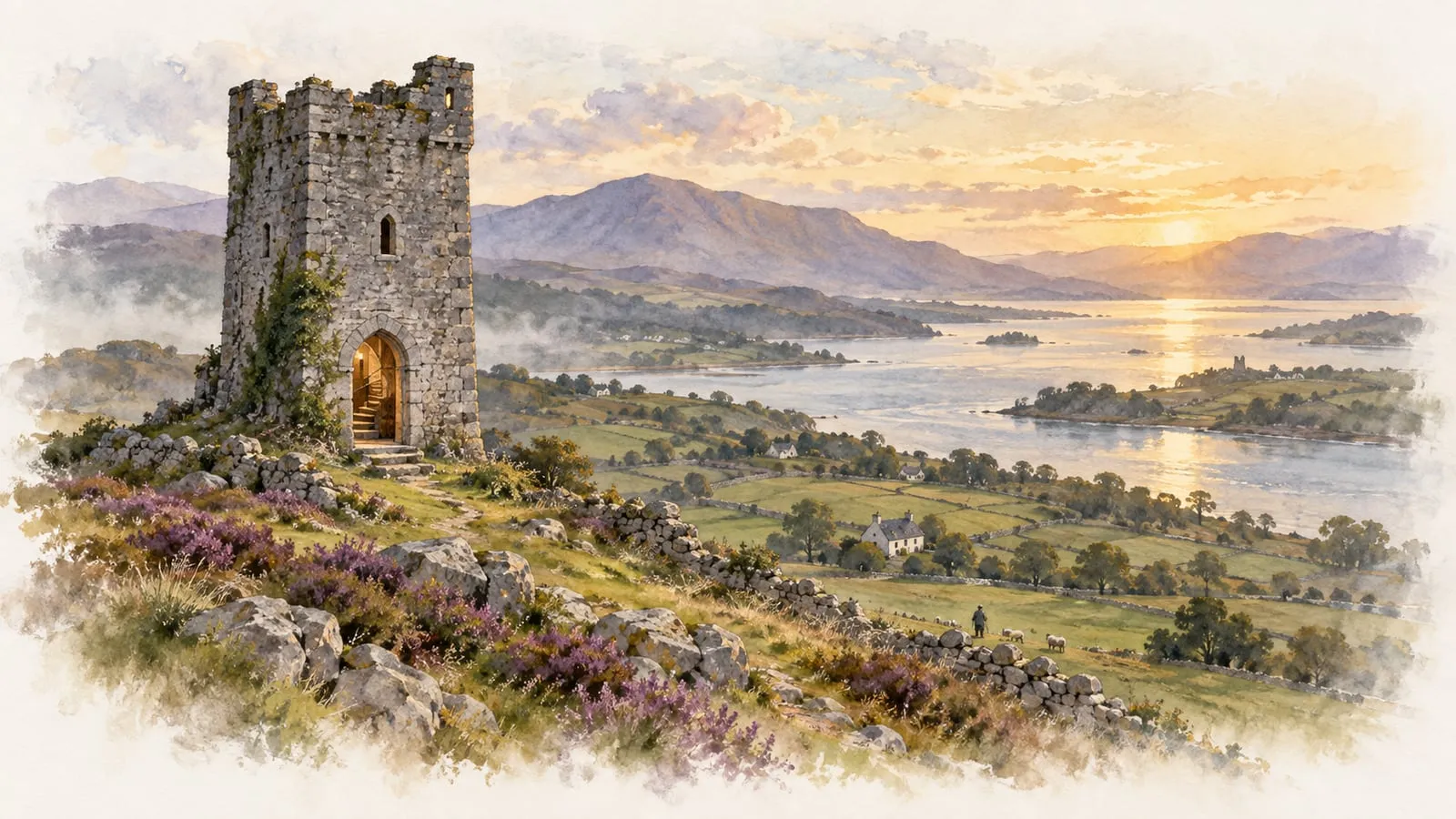
Yeats describes Thoor Ballylee: the "ancient bridge", the tower, the "acre of stony ground", the winding stair and a candle lighting a "written page". He imagines Milton's midnight scholar in "Il Penseroso" working in such a room, and names two founders of the place: an old man-at-arms, and himself, leaving "Befitting emblems of adversity" for his heirs.
Lines 71 to 102III: My Table
On his table lies "Sato's gift, a changeless sword", five hundred years old. It leads him to think of old Japan, where skills passed "From father unto son" for centuries and only "an aching heart" could conceive a lasting work of art. The section ends on a strange omen: "Juno's peacock screamed".
Lines 103 to 126IV: My Descendants
He hopes to leave "a woman and a man behind" as vigorous of mind as himself, yet fears they may decline into "common greenness". If so, let the tower become "a roofless ruin" for the owl. Still, love and friendship are enough, and the stones will stand as "their monument and mine".
Lines 127 to 141V: The war arrives
The war reaches the tower: first "An affable Irregular", an anti-Treaty fighter joking about death, then a "brown Lieutenant" and his men in "national uniform". Yeats talks about the weather, then counts the moor-hen's chicks "To silence the envy in my thought", envy of men who act.
Lines 142 to 146VI: Bees in the wall
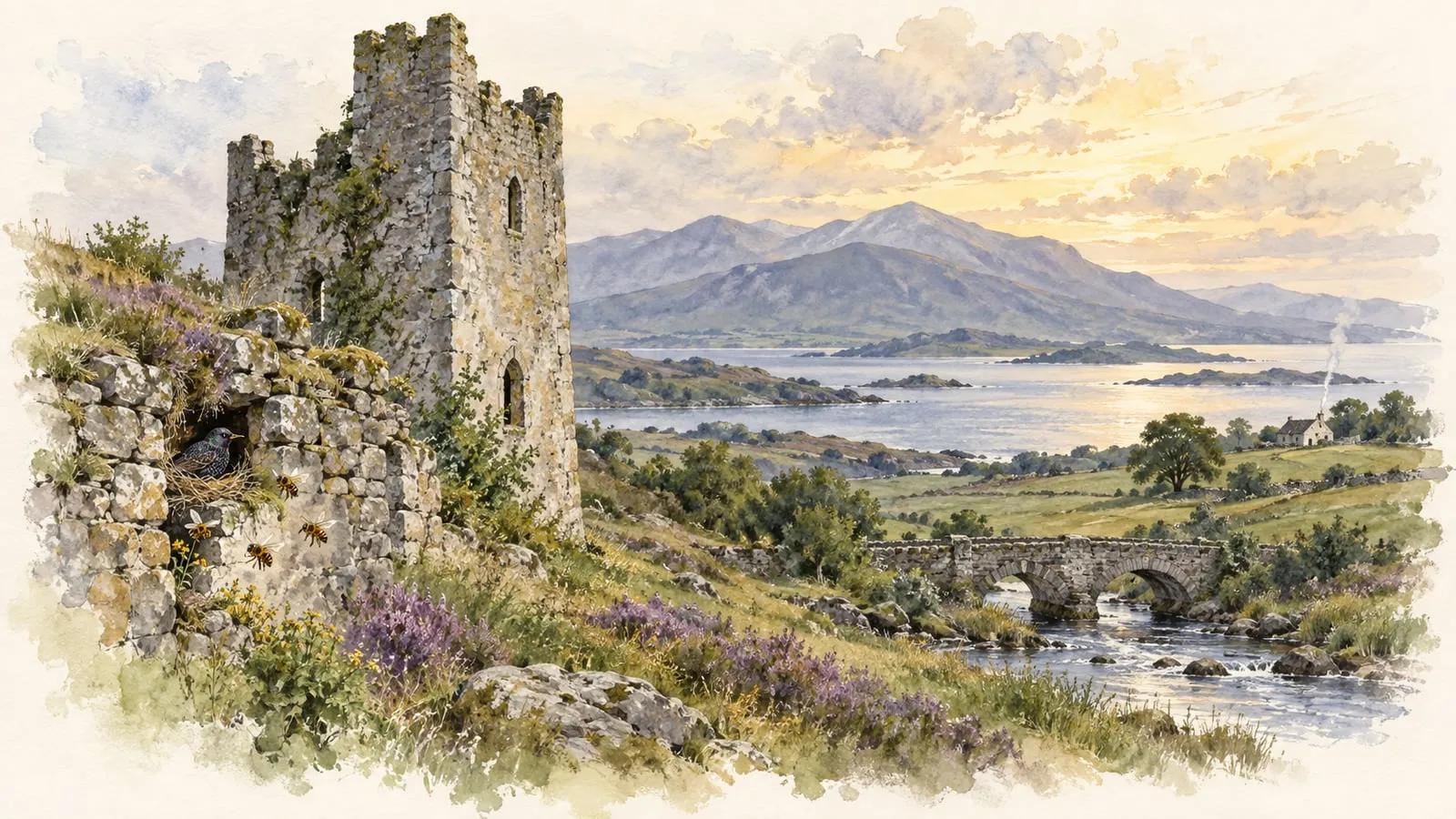
The prescribed section opens with bees building in the crevices of the old wall while mother birds feed their young. The wall is "loosening", like the order of the country, and the refrain calls the honey-bees to "Come build in the empty house of the stare", the starling's deserted nest.
Lines 147 to 151VI: Closed in
The household is "closed in", the key turned "On our uncertainty". News comes only as rumour: "A man is killed, or a house burned", yet there is "no clear fact to be discerned". The vague "somewhere" catches the fear of living inside a war you cannot see.
Lines 152 to 156VI: The dead soldier
The war becomes concrete: a barricade, "Some fourteen days of civil war", and last night a "dead young soldier in his blood" trundled down the road. The flat, factual voice makes the image harder to bear, and the refrain that follows sounds like a prayer.
Lines 157 to 161VI: The brutal heart
The last stanza turns inward and admits a shared guilt: "We had fed the heart on fantasies", and the heart has "grown brutal from the fare". Hatred now has more "substance" than love. The cry "oh, honey-bees" makes the final refrain an urgent plea for sweetness to be rebuilt.
Lines 162 to 185VII: Phantoms of hatred
From the tower top Yeats sees mist sweep the valley under a strange moon, and images "swim to the mind's eye". First a mob crying "Vengeance for Jacques Molay", tearing at one another and grasping at nothing; then unicorns carrying ladies whose hearts are full of "their own sweetness".
Lines 186 to 201VII: The brazen hawks
Both visions give way to "brazen hawks", an "indifferent multitude" of "grip of claw" whose wings "have put out the moon". Yeats shuts the door and wonders whether he should have proved his worth in action, but concludes that "daemonic images" suffice him now, as they did when he was a boy.
Themes
Violence and civilisation
Section I argues that beauty and order are built by "Bitter and violent men", and may soften into weakness, taking "our greatness with our violence". The war then shows violence without any beauty: barricades, burned houses, a "dead young soldier in his blood". The sequence ends with "brazen hawks" putting out the moon, force without meaning.
Inheritance
Every section asks what lasts and what is handed on: the ancestral houses, the tower's "emblems of adversity", Sato's five-hundred-year-old sword, and his own children, who may "lose the flower". Yeats's answer is modest: whatever happens, "These stones remain their monument and mine."
Hatred and love
Section VI gives the sequence its moral centre: "More substance in our enmities / Than in our love". Hearts fed on "fantasies" have grown "brutal". Against that, the bees and the mother birds keep building and feeding, and the refrain "Come build in the empty house of the stare" asks for sweetness and care to return where hatred has emptied things out.
Thought and action
Yeats watches soldiers from his doorway and feels "the envy in my thought" for men of action. At the end he wonders how often he "could have proved my worth" in some shared cause. He chooses the solitary life of the mind instead: "The abstract joy, / The half read wisdom of daemonic images".
Context
Yeats bought Thoor Ballylee, a fifteenth-century tower house in County Galway near Coole, for 35 pounds in 1917, restored it and used it as a summer home. He was living there with his family in 1922 when the Civil War broke out between supporters and opponents of the Anglo-Irish Treaty. The sequence records that time: its roads, rumours, barricades and soldiers from both sides.
Yeats's own notes explain two images. "Stare" is the West of Ireland word for a starling, and during the civil war one built its nest in a hole in the masonry by his bedroom window. He took the cry for vengeance on Jacques Molay, Grand Master of the Knights Templar, as a symbol of those who "labour from hatred".
The sequence stands among the opening poems of The Tower (1928), after "The Tower" and before "Nineteen Hundred and Nineteen". Only section VI is prescribed for the Leaving Certificate, but it reads more richly against the whole: the building bees answer the violent founders of section I and the hawks of section VII.
Form
Each section has its own form. I and IV are in ottava rima, eight pentameter lines rhyming ABABABCC; II uses ten-line stanzas; III runs in short rhyming couplets; V and VI use five-line stanzas rhyming ABAAB; VII has eight long lines rhyming ABABCDCD. In VI the fifth line is always the same refrain, so every stanza closes on the same plea.
Yeats's own note
In the West of Ireland we call a starling a stare, and during the civil war one built in a hole in the masonry by my bedroom window.
The cry “Vengeance on the murderers of Jacques Molay,” Grand Master of the Templars, seems to me fit symbol for those who labour from hatred, and so for sterility in various kinds. It is said to have been incorporated in the ritual of certain Masonic societies of the eighteenth century, and to have fed class-hatred.
I have a ring with a hawk and a butterfly upon it, to symbolise the straight road of logic, and so of mechanism, and the crooked road of intuition: “For wisdom is a butterfly and not a gloomy bird of prey.”
Studying this poem
What to focus on
- How the refrain "Come build in the empty house of the stare" works as a prayer for renewal against the violence of the Civil War.
- The contrast between images of building and nurture (bees, mother birds) and images of destruction (loosening masonry, barricades, a burned house).
- The atmosphere of uncertainty and confinement in section VI, and how rumour and the dead soldier make the war real.
- The confession of the final stanza, where Yeats includes himself in a shared guilt: hearts fed on "fantasies" have grown brutal.
- How the short five-line stanzas and repeated refrain shape the mood, and how section VI fits the wider sequence.
Key quotations
My wall is loosening; honey-bees
The crumbling tower wall mirrors the breakdown of order in Ireland. Yet in its cracks the bees still build, bringing sweetness and life.
Come build in the empty house of the stare.
The refrain asks creation to fill an emptiness. Repeated four times, it becomes a prayer that sweetness and new life will replace destruction.
We are closed in, and the key is turned
Images of being locked in convey isolation and fear. The household is shut up with its "uncertainty", cut off from reliable news of the war.
Yet no clear fact to be discerned:
In civil war, rumour replaces truth. The line captures the anxiety of living through violence known only in fragments.
That dead young soldier in his blood:
The one concrete image of death in section VI. Plain, blunt words and the word "young" make the cost of civil war personal and shocking.
The heart's grown brutal from the fare;
A metaphor of feeding: dreams and "fantasies" have hardened hearts. Yeats says "We", including himself, which makes this a confession, not an accusation.