Nineteen Hundred and Nineteen
Earlier titled "Thoughts upon the Present State of the World"
Listen
I
II
III
IV
V
VI1
Text: Poetry, by W. B. Yeats (Standard Ebooks, 2024), from the collected editions of 1908 to 1928. Public domain.
In brief
SummaryViolence returns to Ireland, and the hope of a civilised world dies.
A poem in six parts about the collapse of a civilised hope. It begins with the lost treasures of ancient Athens, then turns to "us": the generation that believed law, habit and public opinion had tamed human savagery for good. Now "days are dragon-ridden": soldiers murder a mother at her door and go free, and the poet sees that we are "but weasels fighting in a hole". The later parts move through whirling dancers and the "platonic year", a swan leaping into "the desolate heaven", bitter mockery of the great, the wise and the good, and a last vision of evil spirits riding a wind of dust. The final image is the demon Robert Artisson lurching past. The poem offers no comfort except the courage to see clearly.
Lines to remember
Now days are dragon-ridden, the nightmare
Man is in love and loves what vanishes,
Who are but weasels fighting in a hole.
Line by line
Lines 1 to 8Lost wonders of Athens
"Many ingenious lovely things are gone", though Athens thought them safe from the moon's changes. He names an "ancient image made of olive wood", usually taken as the old statue of Athena on the Acropolis, the ivories of Phidias, and golden ornaments shaped as grasshoppers and bees. Even the greatest works vanish.
Lines 9 to 16Our pretty toys
"We too had many pretty toys when young": a law that no bribe could bend, habits that melted old wrongs like "wax in the sun's rays", a public opinion ripening for years. The stanza ends in self-mockery at their belief that "the worst rogues and rascals had died out".
Lines 17 to 24Peace as display
In that world "a great army" was only "a showy thing", kept for parades, and powder was burned only so the trumpeters would not "burst with trumpeting". The joke about the guardsmen's "drowsy chargers" catches the ease of years when violence seemed like theatre.
Lines 25 to 32Dragon-ridden days
The turn: "Now days are dragon-ridden". A "drunken soldiery" can leave a mother murdered at her door "and go scot-free". All their philosophy and plans to "bring the world under a rule" are exposed; we "are but weasels fighting in a hole".
Lines 33 to 48Cold comfort
Whoever reads the signs clearly knows that no work of hand or mind will last; his one comfort is solitude. Then comes the deeper truth, "Man is in love and loves what vanishes", and the thought that no Athenian would have believed anyone could burn "that stump on the Acropolis".
Lines 49 to 58The dancers and the dragon
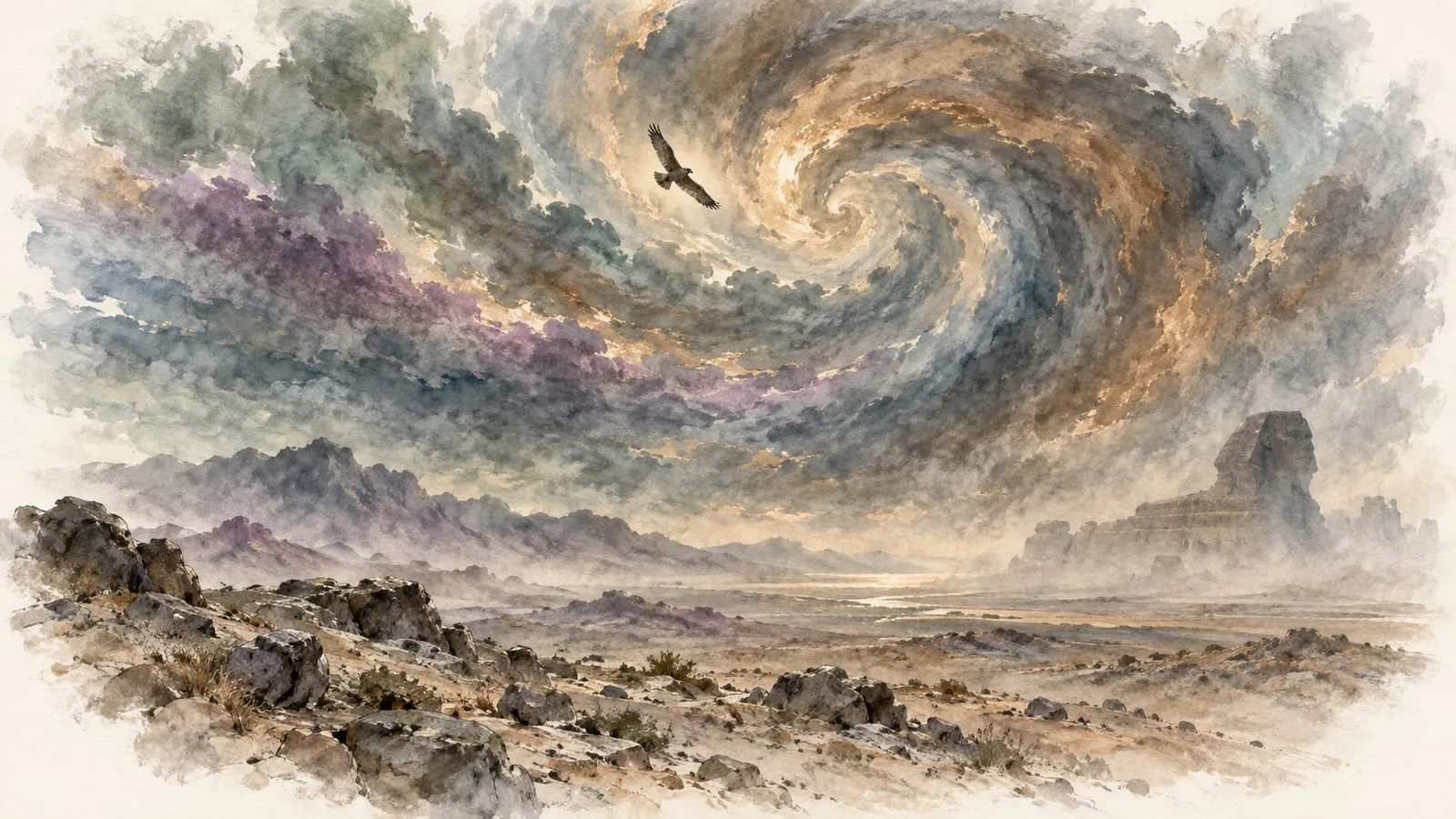
Part II is one image. Loie Fuller's dancers whirl a ribbon of cloth until "a dragon of air" seems to fall among them. History moves the same way: the "platonic year" whirls new right and wrong out and old in, and "All men are dancers" to "the barbarous clangour of gong".
Lines 59 to 68The swan
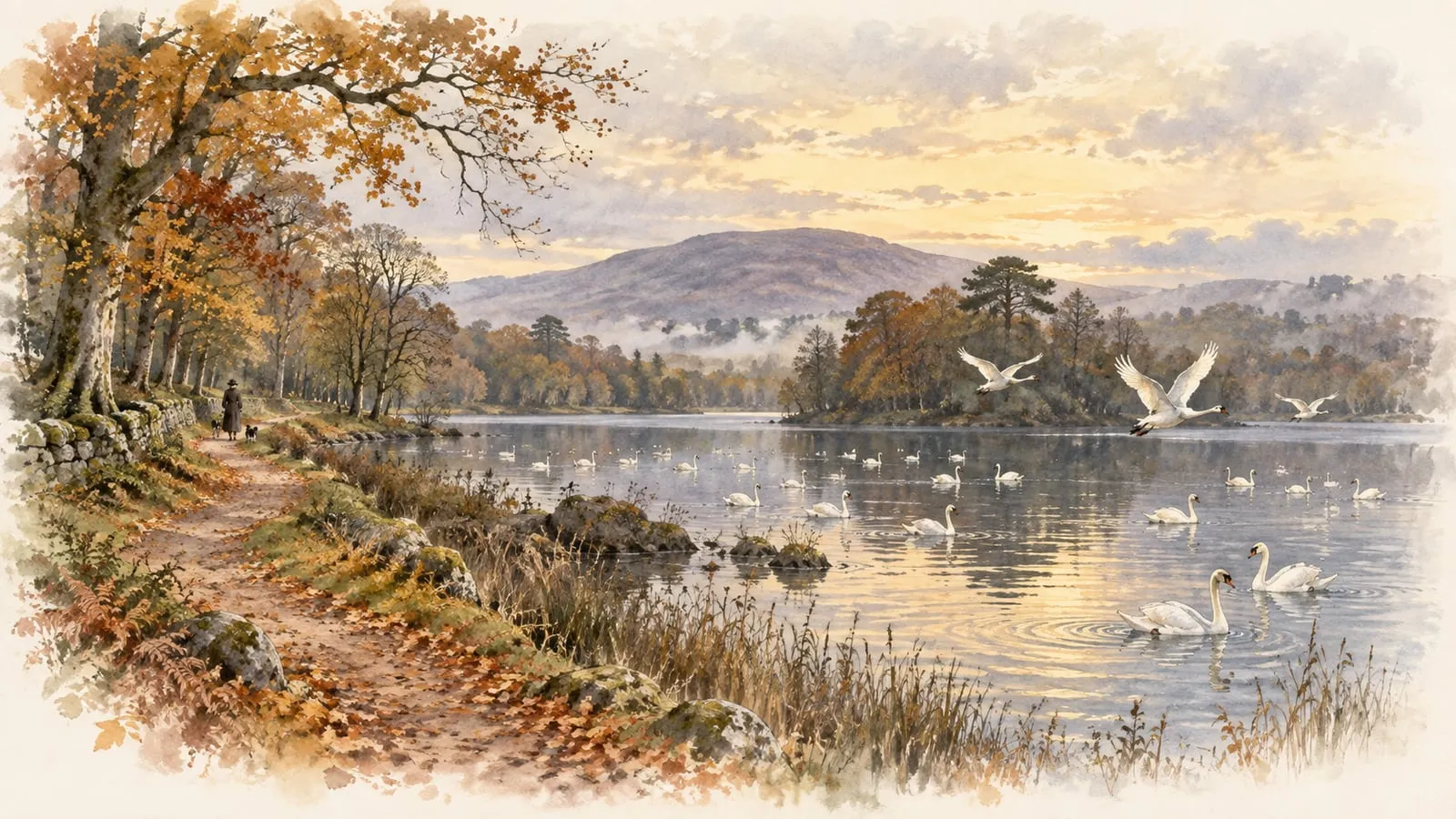
Part III compares the solitary soul to a swan, seen in "a troubled mirror" before its brief gleam of life is gone: wings half spread, breast thrust out in pride, ready to play or to ride "Those winds that clamour of approaching night".
Lines 69 to 88Wildness and rage
A man lost in the labyrinth of his art or politics might count it "a lucky death" if his works vanished with him. Then "The swan has leaped into the desolate heaven", bringing a rage to end everything, even "the half written page". Their dreams of mending the world were "crack-pated".
Lines 89 to 92The weasel's tooth
Part IV is a bitter four-line epigram. People who "Talked of honour and of truth" only seven years ago now "Shriek with pleasure" at showing "The weasel's twist, the weasel's tooth", picking up the weasels of part I.
Lines 93 to 112Come let us mock
Part V repeats "Come let us mock" at the great, the wise and the good, whose monuments, calendars and holidays were swept away by the "levelling wind". The last stanza turns on the mockers, speaker included, who would not lift a hand "To bar that foul storm out".
Lines 113 to 124Riders on the wind
Part VI returns to horses: "Violence upon the roads". The garlanded riders vanish and "evil gathers head". "Herodias' daughters have returned again" in a blast of dusty wind, blind spirits who turn with amorous or angry cries on anyone who touches them.
Lines 125 to 130Robert Artisson
The wind drops, the dust settles, and one figure lurches past with thoughtless eyes and "stupid straw-pale locks": "That insolent fiend Robert Artisson", to whom Lady Kyteler brought peacock feathers and the red combs of her cocks. The poem ends on an image of lust and evil, not a conclusion.
Themes
Violence and civilisation
The poem measures how thin civilisation is. Law, habit and public opinion were "pretty toys", and the army "but a showy thing". Once violence returns, a "drunken soldiery" can murder "and go scot-free", and humanity is reduced to "weasels fighting in a hole". The weasel returns in part IV, now as something people are proud to show.
Everything vanishes
From Phidias' ivories to "the half written page", nothing made by hand or mind is safe. The poem does not console: "Man is in love and loves what vanishes". The "platonic year" turns right and wrong over like dancers' ribbons, and the "levelling wind" of part V flattens every monument.
Mockery and self-judgement
Yeats does not spare himself. "O what fine thought we had" mocks his own generation, and "we were crack-pated when we dreamed" admits their folly. Part V invites us to mock the great, the wise and the good, then to mock the mockers, including the speaker, who "Traffic in mockery" instead of acting.
Context
The poem was first printed as "Thoughts upon the Present State of the World" in Seven Poems and a Fragment (Cuala Press, 1922) and collected under its present title in The Tower (Macmillan, 1928). The title names the year the Anglo-Irish War began. The murdered mother of part I is usually linked to Ellen Quinn, shot from a passing lorry of Crown forces at Kiltartan, near Gort, in November 1920.
Yeats's note explains part VI. Country people see riders "with flowers upon the heads of the horses", and he imagined them giving way to worse "now that the times worsen". Robert Artisson was, in his words, "an evil spirit much run after in Kilkenny" in the early fourteenth century; he was linked to Dame Alice Kyteler, tried for witchcraft there in 1324.
The poem belongs with "The Second Coming" and "Meditations in Time of Civil War" as Yeats's darkest response to the violence of those years. Its images of whirling dancers, the platonic year and riders in the dust also draw on the cyclical view of history he was then working out, where one age of order gives way to another of chaos.
Form
Six sections in different forms. Part I uses ottava rima, eight pentameter lines rhymed ABABABCC, a stately form for a public theme. Part II is one ten-line stanza; part III has ten-line stanzas rhymed ABCABCDEED; part IV is a quatrain; part V has five-line stanzas rhymed ABABB; part VI is eighteen long lines rhymed ABCABC. The breaking of forms mirrors the breaking of order.
Yeats's own note
The country people see at times certain apparitions whom they name now “fallen angels,” now “ancient inhabitants of the country,” and describe as riding at whiles “with flowers upon the heads of the horses.” I have assumed in the sixth poem that these horsemen, now that the times worsen, give way to worse. My last symbol, Robert Artisson, was an evil spirit much run after in Kilkenny at the start of the fourteenth century. Are not those who travel in the whirling dust also in the Platonic Year?
First printed as 'Thoughts upon the Present State of the World' (Seven Poems and a Fragment, Cuala 1922, Gutenberg 31959).