The Second Coming
Listen
Text: Poetry, by W. B. Yeats (Standard Ebooks, 2024), from the collected editions of 1908 to 1928. Public domain.
In brief
SummaryA vision of the world collapsing and a monstrous new age arriving.
The poem opens on a world spinning out of control. A falcon circles so widely that it can no longer hear the falconer; things "fall apart", a tide of blood drowns innocence, and the good have lost their nerve while the worst are full of fanatical energy. In the second stanza the speaker feels that some revelation must be near, surely the Second Coming of Christ. Instead a vision rises from the world's memory: a sphinx-like creature with a lion's body and a man's head, stirring in the desert. The vision fades, but he now knows that two thousand years of the Christian age are ending, and he asks what "rough beast" is coming to be born.
Lines to remember
Things fall apart; the centre cannot hold;
And what rough beast, its hour come round at last,
Slouches towards Bethlehem to be born?
Line by line
Lines 1 to 2The widening gyre
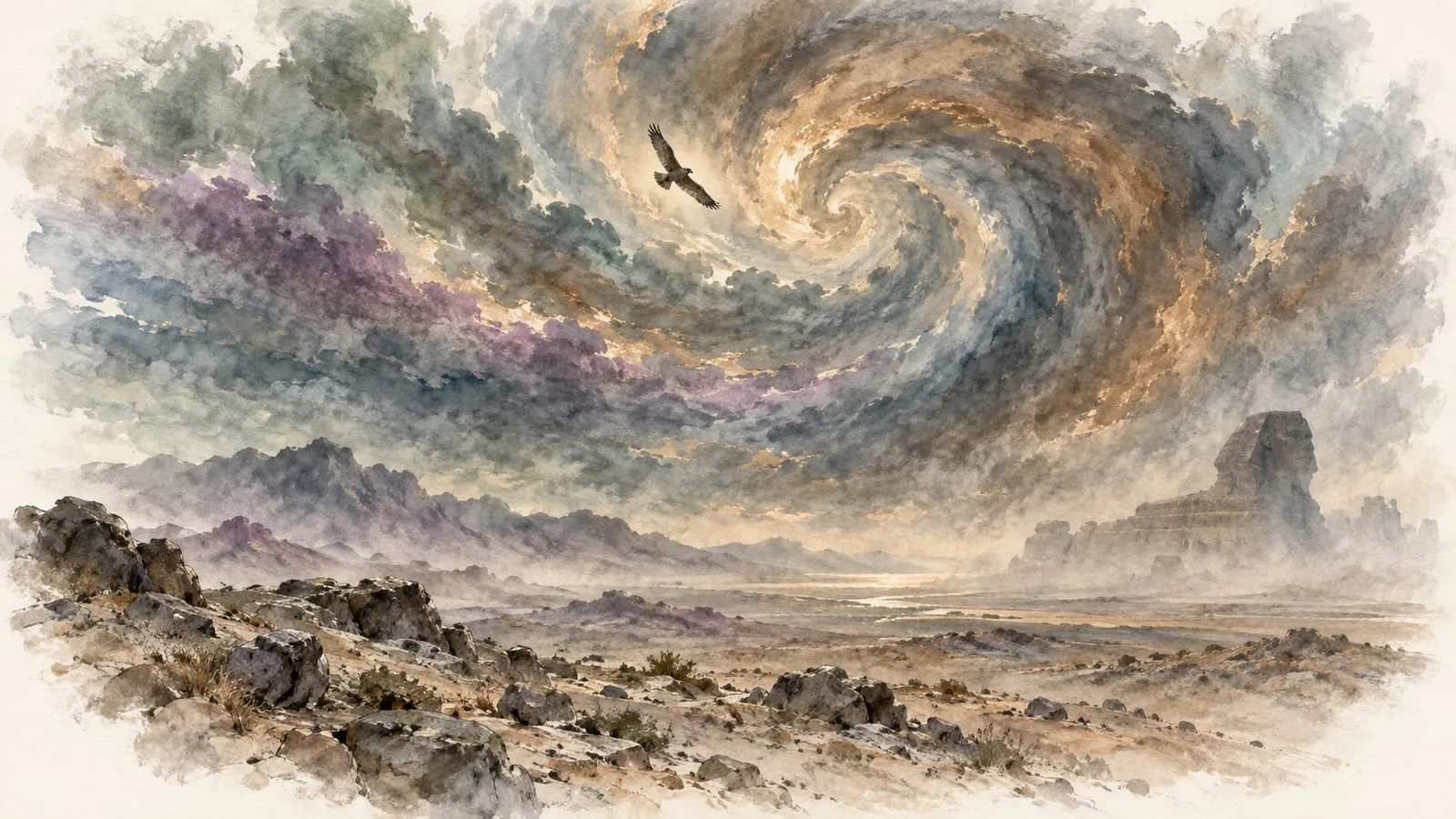
A falcon flies in ever wider circles until it can no longer hear its master. The "gyre", a spiral, is Yeats's image for an age of history unwinding, and the broken link between falcon and falconer suggests a world that has lost touch with its centre of control or belief.
Lines 3 to 8Things fall apart
Short, blunt statements describe collapse: "Things fall apart; the centre cannot hold". Violence is a "blood-dimmed tide" that drowns "The ceremony of innocence", the rituals that protect what is pure. The last two lines give the famous diagnosis: the best are paralysed by doubt while the worst act with "passionate intensity".
Lines 9 to 12Surely some revelation
The repeated "Surely" sounds like a man trying to convince himself. As soon as he speaks the words "The Second Coming", the return of Christ, a "vast image" comes to him out of "Spiritus Mundi", Latin for the spirit of the world: for Yeats, a store of images shared by all minds.
Lines 13 to 17The shape in the desert
In the desert a creature like the Sphinx, "A shape with lion body and the head of a man", is waking, its gaze "blank and pitiless as the sun". "Moving its slow thighs" makes it horribly physical. Around it wheel the "indignant desert birds", disturbed like the falcon of line 2.
Lines 18 to 22The rough beast
The darkness returns, but now he knows: the "twenty centuries of stony sleep" since Christ's birth were "vexed to nightmare by a rocking cradle". A new age is due, and the last lines turn the nativity upside down, as a "rough beast" "Slouches towards Bethlehem to be born".
Themes
Chaos and violence
The first stanza is a catalogue of collapse: "Things fall apart", "Mere anarchy is loosed upon the world", "The blood-dimmed tide is loosed". The passive verbs make the violence seem unstoppable, as if no one were in charge. Even the moral order fails: "The best lack all conviction, while the worst / Are full of passionate intensity."
History as cycles
Yeats believed history moves in great cycles, or gyres, of about two thousand years, each ending in violence and giving way to its opposite. The "widening gyre" of line 1 is one such cycle unwinding, and the "twenty centuries" of line 19 are the Christian age now ending. The beast's "hour come round at last" suggests something fated by the turning of time.
Revelation and religion
The poem borrows the Christian hope of the Second Coming and reverses it. Instead of Christ returning, a pitiless beast "Slouches towards Bethlehem to be born". The "rocking cradle" of the nativity has vexed the centuries "to nightmare". The revelation the speaker longs for arrives, but it is terrifying, and its meaning is left as an open question.
Context
Yeats wrote the poem in 1919, the year after the First World War ended, when revolution had already broken out in Russia and violence was spreading in Ireland. It was first printed in The Dial and The Nation in November 1920 and collected in Michael Robartes and the Dancer (Cuala Press, 1921), beside "Easter, 1916" and "A Prayer for my Daughter".
After his marriage in 1917, Yeats and his wife George explored her automatic writing, which gave him the system he later set out in A Vision (1925). In it, history turns in interlocking gyres, and each age of about two thousand years ends by giving way to its opposite. The poem imagines the Christian era reaching that point.
Its lines have passed into everyday language and are quoted whenever the world seems to be losing its balance. The Nigerian novelist Chinua Achebe took the title of Things Fall Apart (1958) from line 3, and Joan Didion called a book of essays Slouching Towards Bethlehem (1968).
Form
Two verse paragraphs of 8 and 14 lines in loose blank verse: lines of roughly five beats, mostly unrhymed, with only a few faint chimes such as "hold" and "world". The freedom of the verse suits a world where "the centre cannot hold", and the long, rolling sentences of the second part build like a vision gathering force.
Studying this poem
What to focus on
- How images of disorder (the gyre, the falcon, the "blood-dimmed tide") convey a world in collapse.
- The shift from general statement in the first stanza to personal, prophetic vision in the second.
- Yeats's use of Christian ideas, especially the ironic reversal of the Second Coming and the nativity at Bethlehem.
- Yeats's cyclical view of history and how it shapes the poem's imagery and ending.
- Why the poem still feels relevant, and how its prophetic, public tone is created.
Key quotations
Turning and turning in the widening gyre
The repeated present participle creates a relentless circling motion, and the widening spiral suggests a world moving ever further from its centre.
Things fall apart; the centre cannot hold;
Blunt, short words and strong pauses state the collapse of order simply. The "centre" can be read as authority, faith or shared values.
The best lack all conviction, while the worst
A sharp antithesis, completed in the next line: moral paralysis among good people against fanatical energy among the worst, a diagnosis readers keep applying to their own times.
A gaze blank and pitiless as the sun,
The simile gives the beast an inhuman, merciless stare, as indifferent as the desert sun. Whatever age is coming will have no pity.
Slouches towards Bethlehem to be born?
A grotesque reversal of the nativity. The ugly verb "Slouches" makes the birth sinister, and ending on a question leaves the future frighteningly open.