The Dedication to a Book of Stories selected from the Irish Novelists
Listen
Text: Poetry, by W. B. Yeats (Standard Ebooks, 2024), from the collected editions of 1908 to 1928. Public domain.
In brief
SummaryA book of Irish stories offered to exiles as a healing bell branch.
The poem opens with a legend: in old Ireland a green branch hung with bells brought "A Druid kindness" to all who heard it, charming the merchant from his tricks and lulling armies to sleep. Then the speaker turns to Irish exiles, restless and still plotting against "ancestral Sorrow", and offers them his own bell branch: this book of stories. He tore it, he says, from "the barren boughs of Eire", a country that can batter a man until he is loveless. Yet its bells, merry or sad, will bring back memories of home, of places untouched by "our bitterness".
Lines to remember
I also bear a bell branch full of ease.
On Munster grass and Connemara skies.
Line by line
Lines 1 to 4The old bell branch
In the days "When her own people ruled this tragic Eire", a green branch hung with bells shed "A Druid kindness" on all who heard it. The murmur of the bells blends with "greenness" and "calm of faery" into one peaceful image.
Lines 5 to 8Its magic
The branch charms the merchant from "his guile", turns the farmer's thoughts from his cattle and hushes "the roaring ranks of battle". Its power is gentle and brief: "all grew friendly for a little while". The modest last line keeps the legend from sounding grand.
Lines 9 to 12To the exiles
The speaker turns to Irish "Exiles", scattered "over lands and seas" and still planning for a day that might "set a stone upon ancestral Sorrow", a gravestone on old grief. He offers them what the legend offered: "I also bear a bell branch full of ease."
Lines 13 to 20Torn from Eire
Twice he says "I tore it", from wind-tossed boughs and from "the barren boughs of Eire". The sentence runs over the stanza break into a bitter list, a man "battered, badgered and destroyed" until he is "a loveless man". Then the bells return: merry ones shake cobwebs from the rafters, but "the saddest chimes are best enjoyed".
Lines 21 to 24Memories of home
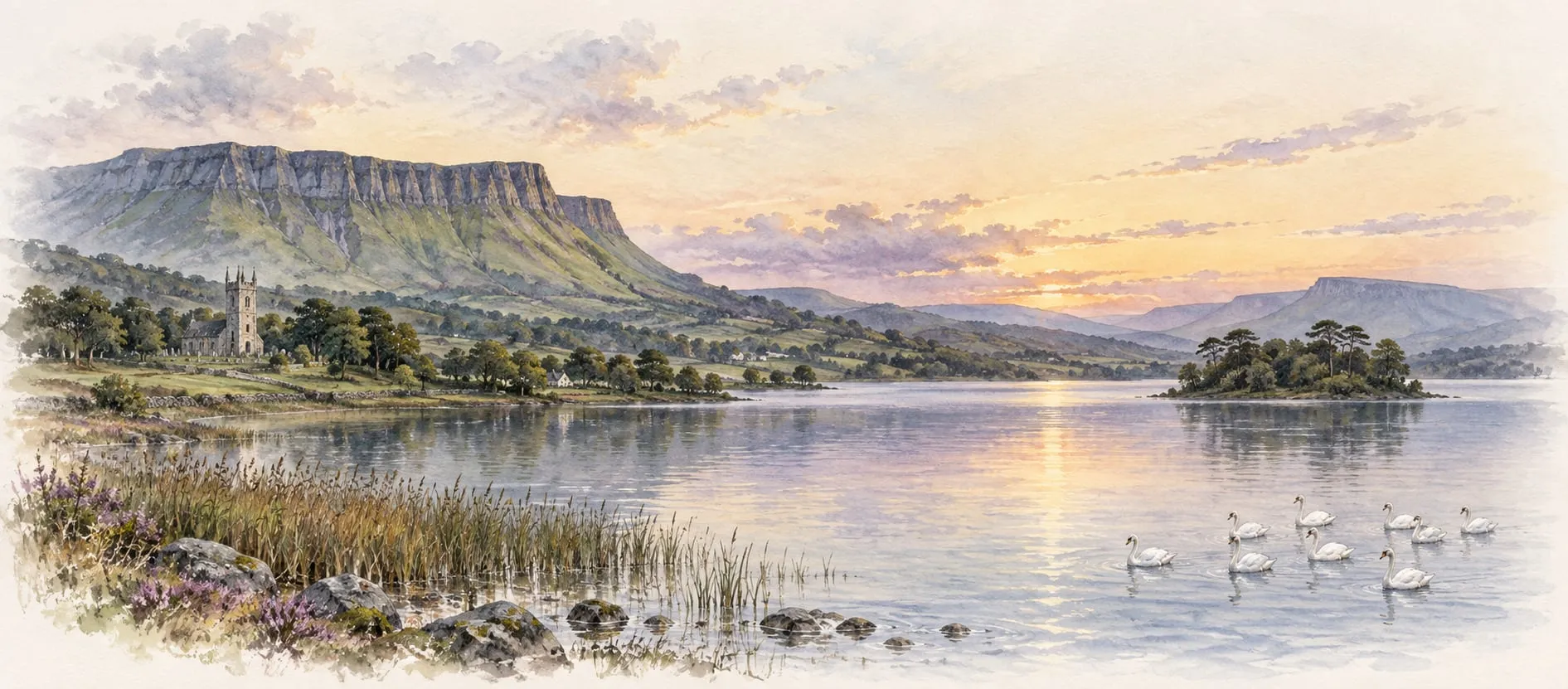
Merry or sad, the bells bring memories of "half-forgotten innocent old places". The last lines offer a quiet comfort: human bitterness has "left no traces" on "Munster grass and Connemara skies". The land itself stays clean of the quarrels of its people.
Themes
Exile and memory
The poem is written for people far from Ireland, still bound to it by grievance and longing. What the speaker offers is not a solution but memory: the bells bring back "half-forgotten innocent old places". Munster and Connemara stand for a home that survives in the mind, untouched by the "bitterness" of politics.
Stories as healing
The bell branch of legend and the book of stories do the same work. The old branch made enemies "friendly for a little while"; the book offers exiles "ease". The poem is modest about the cure: it is brief, and "the saddest chimes are best enjoyed". Stories cannot mend Ireland, but they can soothe the people who love it.
A hard country
Alongside the tenderness runs anger. Ireland is "tragic Eire", a place of "barren boughs" where a man can be "battered, badgered and destroyed". The alliteration of line 17 gives the bitterness force. The closing comfort, that bitterness leaves "no traces" on the land, only works because the bitterness has been named so plainly.
Context
Yeats wrote the poem as the dedication to Representative Irish Tales (1891), an anthology of stories by nineteenth-century Irish novelists that he selected and introduced. It then appeared in The Countess Kathleen and Various Legends and Lyrics (1892), in the group of lyrics later called "The Rose". Yeats revised it substantially in 1925, and the text here is the later version.
The bell branch comes from Irish legend, where a branch hung with small bells could be shaken to bring calm or sleep to those who heard it. The poem turns that old image into a way of describing what a book of stories can do for readers far from home.
Form
Six quatrains in iambic pentameter, rhymed ABBA, some with loose or half-rhymes ("Eire" and "faery", "memories" and "skies"). Many inner rhymes are two-syllable, falling endings ("cattle", "battle"; "laughter", "rafter"). In the second half one long sentence runs from stanza four into stanza six, so the feeling about Ireland spills over the poem's neat divisions.
Substantially revised in 1925 (about 60 per cent word overlap between the 1895 text in Gutenberg 38877 and the later text in Standard Ebooks).