The Circus Animals' Desertion
About the text
Yeats first published this poem in 1939. It is out of copyright in Ireland and the EU, but in the United States it stays in copyright until the start of 2035, and this site is served partly from American servers. So for now we give the notes without the full text; it will appear here in 2035.
It begins: I sought a theme and sought for it in vain
In brief
SummaryAn old poet loses his themes and finds their source in the heart.
The poet has searched for a subject for weeks and found nothing. His old themes, his "circus animals", have deserted him, and he wonders whether, as a broken old man, he must make do with his own heart. So he lists the great images of his past work. There was Oisin, led through enchanted islands, though what really drove that poem was the poet's own starved desire. There was the Countess Cathleen, who sold her soul for others, a play prompted by his fear for a woman he loved, until the play itself took all his love. There was Cuchulain fighting the sea, where again the dream on stage enchanted him more than the realities behind it. The last stanza asks where those masterful images began, and answers with a heap of rubbish: old kettles, bottles, bones and rags. Now that his ladder has gone, he must lie down where all ladders start, in the heart's foul rag-and-bone shop.
Lines to remember
In the foul rag-and-bone shop of the heart.
Those masterful images because complete
Line by line
Lines 1 to 4A theme sought in vain
The poem begins with writer's block. For six weeks or so he has looked for a theme, and he half accepts that, being "a broken man", he may have to be content with his heart as his only subject.
Lines 5 to 8The circus animals
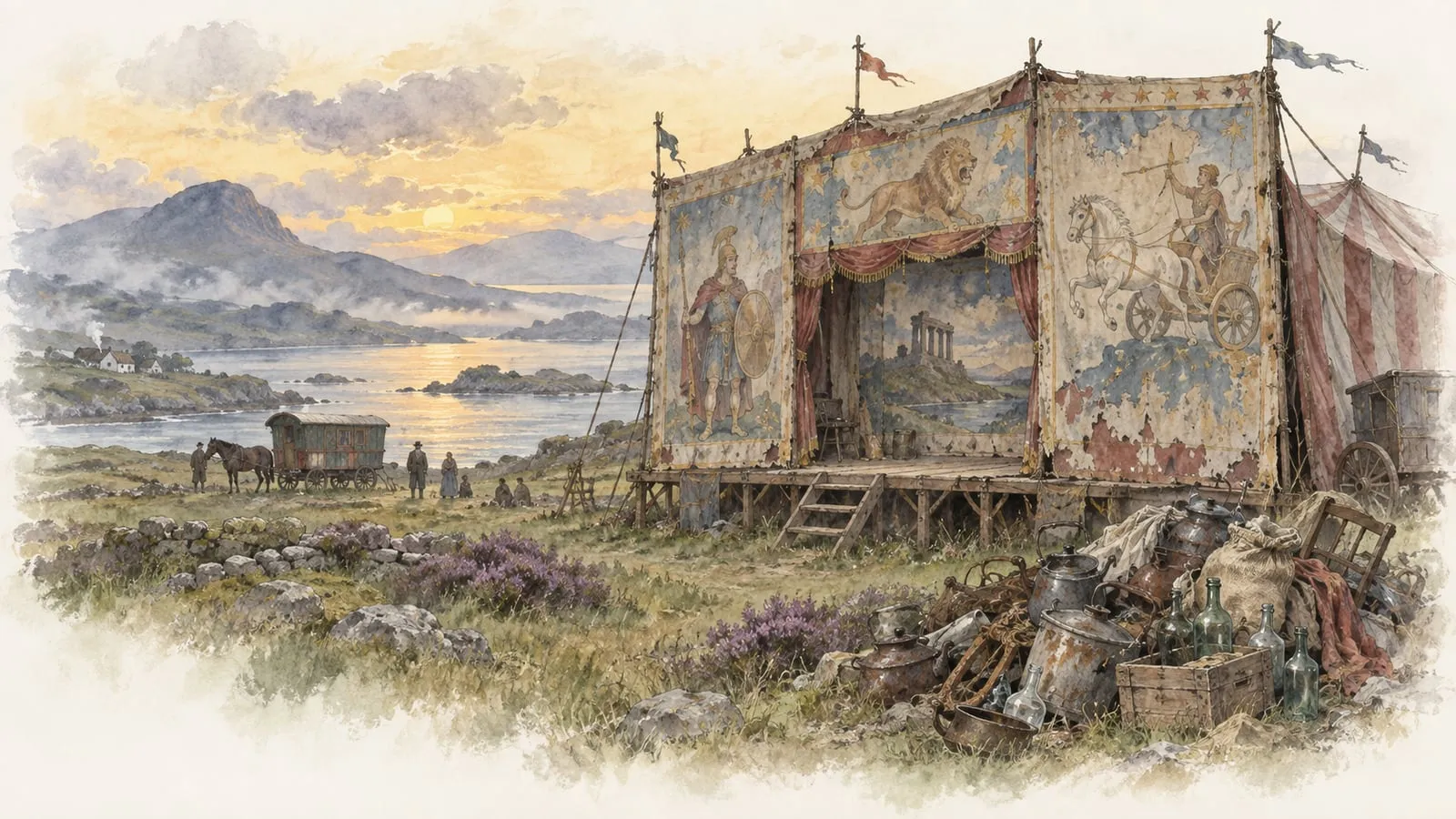
All his working life, until old age, his images were on show like animals in a circus parade: boys on stilts, a gleaming chariot, a lion and a woman. The dismissive ending, "the Lord knows what", mocks his own grand symbols.
Lines 9 to 16Oisin's islands
All he can do is count over old themes. First comes Oisin, the sea-rider led by his fairy bride through three enchanted islands, from Yeats's early long poem. It looked like allegory, but the poet now admits he was really starved for the love the poem imagined.
Lines 17 to 24The Countess Cathleen
Next came a play, The Countess Cathleen, in which a woman driven by pity gives away her soul and is saved by Heaven. He wrote it fearing that "my dear" would destroy her own soul through fanaticism and hate. Yet soon the dream itself had all his thought and love.
Lines 25 to 32Cuchulain and the sea
Then, while the Fool and the Blind Man stole bread, Cuchulain fought the sea, as in his play On Baile's Strand. There were mysteries of the heart there, but again the dream enchanted him. "Players and painted stage" took his love, not the real things they stood for.
Lines 33 to 37Out of what began
The final section asks where those complete, masterful images came from. The answer is a heap of refuse and street sweepings: kettles, bottles, a broken can, iron, bones, rags, and a raving woman keeping the till. The list is deliberately squalid.
Lines 38 to 40The rag-and-bone shop
His ladder, the climb of art and imagination, is gone. He must lie down where all ladders start, in the heart, imagined as a foul junk shop where scraps are bought and sold. The last line is among the most quoted Yeats wrote.
Themes
Art and life
The poem confesses that Yeats loved his images more than the life behind them: the dream "had all my thought and love", and the stage took the place of what it stood for. Now he sees that every great image grew from something humble and messy. The ending sends him back from art to its raw material.
Old age
The poet is "but a broken man", and his animals have deserted him. Yet the poem is not defeated. Admitting the loss of inspiration becomes its own inspiration, and the old man's review of his career turns into one of his finest late poems. Lying down in the rag-and-bone shop is humbling, but it is also a new start.
The heart
At the start the heart is a poor second-best, something he "must be satisfied with". By the end it is the source of everything, the place "where all the ladders start". The shop is foul and full of junk, but it is where imagination begins, so the poem ends by accepting the heart's squalor as the ground of art.
Context
The poem was first published in book form in Last Poems (1939), issued after Yeats's death in January of that year, and it is one of the great poems of his last years. It is a review of his own career, naming work that his readers would recognise: The Wanderings of Oisin (1889), his first long poem; The Countess Cathleen, his early play; and On Baile's Strand, in which Cuchulain, having unknowingly killed his son, fights the waves while a Fool and a Blind Man steal bread.
The "dear" whose soul he feared for is usually taken to be Maud Gonne, for whom The Countess Cathleen was written and whose political passion Yeats often described as fanaticism. The poem does not name her. Its final image of the rag-and-bone shop, a dealer in cast-off scraps, gives the late Yeats his most famous statement about where poetry comes from.
Form
Five stanzas of ottava rima, eight pentameter lines rhymed ABABABCC, arranged in three numbered sections. Many rhymes are slant ("vain" and "man", "complete" and "slut"), which keeps the tone rough and conversational. The tidy stanza holds a catalogue that grows steadily more disordered until the heap of rubbish at the end.