Under Ben Bulben
About the text
Yeats first published this poem in 1939. It is out of copyright in Ireland and the EU, but in the United States it stays in copyright until the start of 2035, and this site is served partly from American servers. So for now we give the notes without the full text; it will appear here in 2035.
It begins: Swear by what the sages spoke
In brief
SummaryYeats's final creed for Irish poets, ending with his own grave and epitaph.
One of the last poems Yeats finished, named for the mountain above the Sligo churchyard where he asked to be buried. It has six numbered sections. Section I swears by ancient sages and by the immortal horsemen who ride the dawn around Ben Bulben. Section II says that man lives and dies many times, so death is only a brief parting. Section III claims that violence can complete a man's mind. Section IV tells artists to keep up the great tradition, from Egypt and Greece to Michelangelo and the Italian painters, which has since fallen into confusion. Section V, prescribed for the Leaving Certificate, tells Irish poets to learn their trade and sing the peasant, the country gentleman, the monk and the drinker, so that the Irish stay unconquered. Section VI, also prescribed, describes his grave at Drumcliff and ends with the three-line epitaph now cut on his headstone.
Lines to remember
Cast a cold eye
Horseman, pass by!
Line by line
Lines 1 to 12Swear by the sages
Section I is an oath. Yeats swears by the wisdom of the sages who lived around the Mareotic Lake near Alexandria, and by a pale, superhuman company of riders, the immortal horsemen and women of Irish folklore, who now ride the wintry dawn around Ben Bulben. What follows is the gist of what they mean.
Lines 13 to 24Two eternities
Section II states a belief in rebirth: man lives and dies many times between two eternities, that of the race and that of the soul, as ancient Ireland knew. So death, in bed or by the rifle, is only a brief parting from loved ones. Grave-diggers merely push the dead back into human memory.
Lines 25 to 36Fighting mad
Section III recalls the Young Ireland rebel John Mitchel, who prayed for war in his own time. When a man is fighting mad, Yeats says, his blindness falls away, his mind is completed and he laughs with his heart at peace. Even the wisest must pass through some violence to fulfil his fate. Many readers find this praise of violence troubling.
Lines 37 to 44Poet and sculptor
Section IV turns to the arts. Poets, sculptors and even fashionable painters must continue their forefathers' work: bringing the soul to God and showing the right human forms, so that the next generation is well made. Great art, he says, began with measurement, in the proportions of Egyptian sculpture and of the Greek sculptor Phidias.
Lines 45 to 52The Sistine ceiling
Michelangelo's half-awakened Adam on the Sistine Chapel ceiling proves the point: its beauty can stir desire even in a globe-trotting tourist. For Yeats this shows that a purpose is set before the mind of the artist: the perfect human form, made by an art of the body rather than of the church.
Lines 53 to 67Gyres run on
The Italian painters of the fifteenth century set gardens behind their gods and saints, heavenly places where the soul is at ease, like a vision seen between sleeping and waking. When that dream faded, later painters such as Calvert, Wilson, Blake and Claude kept a smaller vision alive. After them came confusion, as the gyres of history turned.
Lines 68 to 73Learn your trade
Section V, prescribed for the Leaving Certificate, is a direct command: Irish poets must learn their craft, sing whatever is well made, and scorn the new generation, which Yeats sees as shapeless in body and mind and cut off from memory. His harsh phrase about "base beds" reflects his late belief in breeding and lineage.
Lines 74 to 77Sing the peasantry
He gives poets their subjects: the peasantry, hard-riding country gentlemen, the holiness of monks and the bawdy laughter of porter-drinkers. The list draws together the Ireland Yeats valued, rich and poor, holy and rowdy, and it pointedly leaves out the modern, urban middle class.
Lines 78 to 83Seven heroic centuries
Poets must also sing the old lords and ladies who were beaten into the clay over seven heroic centuries of conquest. By casting their minds back to other days, they can keep the Irish unconquered in the days to come. The section ends on the proud, defiant phrase "the indomitable Irishry".
Lines 84 to 89Drumcliff churchyard
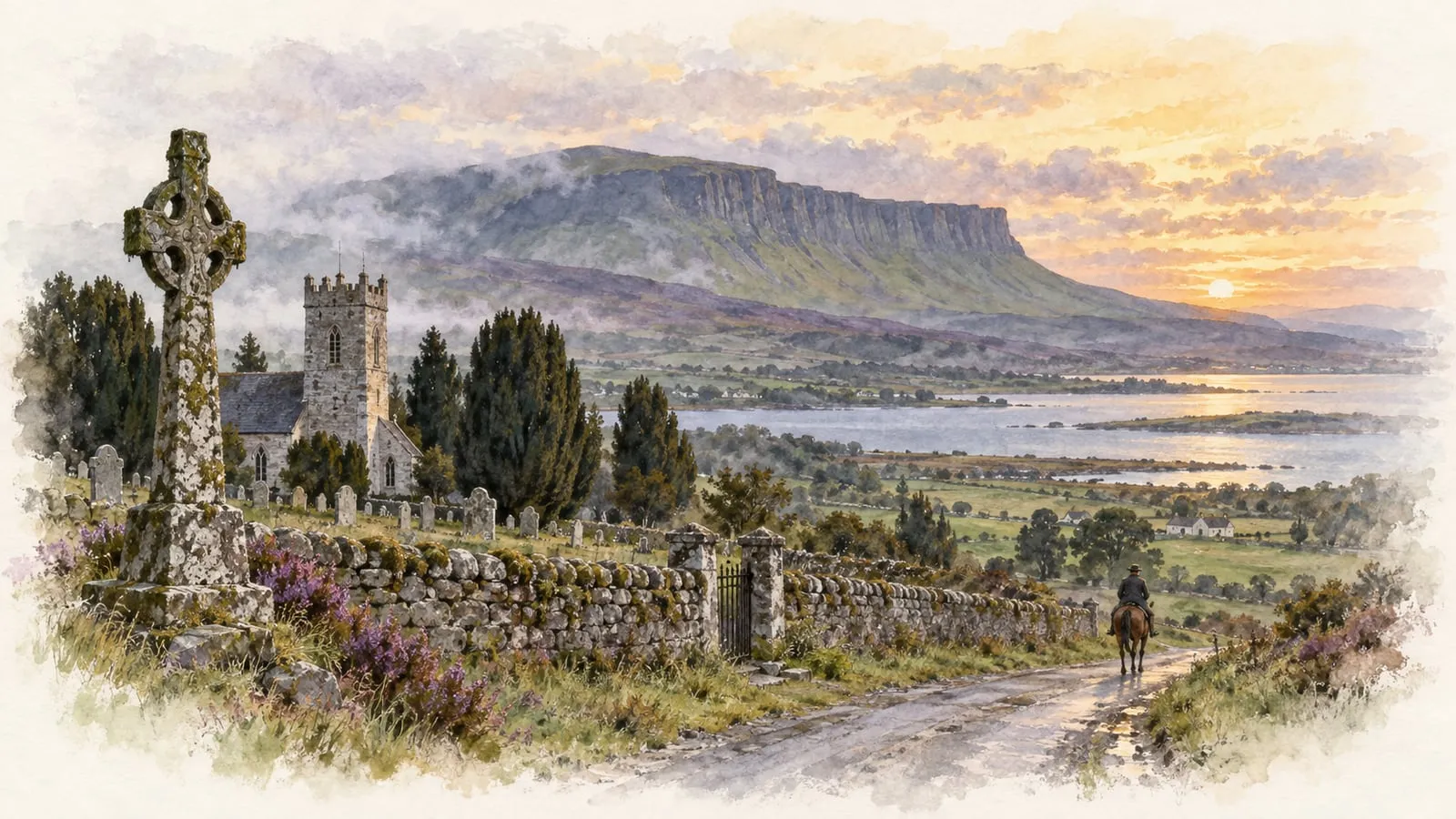
Section VI changes tone completely. In a calm voice, speaking of himself in the third person, Yeats describes his burial in Drumcliff churchyard under bare Ben Bulben. An ancestor was rector there, a church stands near, and an ancient cross stands by the road. He wants no marble and no conventional phrase on his grave.
Lines 90 to 94The epitaph
Instead, words of his own choosing are to be cut on limestone quarried nearby. The epitaph tells a horseman to cast a cold eye on life and on death, and to ride on past the grave. After a poem full of commands to others, his last command asks for detachment, not mourning.
Themes
Art and tradition
Sections IV and V treat art as a trade handed down through generations. Artists must do what their forefathers did, and Irish poets must "learn your trade" and sing "whatever is well made". Yeats believes that tradition shapes a people: good art gives the nation models to live up to, and a break with tradition leads to confusion and formlessness.
Irish identity
Section V builds a picture of Ireland from its peasants, gentry, monks and drinkers, and from the Gaelic lords crushed over seven centuries. Memory is a weapon: by remembering other days, poets keep the Irish unconquered. The vision is proud and inclusive of rich and poor, but it also scorns the modern crowd, and many readers find its idea of who belongs uncomfortable.
Death
Section II makes death only a brief parting in a cycle of lives, and section VI faces Yeats's own death directly. He describes his grave as if it were already made, in a flat third person, and chooses plain local stone over marble. The epitaph asks for a cold eye on both life and death: neither fear nor grief, but clear detachment.
Place and belonging
Ben Bulben frames the poem: the immortal riders gallop there in section I, and the grave lies under the mountain in section VI. The ancestor who was rector, the ancient cross and the limestone quarried near the spot root Yeats in Sligo. After a life spent between Dublin, London and Galway, he chooses to end where his family began.
Context
This was among the last poems Yeats finished. He died in France on 28 January 1939, and the poem was first printed in the Irish Times, the Irish Independent and the Irish Press on 3 February 1939, then in Last Poems and Two Plays (Cuala Press, Dublin, 1939). The texts differ in details, and editors disagree about whether it should open or close his last poems. The Leaving Certificate prescribes sections V and VI only.
Ben Bulben is the flat-topped mountain that dominates the Sligo country Yeats knew as a child. His great-grandfather John Yeats had been rector of Drumcliff, which is why the poem chooses that churchyard. Yeats was first buried in France, but in September 1948 his remains were brought home on the Irish naval corvette Macha and reburied at Drumcliff, under the epitaph from section VI.
Section V reflects views Yeats set out in his late prose, especially On the Boiler (1939): scorn for modern, mass culture and a belief that breeding and lineage shape a nation. Readers today often find this side of the poem troubling, and it is worth discussing alongside the poem's pride in Irish tradition and its hope that poets can keep a people's spirit alive.
Form
Six numbered sections, almost entirely in rhyming couplets of short four-beat lines, often with half rhymes ("head" and "laid"). The tight couplets give the poem the sound of a set of rules or commandments, suited to a poet giving his final instructions. The epitaph at the end breaks the pattern: three short lines, cut down like words carved in stone.
Studying this poem
What to focus on
- Only sections V and VI are prescribed: know how they close the longer poem, with V giving instructions to Irish poets and VI describing Yeats's own grave.
- Yeats's view of the poet's craft and of Irish tradition in section V, including the four kinds of people he tells poets to sing.
- The attitudes in section V that readers find elitist or troubling, such as the scorn for a modern generation he calls "Base-born".
- The shift in tone from the commanding public voice of section V to the calm, impersonal description of the grave in section VI.
- The meaning of the epitaph, and what a cold, detached eye on life and death might mean for a poet facing his own end.
Key quotations
Irish poets, learn your trade,
The opening command of section V. Poetry is presented as a craft to be mastered like any trade, and Yeats speaks as a master addressing his apprentices.
Base-born products of base beds.
Yeats's contempt for the new generation, which he sees as poorly bred and cut off from tradition. The repeated "base" is harsh and links to his late interest in eugenics.
Still the indomitable Irishry.
The climax of section V. By remembering the past, poets keep the Irish unconquered. The unusual word "Irishry" suggests a whole people and its spirit rather than a state.
No marble, no conventional phrase;
Yeats rejects a grand monument and the usual pious words of gravestones. He wants plain local stone and words of his own, in keeping with his lifelong pride in style.
Cast a cold eye
The epitaph asks the passer-by to look on life and death with calm detachment. It is Yeats's last word to his readers: not grief or fear, but a clear, unsentimental gaze.