The Statues
About the text
Yeats first published this poem in 1939. It is out of copyright in Ireland and the EU, but in the United States it stays in copyright until the start of 2035, and this site is served partly from American servers. So for now we give the notes without the full text; it will appear here in 2035.
It begins: Pythagoras planned it. Why did the people stare?
In brief
SummaryGreek statues, measured by number, shaped Europe and inspired Ireland's 1916.
The poem begins with Pythagoras, whose mathematics of proportion lay behind the Greek statues. Numbers alone lacked life, but lonely young people knew what the statues meant and kissed their marble faces at midnight, so passion supplied the character. The sculptors, greater than Pythagoras, gave flesh to calculation, and by giving Europe an ideal of human form they defeated the vast, vague power of Asia more surely than the Greek fleet did at Salamis. The third stanza follows one Greek image eastward, where it grew round and slow and became the dreaming Buddha, emblem of emptiness. The last stanza comes home to Dublin. When Pearse called on Cuchulain in the Post Office in 1916, it was that ancient discipline of number and measurement that answered. The Irish, heirs of that tradition but wrecked by a formless modern tide, must climb into their proper darkness to trace again the outlines of the measured face.
Lines to remember
When Pearse summoned Cuchulain to his side.
We Irish, born into that ancient sect
Line by line
Lines 1 to 3Pythagoras planned it
The Greek statues were designed by the mathematics of Pythagoras, the numbers of ideal proportion. The people stared, puzzled, because those numbers, however lifelike in marble or bronze, seemed to lack character.
Lines 4 to 8Kisses at midnight
But young people pale from solitary longing understood. Passion could bring character enough, and at midnight they pressed living lips on the statues' faces. The phrase "plummet-measured face" joins cold measurement with warm desire, and returns as the poem's last words.
Lines 9 to 14Greater than Pythagoras
The sculptors who turned calculations into what looks like casual flesh were greater than Pythagoras. They, not the oarsmen of the Greek fleet at Salamis, defeated the "Asiatic vague immensities": Greek form, not Greek arms, won the real victory.
Lines 15 to 16Phidias and the mirror
Europe cast off the foam of that sea battle when Phidias, the great sculptor of Athens, gave women dreams and gave dreams a mirror. His ideal figures showed people what beauty could look like, and so shaped desire itself.
Lines 17 to 22The fat dreamer
One Greek image travelled across the sea into Asia and changed in the tropical shade, growing round and slow. It is no thin, brooding Hamlet but a fat dreamer, the Buddha of Asian sculpture, whose blank eyes know that knowledge only multiplies illusion, like mirrors reflecting mirrors.
Lines 23 to 24Buddha's emptiness
When gong and conch call the faithful to prayer, even the cat creeps towards the Buddha's emptiness. The couplet is gently mocking: an ideal of stillness and nothingness, set against the Greek ideal of measured, living form.
Lines 25 to 27Pearse and Cuchulain
The scene moves to Easter 1916. When Pearse summoned the hero Cuchulain to his side, what stalked through the General Post Office was the old intellect of calculation, number and measurement, the same discipline that made the Greek statues.
Lines 28 to 32We Irish
The Irish belong to that ancient sect of form, but have been thrown on a "filthy modern tide" and wrecked by its formless fury. Their task is to climb into their own darkness and trace again the outlines of the measured face.
Themes
Form and measurement
The poem argues that civilisation rests on exact form. Pythagoras's numbers, the sculptors' calculations and Phidias's ideal bodies give Europe its image of itself. Against them the poem sets "Asiatic vague immensities" and the "formless spawning fury" of modern life. Measurement here is not cold; it is what makes passion and heroism visible.
Art and history
Yeats claims that statues, not battles, shape history. The sculptors did more than the fleet at Salamis, and the discipline behind the Greek face answered Pearse in the Post Office. Art gives people a pattern to love and imitate, and that pattern then acts in the world.
Ireland
The last stanza makes the Rising part of the long European tradition of heroic form. The Irish are "born into that ancient sect" but stranded in a formless present. The poem's hope is that they can recover the measured image, through the darkness of their own history and imagination.
Context
The poem was written in the last year of Yeats's life and first collected in Last Poems (1939), published after his death that January. It draws on his late belief that civilisations are shaped by the images of the human body their artists create, an idea that also runs through "Under Ben Bulben".
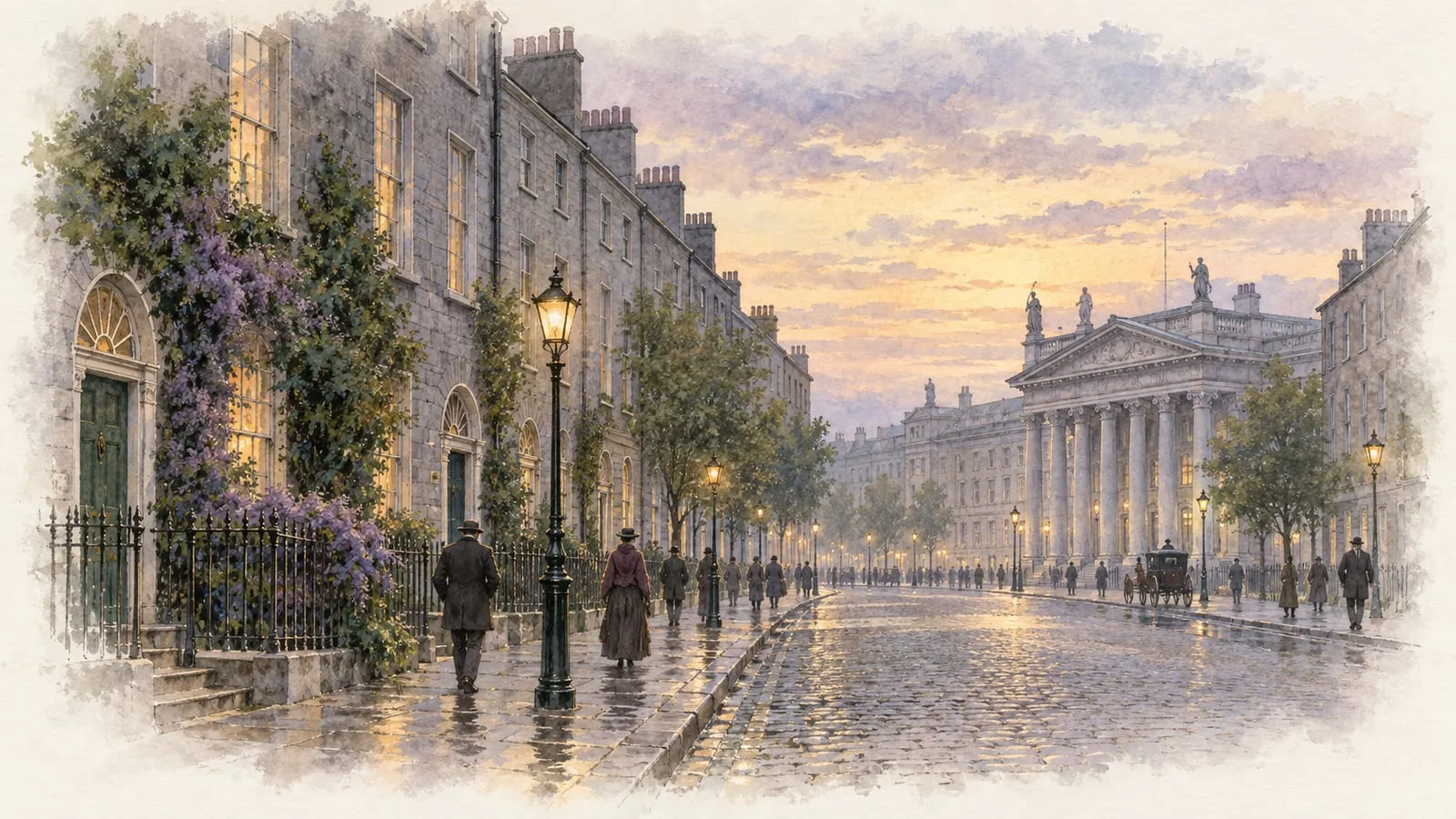
The last stanza turns to the General Post Office in Dublin, headquarters of the Easter Rising of 1916, led in part by Patrick Pearse, who had long held up the legendary hero Cuchulain as a model for Irish youth. In 1935 a bronze statue of the dying Cuchulain by Oliver Sheppard was placed in the Post Office as a memorial to the Rising, which gives Yeats's question about what "stalked" there a physical presence.
Form
Four stanzas of ottava rima, eight lines rhymed ABABABCC in a loose, heavily stressed pentameter, with some slant rhymes such as "move" and "love". Each stanza ends on a couplet that sharpens its image, and the last line returns to the "plummet-measured face" of the first stanza, closing the circle.