News for the Delphic Oracle
Earlier titled "News from the Delphic Oracle"
About the text
Yeats first published this poem in 1939. It is out of copyright in Ireland and the EU, but in the United States it stays in copyright until the start of 2035, and this site is served partly from American servers. So for now we give the notes without the full text; it will appear here in 2035.
It begins: There all the golden codgers lay
In brief
SummaryA comic, bawdy report from the paradise of the blessed dead.
The poem revisits the paradise that the Delphic oracle promised the philosopher Plotinus, and finds it rather less solemn. In the first section the immortals lie about sighing for love: Niamh beside Oisin, Pythagoras among his choir, and Plotinus himself, who arrives, stretches, yawns and joins them. In the second, the souls of the newly dead ride in on dolphins, reliving their deaths, until the dolphins toss them off in a sheltered bay where the choir of love waits with laurel crowns. The third section turns to the wedding of Peleus and the sea-nymph Thetis, as wild music falls from Pan's cave and nymphs and satyrs mate in the foam.
Lines to remember
There all the golden codgers lay,
Line by line
Lines 1 to 4The golden codgers
The blessed lie at their ease in a paradise of silver dew, and the sea and the wind sigh for love. Calling the immortals "golden codgers" sets the tone at once: the heavenly company is affectionately mocked as a gathering of idle old men.
Lines 5 to 12Niamh, Pythagoras, Plotinus
Niamh, who chose Oisin and carried him off, leans and sighs beside him; tall Pythagoras sighs among his choir. Plotinus arrives with sea salt still on his chest from his long swim, looks about, stretches and yawns, and lies down sighing like everyone else. The great philosopher's arrival is an anticlimax.
Lines 13 to 18Riding the dolphins
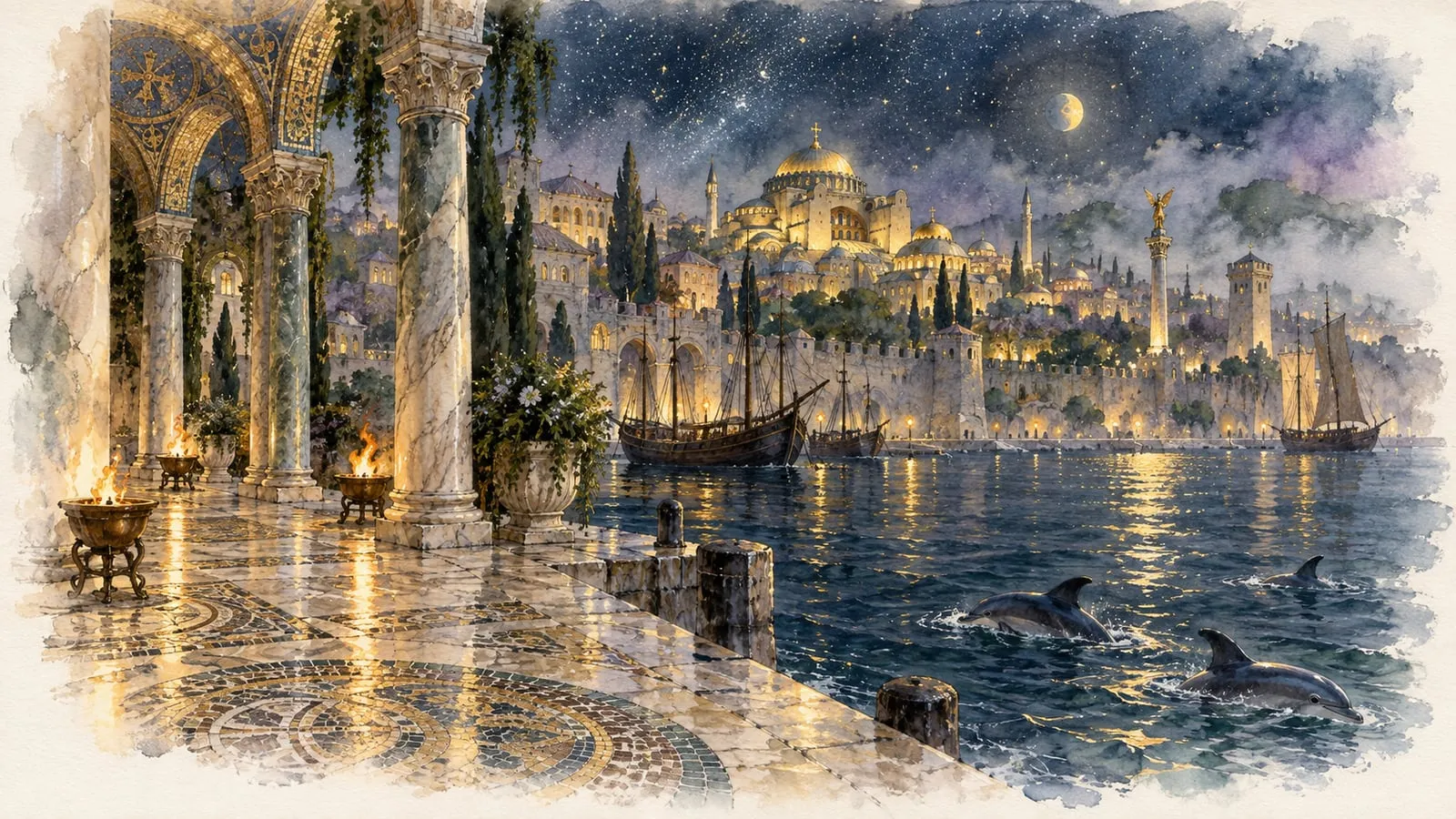
The souls of the Innocents come across the sea, each astride a dolphin and steadied by a fin. They relive their deaths and their wounds open again, yet the waters laugh with delight at their strange, sweet cries. Suffering and ecstasy are mixed together.
Lines 19 to 24Landing in the bay
The dolphins plunge on through the patterns of an ancient dance until they reach a bay under the cliffs. There the choir of love wades out offering laurel crowns, and the brute dolphins simply pitch their riders off. The homely verb keeps the vision comic.
Lines 25 to 30Peleus and Thetis
Peleus stares at the sea-nymph Thetis, whom a nymph has undressed. Her limbs are as delicate as an eyelid, and love has blinded him with tears. Yet her body is already listening, as if waiting for the child who will be conceived. Music begins to fall from Pan's cave on the mountain.
Lines 31 to 36Copulation in the foam
Pan's music is "intolerable", too intense to bear. A goat's head, a brutal arm, glimpses of body flash like fish, and nymphs and satyrs couple in the sea foam. The final picture replaces the sighing calm of the opening with raw animal energy.
Themes
Paradise mocked
In the earlier poem "The Delphic Oracle upon Plotinus" the afterlife was grave and stately. Here the same figures are "codgers" who sigh and yawn, and the dolphins dump their riders like sacks. Yeats is laughing at the idea of a heaven of pure calm, and perhaps at his own earlier solemnity.
Body and spirit
The poem moves steadily from spirit to flesh. The first section is all sighing; the second mixes wounds with ecstasy; the third ends with bodies coupling in the foam. For the old Yeats, even paradise cannot be separated from desire, and the life of the body is the source of the divine rather than its opposite.
Myth and art
Irish and Greek myth share one sea here: Niamh and Oisin lie beside Pythagoras and Plotinus, and the wedding of Peleus and Thetis ends the poem. The third section is especially pictorial, built from bodies, gestures and colours, as if the poet were describing a painted scene.
Context
The poem was first published in Last Poems and Two Plays (Cuala Press, Dublin, July 1939), months after Yeats's death; an earlier title was "News from the Delphic Oracle". It answers "The Delphic Oracle upon Plotinus" from Words for Music Perhaps, which retold the oracle's report of the philosopher's soul reaching the company of the blessed.
Niamh and Oisin are the lovers of Yeats's early long poem "The Wanderings of Oisin" (1889), so the poem gathers figures from across his career. The belief that dolphins carried the souls of the dead to the Islands of the Blessed also lies behind "Byzantium". The third section is often linked to a painting by Poussin in the National Gallery of Ireland, long known as the marriage of Peleus and Thetis.
Form
Three twelve-line sections. The first two move in ballad-like lines alternating four and three beats, rhymed on alternate lines, often loosely. The third breaks into lines of very uneven length with rougher rhymes, and its bluntly physical words speed up as the scene grows wilder, so the form itself loses its composure.