An Acre of Grass
About the text
Yeats first published this poem in 1938. It is out of copyright in Ireland and the EU, but in the United States it stays in copyright until the start of 2034, and this site is served partly from American servers. So for now we give the notes without the full text; it will appear here in 2034.
It begins: Picture and book remain
In brief
SummaryAn old man in a quiet house prays for the frenzy to keep creating.
Yeats lists what old age has left him: pictures and books, an acre of grass for air and exercise now that his strength is going, and an old house at midnight where only a mouse moves. The easy path would be to settle into that quiet. But he says that neither a drifting imagination nor the grinding work of the reasoning mind can reach the truth at life's end. So he prays for "an old man's frenzy". He wants to remake himself until he is like Shakespeare's raging old men, Timon and Lear, or like William Blake, or like Michelangelo, whose mind could pierce the clouds and wake the dead. Without that fierce, inspired energy, he says, an old man is simply forgotten.
Lines to remember
Grant me an old man's frenzy,
An old man's eagle mind.
Line by line
Lines 1 to 6What is left
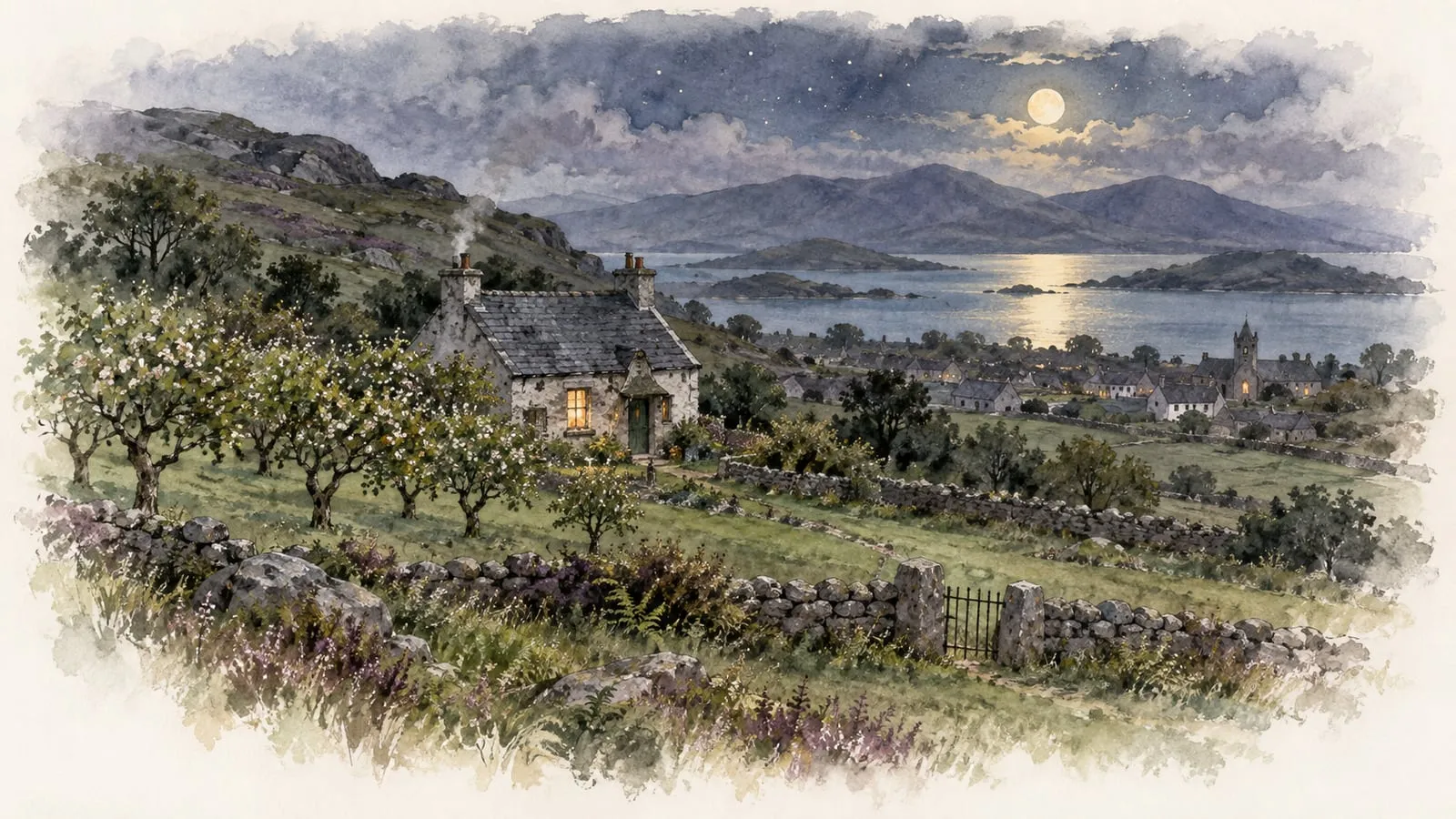
The poem opens with an inventory of a shrunken life: pictures, books and a patch of grass for gentle exercise, because his bodily strength is failing. The stanza ends at midnight in an old house where nothing moves but a mouse. The short, flat lines and plain nouns match the stillness.
Lines 7 to 12The quiet temptation
He names the danger: his temptation is to be quiet. At the end of life, he says, neither loose, wandering imagination nor the mind working like a mill, grinding over its scraps of rag and bone, can make the truth known. Ordinary thinking, whether dreamy or mechanical, is not enough.
Lines 13 to 18Timon, Lear and Blake
The turn comes as a prayer for an old man's frenzy. He must remake himself until he is Timon or Lear, Shakespeare's furious old men, or William Blake, who beat upon the wall until Truth obeyed his call. Frenzy here means visionary passion, not mere madness.
Lines 19 to 24The eagle mind
He also wants the kind of mind Michelangelo knew, one that can pierce the clouds or, driven by frenzy, shake the dead in their shrouds. Otherwise mankind forgets him. The last line lifts the poem from the mouse of stanza 1 to the eagle, a bird of height, sharp sight and power.
Themes
Old age
The first stanza accepts the physical facts: strength goes, exercise shrinks to an acre of grass, nights are silent. But Yeats refuses the calm that age is supposed to bring. The poem moves from a quiet house to a prayer for frenzy, and from a mouse to an eagle. Growing old, for him, is a reason to become more intense, not less.
Truth and vision
Stanza 2 dismisses two ways of knowing: imagination that drifts, and reason grinding like a mill. Neither can make the truth known. In this poem truth is reached by force of spirit, as when Blake beat upon the wall until Truth obeyed. Real insight is seized in passion, not calmly worked out.
Madness and inspiration
Every figure Yeats names is touched by rage or vision: Timon, who turned against mankind; Lear, driven mad by his daughters; Blake, whom many thought mad; Michelangelo, whose art seems to shake the dead. The word "frenzy" appears twice. Yeats wants the wildness that produces great art, and he treats it as a gift to be prayed for.
Context
The poem was first published in New Poems (Cuala Press, Dublin, 1938), the book that also contains "Lapis Lazuli" and "Beautiful Lofty Things". Yeats was in his early seventies and often ill. From 1932 his Irish home was Riversdale, a house with gardens in Rathfarnham on the edge of Dublin, and its old house and grounds fit the setting of the first stanza.
Many of Yeats's last poems refuse to grow old quietly. "The Spur" and "Why should not Old Men be Mad?" also defend rage, desire and madness in old age as the sources of song. The phrase "rag and bone" returns in "The Circus Animals' Desertion", where Yeats pictures the heart itself as a rag and bone shop, the place all poems start.
Form
Four six-line stanzas of short lines, mostly of three beats, rhyming ABCBDD. Some of the rhymes are half rhymes ("end" and "mind"), but each stanza closes on a firmly rhyming couplet. The clipped lines suit the bare, quiet opening, and the closing couplets give the later stanzas the ring of a vow.
Studying this poem
What to focus on
- The contrast between the quiet, shrunken life of stanzas 1 and 2 and the passionate demand for frenzy in stanzas 3 and 4.
- Yeats's attitude to old age: his refusal of calm acceptance in favour of creative and visionary energy.
- What each named figure (Timon, Lear, Blake, Michelangelo) adds to his picture of an inspired old age.
- The imagery of the mind in the poem, from the grinding mill to the eagle, and the movement from mouse to eagle.
- How the short lines and closing couplets create a tone that moves from resignation to resolve.
Key quotations
My temptation is quiet.
A plain, four-word admission. The danger for the old poet is not pain but peace: the pull towards a comfortable, silent retirement that would end his art.
the mill of the mind
Reason pictured as a machine grinding over scraps. Like Blake, Yeats distrusts mechanical thinking, which on its own cannot make the truth known.
Grant me an old man's frenzy,
The turning point, phrased as a prayer. Frenzy here means inspired, visionary intensity, and Yeats asks for it as a gift rather than claiming he already has it.
Myself must I remake
The inverted word order puts "Myself" first. Old age becomes a time for deliberate self-transformation, one of the central ideas of Yeats's whole career.
An old man's eagle mind.
The eagle, soaring and sharp-eyed, answers the mouse of the first stanza. The final image sums up the poem's movement from weakness to power.