The Valley of the Black Pig
Listen
Text: Poetry, by W. B. Yeats (Standard Ebooks, 2024), from the collected editions of 1908 to 1928. Public domain.
In brief
SummaryA vision of a final battle, and a prayer from those weary of empire.
The speaker, drowsing as the dews fall, sees a sudden vision: unknown spears flying, horsemen falling, the cries of dying armies. Then the poem turns to "We", the people who still work by the ancient cromlech and cairn as the day ends. Weary of "the world's empires", they bow down to a divine "Master of the still stars and of the flaming door". In eight lines the poem moves from a dream of war to an act of worship.
Lines to remember
Being weary of the world's empires, bow down to you,
Master of the still stars and of the flaming door.
Line by line
Lines 1 to 4The vision
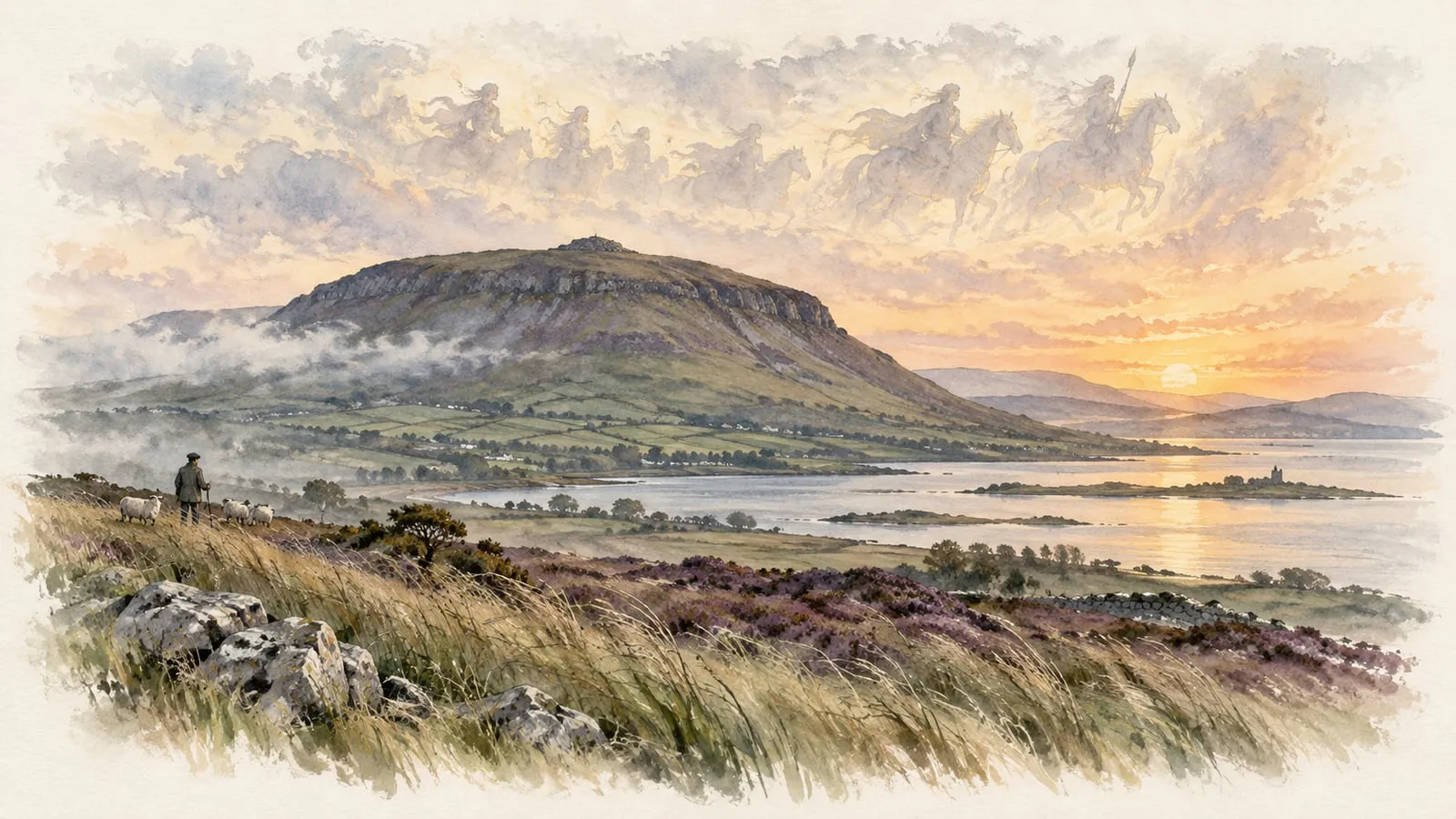
As "dews drop slowly and dreams gather", the speaker's "dream-awakened eyes" see spears hurtle and hear the clash of horsemen and the cries of "unknown perishing armies". The repeated "unknown" makes the battle vast and nameless, heard more than seen.
Lines 5 to 8The prayer
The voice becomes "We", those who "still labour by the cromlec on the shore" and the "grey cairn on the hill" as day "sinks drowned in dew". Weary of empires, they bow to the "Master of the still stars and of the flaming door", a god of stillness and of fire.
Themes
Prophecy and war
The armies are a glimpse of a battle to come, not a memory. The spears arrive "Suddenly", the armies are "unknown", and their cries "beat about my ears". Irish country prophecy foretold a great battle in the Valley of the Black Pig, and the poem gives that prophecy the feel of a waking dream.
Weariness with empire
The people of the second half are "weary of the world's empires". They live by ancient stones, not in cities, and their worship looks beyond politics to "the still stars". The poem sets an older, rural and sacred world against the power of empires, which in the 1890s included British rule in Ireland.
A sacred landscape
The cromlech and the cairn are prehistoric monuments, older than any empire. Those who "still labour" beside them keep a link with an ancient faith. The "Master" they bow to rules both "the still stars" and "the flaming door", calm and fire together, a power far beyond the battle.
Context
The poem was collected in The Wind Among the Reeds (Elkin Mathews, London, 1899). It draws on a prophecy from Irish folk belief that a last great battle would one day be fought in the Valley of the Black Pig.
Its sense of coming catastrophe links it with other poems in the book, especially "He mourns for the Change that has come upon Him and his Beloved, and longs for the End of the World", in which the Boar without bristles roots the stars out of the sky. In these years Yeats often imagined the end of an age in images drawn from Irish legend.
Form
Eight long lines, mostly of six beats, rhymed abba cddc ("spears", "eyes", "cries", "ears"; "shore", "dew", "you", "door"). The first four lines are one sentence of vision and the last four one sentence of prayer, so the poem splits cleanly in two, each half sealed by its enclosing rhyme.