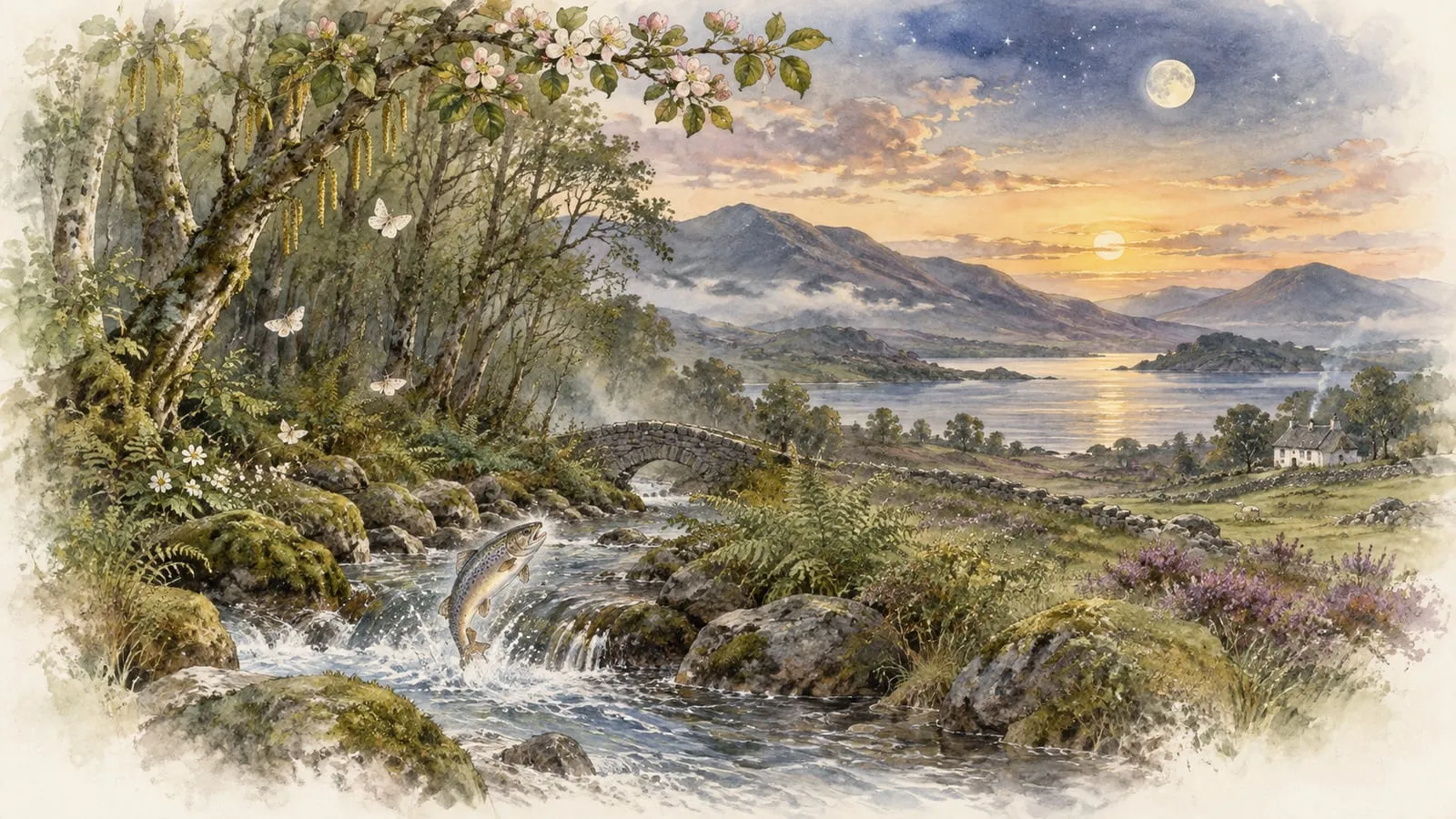
He mourns for the Change that has come upon Him and his Beloved, and longs for the End of the World
Earlier titled "Mongan laments the Change that has come upon him and his Beloved"
Listen
Text: Poetry, by W. B. Yeats (Standard Ebooks, 2024), from the collected editions of 1908 to 1928. Public domain.
In brief
SummaryA lover turned into a hound longs for the world to end.
The speaker has been changed by magic into a hound with one red ear, forever chasing a hornless white deer that he calls to but cannot reach. Someone has hidden "hatred and hope and desire and fear" under his feet, driving him on night and day. A man with a hazel wand transformed him while he was looking the other way, and now his calling is only a hound's bark, while "Time and Birth and Change" rush past. His one wish is for the Boar without bristles to come from the West, root the sun, moon and stars out of the sky and lie down grunting in the dark: the end of everything.
Lines to remember
Do you not hear me calling, white deer with no horns!
And Time and Birth and Change are hurrying by.
Line by line
Lines 1 to 5The hound and the deer
He calls to the "white deer with no horns", the beloved, and tells her he is now a hound "with one red ear". He has passed through "the Path of Stones and the Wood of Thorns", driven by feelings someone hid "Under my feet". The list "hatred and hope and desire and fear" sounds like a curse.
Lines 6 to 9The hazel wand
The change came "without sound" and "suddenly", while he "was looking another way", as enchantments do in the old tales. Now "my calling is but the calling of a hound": his love cries are animal noise. Around him "Time and Birth and Change are hurrying by", the capitals turning them into powers.
Lines 10 to 12The Boar from the West
He longs for "the Boar without bristles" to come from the West and root the sun, moon and stars out of the sky, as a pig roots up earth. The final picture, the Boar lying "in the darkness, grunting", is the end of the world, which he wants because it would end the chase.
Themes
Endless pursuit
The hound and the hornless deer are a picture of love that never arrives. He calls, she does not hear, and the passions hidden under his feet make him "follow you night and day". Being a hound makes the chase compulsive: his calling "is but the calling of a hound". Desire has become an enchantment he cannot break.
Change
The title speaks of "the change that has come upon him and his beloved", and the poem is full of transformation: man into hound, beloved into deer, done "suddenly" with a hazel wand. Beyond the lovers, "Time and Birth and Change are hurrying by". Change is the enemy, and only an end to all things would stop it.
The end of the world
The last three lines imagine the end of the world in a strange, earthy image: a Boar without bristles rooting out the stars, then lying down "grunting" in the darkness. The lover prefers this total dark to his endless chase. Private grief is blown up to the size of the heavens.
Context
The poem was collected in The Wind Among the Reeds (Elkin Mathews, London, 1899) as "Mongan laments the Change that has come upon him and his Beloved". Mongan is a king of early Irish legend who was said to remember former lives and to be able to change his shape. From 1906 the name was dropped and the speaker became simply "He".
The images come from Irish and Celtic story, where hounds with red ears belong to the Otherworld and the hazel is a tree of magic and wisdom. The Boar that uproots the heavens connects with the old prophecy of a final battle that Yeats used in "The Valley of the Black Pig", printed in the same book.
Form
Twelve long, loose lines of five or six beats in a single block, rhymed abab throughout ("horns", "ear", "Thorns", "fear"). Chains of "and" and semicolons drive the verse forward like the hound itself, until the last line, with its "grunting, and turning to his rest", finally slows to a stop.
Title only: 1899 persona title "Mongan laments the Change that has come upon him and his Beloved" (Gutenberg 32233) replaced from 1906 (Gutenberg 49608). Check wording against the 1899 text before choosing a version.