Lullaby
About the text
Yeats first published this poem in 1932. It is out of copyright in Ireland and the EU, but in the United States it stays in copyright until the start of 2028, and this site is served partly from American servers. So for now we give the notes without the full text; it will appear here in 2028.
It begins: Beloved, may your sleep be sound
In brief
SummaryA lover sings over a sleeping beloved, recalling Helen, Tristram and Leda.
A lover wishes the beloved a sound sleep after love. Each stanza compares that sleep with one from legend. The first is the sleep of Paris on his first dawn in Helen's arms, when the world's alarms meant nothing to him. The second is the sleep of Tristram once the love potion had done its work, while deer ran and leapt in the woods. The third is the sleep that fell by the river Eurotas when the divine swan, having done what it was fated to do, withdrew from Leda but not from her care. The lullaby is tender, but every story it names ends in catastrophe.
Lines to remember
Beloved, may your sleep be sound
Line by line
Lines 1 to 6Paris and Helen
The lover blesses the beloved's sleep, found where they took their pleasure. What did the world's alarms matter to Paris when he first slept beside Helen on a golden bed? The question is gentle, but readers know that this bed led to the Trojan War.
Lines 7 to 12Tristram's sleep
The second wish is for the sleep of "wild Tristram" after the love potion had worked. Outside, deer run and leap under oak and beech. Lines 11 and 12 swap their words back and forth, a rocking movement like a cradle.
Lines 13 to 18Leda by the river
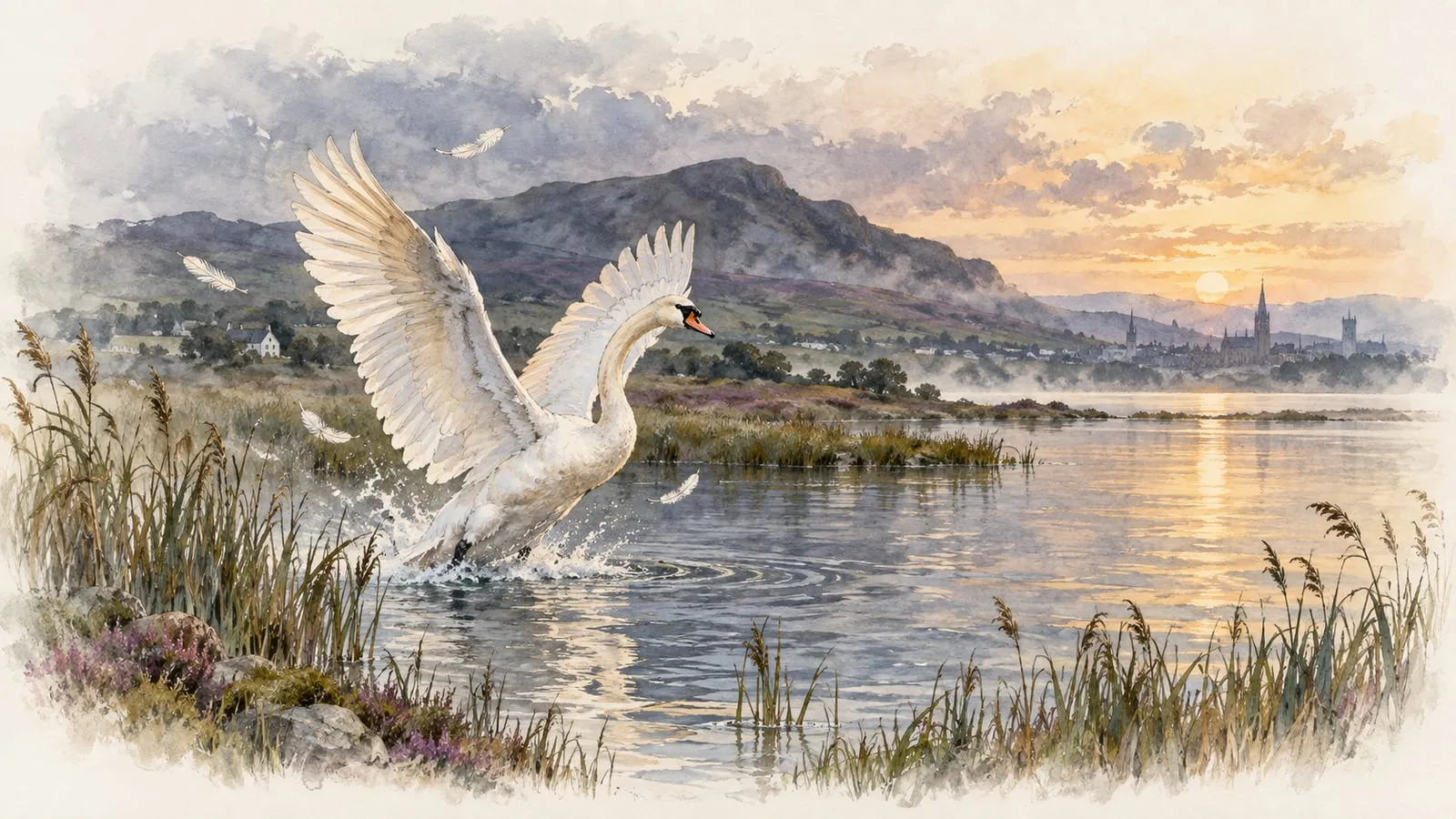
The last comparison is the sleep beside the Eurotas when the holy bird, having fulfilled its fated purpose, sank from Leda's limbs. Yet the swan does not leave her protecting care. The divine lover is imagined as still watching over her.
Themes
Love and rest
The poem celebrates the peace that follows physical love. Sleep here is a reward and a shelter: the world's alarms cannot reach the sleeper. Each stanza offers a new image of that deep rest, from a golden bed to a woodland to a grassy riverbank, and the tone is protective throughout, as a lullaby should be.
Myth and fate
The three couples are famous for what their love set in motion. Helen and Paris brought war to Troy; Tristram's love for Iseult ended in grief; Leda's union with Zeus as a swan led to the birth of Helen herself. So the poem quietly circles back to where it began. The phrase "predestined will" hints that great loves serve purposes the lovers cannot see.
Context
The poem belongs to "Words for Music Perhaps", a sequence of short songs first collected in Words for Music Perhaps and Other Poems (Cuala Press, 1932) and then in The Winding Stair and Other Poems (Macmillan, 1933). Its last stanza returns to the myth Yeats had treated with violence in "Leda and the Swan" (The Tower, 1928), here softened into tenderness. Helen had long been one of his central figures, often linked in his poems with Maud Gonne.
Form
Three six-line stanzas of short four-beat lines, rhyming ABCABC, so each rhyme waits two lines for its partner ("sound" and "found", "fed" and "bed"). The delayed chimes and the soft, even rhythm have a lulling effect. The swapped words of lines 11 and 12 add a rocking repetition that suits a cradle song.