Leda and the Swan
Listen
Text: Poetry, by W. B. Yeats (Standard Ebooks, 2024), from the collected editions of 1908 to 1928. Public domain.
In brief
SummaryZeus, as a swan, rapes Leda, and a whole age of war begins.
The poem retells the Greek myth in which Zeus, king of the gods, takes the form of a swan and rapes the mortal woman Leda. It begins mid-attack, with "A sudden blow", and stays close to her body and her terror. The second stanza asks how she could resist. Then the poem leaps forward in time: from this act will come Helen, the Trojan War, the burning of Troy and the murder of Agamemnon. It ends by asking, without answering, whether Leda in that moment shared the god's knowledge as well as suffering his power.
Lines to remember
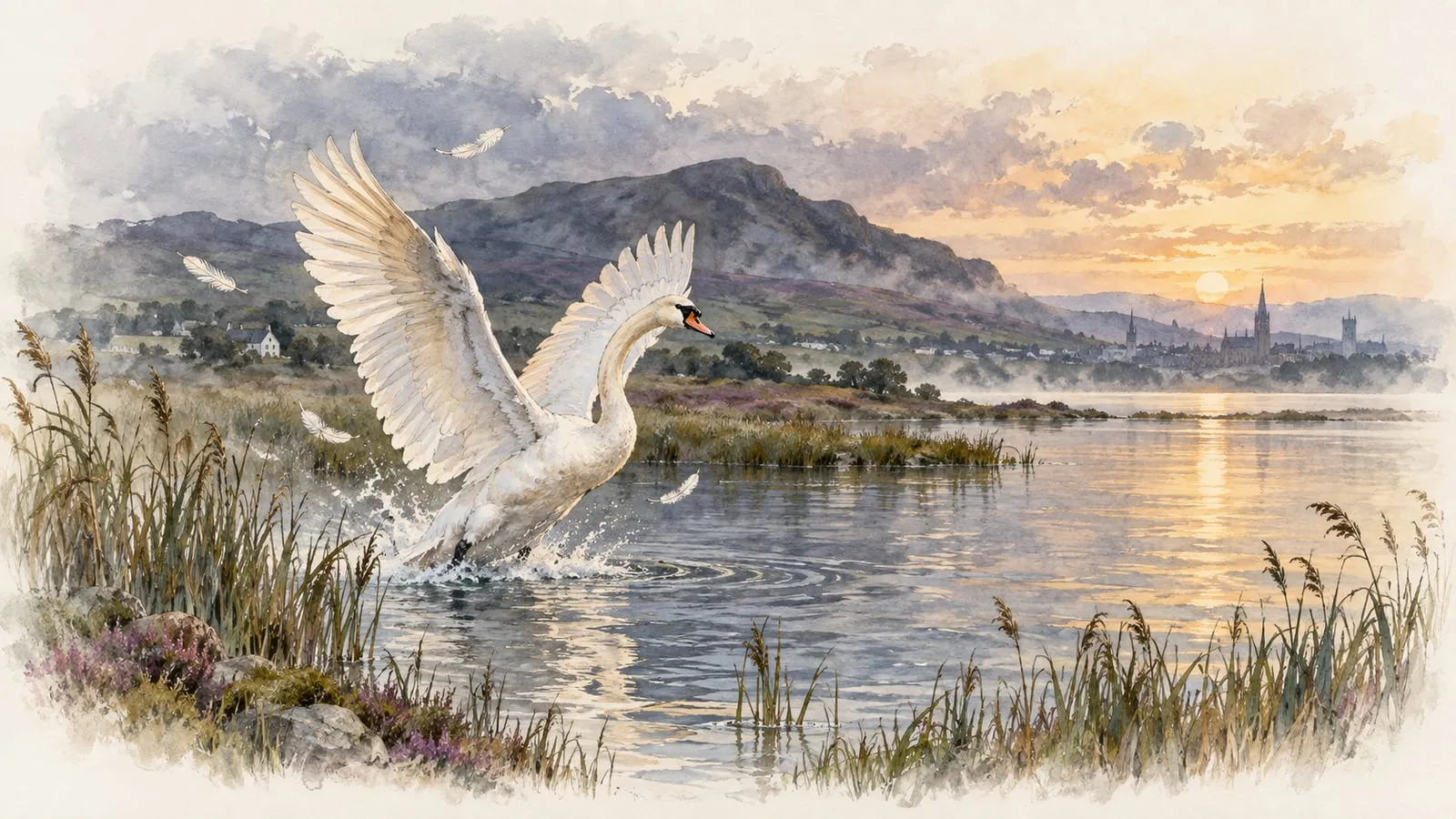
A sudden blow: the great wings beating still
The broken wall, the burning roof and tower
Did she put on his knowledge with his power
Line by line
Lines 1 to 4The attack
The poem opens without warning: "A sudden blow". Beating wings, a "staggering girl", "dark webs" on her thighs and her nape "caught in his bill" come in quick, broken phrases. The swan is never named as a god here; he is felt as force, and she is "helpless".
Lines 5 to 8Two questions
The octave closes with two questions about Leda's body. Her "terrified vague fingers" cannot push away "The feathered glory", and laid in "that white rush" she can only feel "the strange heart" of the god beating against her. "Glory" is unsettling: the language of the divine sits beside the violence.
Lines 9 to 11The future engendered
In one "shudder in the loins" the future is conceived: "The broken wall, the burning roof and tower" of Troy, and "Agamemnon dead". Centuries of war are packed into a line and a half, and line 11 stops short, as if the violence has broken the verse itself.
Lines 12 to 14The final question
The last lines return to Leda, "So mastered by the brute blood of the air". The poem asks whether she took on the god's "knowledge with his power" before "the indifferent beak" let her fall. "Indifferent" is the cruellest word: once the act is done, the god does not care.
Themes
Violence and power
The poem does not soften what happens. "Blow", "helpless", "terrified", "mastered" and "brute" keep the act one of force, and the swan's "indifferent beak" shows how little Leda matters to the power that uses her. Many readers find the poem troubling because it also calls the swan "feathered glory"; the poem holds awe and horror together without resolving them.
History and fate
Lines 9 to 11 turn a single moment into the start of history. Helen, born of this union, will cause the Trojan War; "The broken wall, the burning roof and tower" is Troy's fall, and "Agamemnon dead" points to his murder when he comes home. The poem imagines great ages beginning not in politics but in a violent meeting of god and human.
Knowledge
The closing question, "Did she put on his knowledge with his power", asks whether contact with the divine brings understanding, even foresight of what the act will cause. The poem gives no answer. The question shifts attention from the god back to the woman, and leaves the reader uneasy about what she knew and what it cost.
Context
The poem was first printed in 1924, in The Dial in June and in the Dublin magazine To-morrow, and Yeats revised it several times before it was collected in The Tower (Macmillan, 1928), alongside "Sailing to Byzantium" and "Among School Children". The text here is the Tower version.
In the myth, Leda's children included Helen, fathered by Zeus, whose abduction to Troy began the Trojan War, and Clytemnestra, who killed her husband Agamemnon on his return. Yeats was then building his system of history, published as A Vision (1925), in which each age of about two thousand years begins with a divine visitation to a woman. He saw Leda's story as the start of the Greek age, as the Annunciation to Mary began the Christian one.
Form
A sonnet in iambic pentameter: an octave rhymed abab cdcd, then a sestet in which "there" rhymes with "air" and "tower" with "power", while "dead" and "drop" barely echo. Line 11 is cut short at "And Agamemnon dead", a break in the form that mirrors the destruction it describes.
First printed 1924 (The Dial / To-morrow) with a different opening, reportedly 'A rush, a sudden wheel, and hovering still'; not verified here. The 1928 text (Gutenberg 72985) opens 'A sudden blow: the great wings beating still'.