Mad as the Mist and Snow
About the text
Yeats first published this poem in 1932. It is out of copyright in Ireland and the EU, but in the United States it stays in copyright until the start of 2028, and this site is served partly from American servers. So for now we give the notes without the full text; it will appear here in 2028.
It begins: Bolt and bar the shutter
In brief
SummaryTwo old friends by the fire find the great classics were mad too.
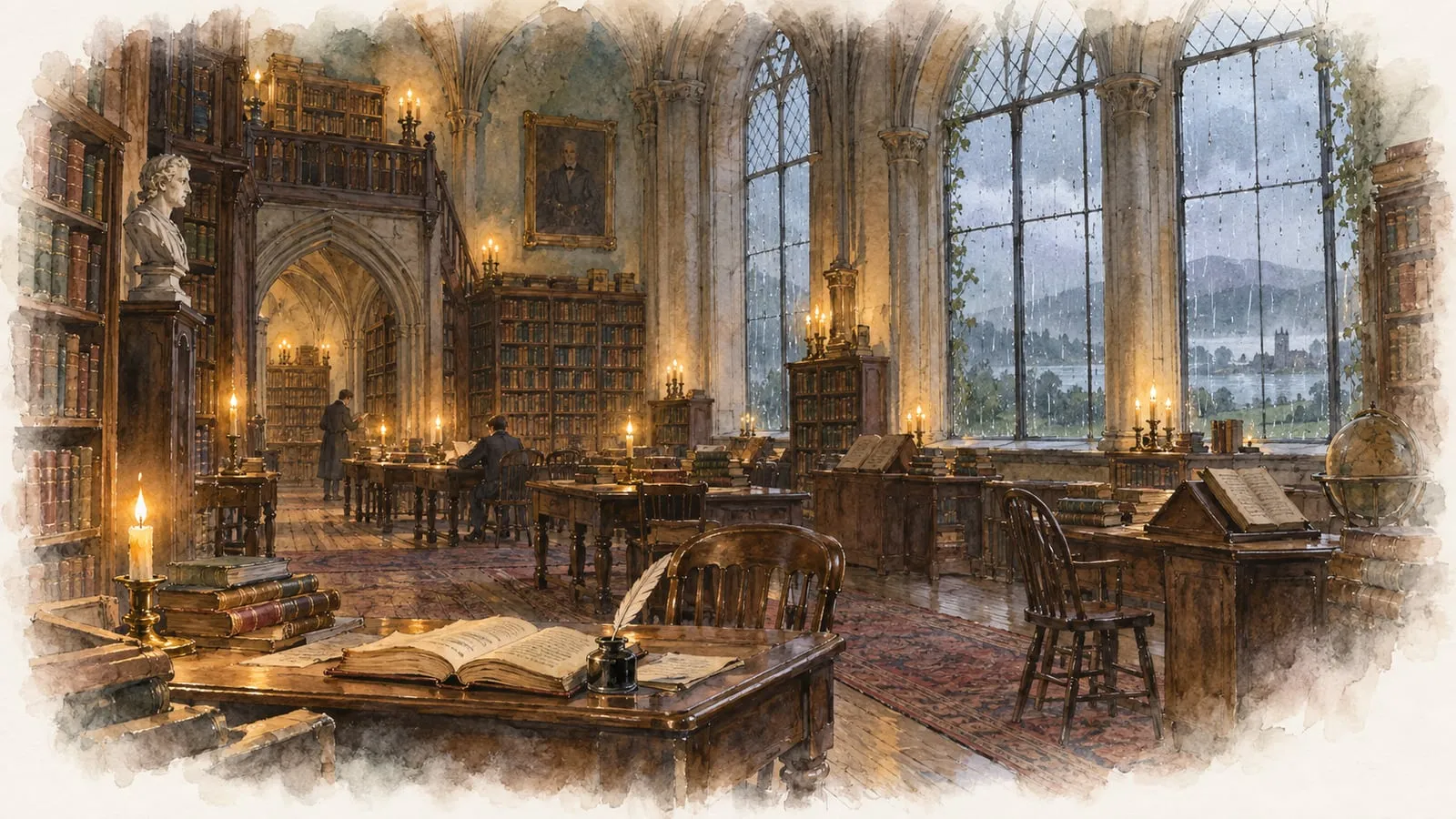
On a stormy night the speaker bolts the shutters and sits with an old friend among books. Their minds feel at their best, and everything outside seems as wild as the weather. On the shelves stand Horace, Homer and Plato, and an open volume of Cicero. The speaker remembers when the two of them were unschooled boys, as wild as the mist and snow themselves. Then his friend asks why he sighs and shudders. His answer turns the refrain on its head: even Cicero and Homer were mad as the mist and snow.
Lines to remember
Mad as the mist and snow.
Line by line
Lines 1 to 6Shutters against the storm
The speaker tells his friend to bar the shutters against the foul winds. Indoors, their minds seem clear and at their best, and the whole world outside looks as mad as the weather. Reason and shelter sit on one side, chaos on the other.
Lines 7 to 12Among the classics
Horace stands by Homer on the shelf, Plato below, and Cicero lies open. The speaker thinks back to when he and his friend were unlettered boys, and asks how many years ago that was. The refrain now applies to their own wild youth.
Lines 13 to 18Even Homer
The friend asks why he sighs and shudders. The answer is that even Cicero and "many-minded Homer" were mad too. The great authors who seemed to stand for order turn out to share the same wildness, and the safe room is not so safe.
Themes
Reason and madness
The poem begins by drawing a firm line: sane minds inside, madness outside. Each stanza moves that line. First the lads they once were are mad; then the great classical writers are too. By the end, madness seems part of every mind, even the greatest. The shudder is at the loss of a comforting belief that learning keeps chaos out.
Friendship and age
Two old friends share a room, a fire and a library, and look back across many years. The warmth of the scene is real, but so is the chill: youth has gone, and wisdom is less solid than they hoped. The quiet question "old friend" frames the whole poem as a late-night talk between equals.
Context
The poem belongs to "Words for Music Perhaps", a sequence of short songs first collected in Words for Music Perhaps and Other Poems (Cuala Press, 1932) and then in The Winding Stair and Other Poems (Macmillan, 1933). Tully was the usual old English name for Marcus Tullius Cicero, so the Roman appears twice under two names. The scene of two ageing people talking late at night, shut in against the world, recalls "After Long Silence" in the same sequence.
Form
Three six-line stanzas of short lines, alternating roughly four and three beats. Every even line rhymes on the same sound ("blow", "know", "ago", "Cicero", "snow"), nine rhymes in all, and each stanza ends with the title as refrain. The refrain stays the same while its meaning shifts, which is the poem's whole argument.