'I am of Ireland'
About the text
Yeats first published this poem in 1932. It is out of copyright in Ireland and the EU, but in the United States it stays in copyright until the start of 2028, and this site is served partly from American servers. So for now we give the notes without the full text; it will appear here in 2028.
It begins: 'I am of Ireland
In brief
SummaryA woman calls a stranger to dance in Ireland; he refuses.
A woman cries out that she is of Ireland, the holy land of Ireland, and that time runs on: for charity's sake, come and dance with her in Ireland. One man alone, in outlandish dress among a rambling crowd, turns his stately head. It is a long way off, he says, time runs on and the night grows rough. She calls again. He mocks: the fiddlers are all thumbs, the fiddle-string cursed, the drums and trumpets burst. With a malicious eye he repeats that time runs on. Her call comes a third time, unanswered.
Lines to remember
'I am of Ireland,
Line by line
Lines 1 to 5Her call
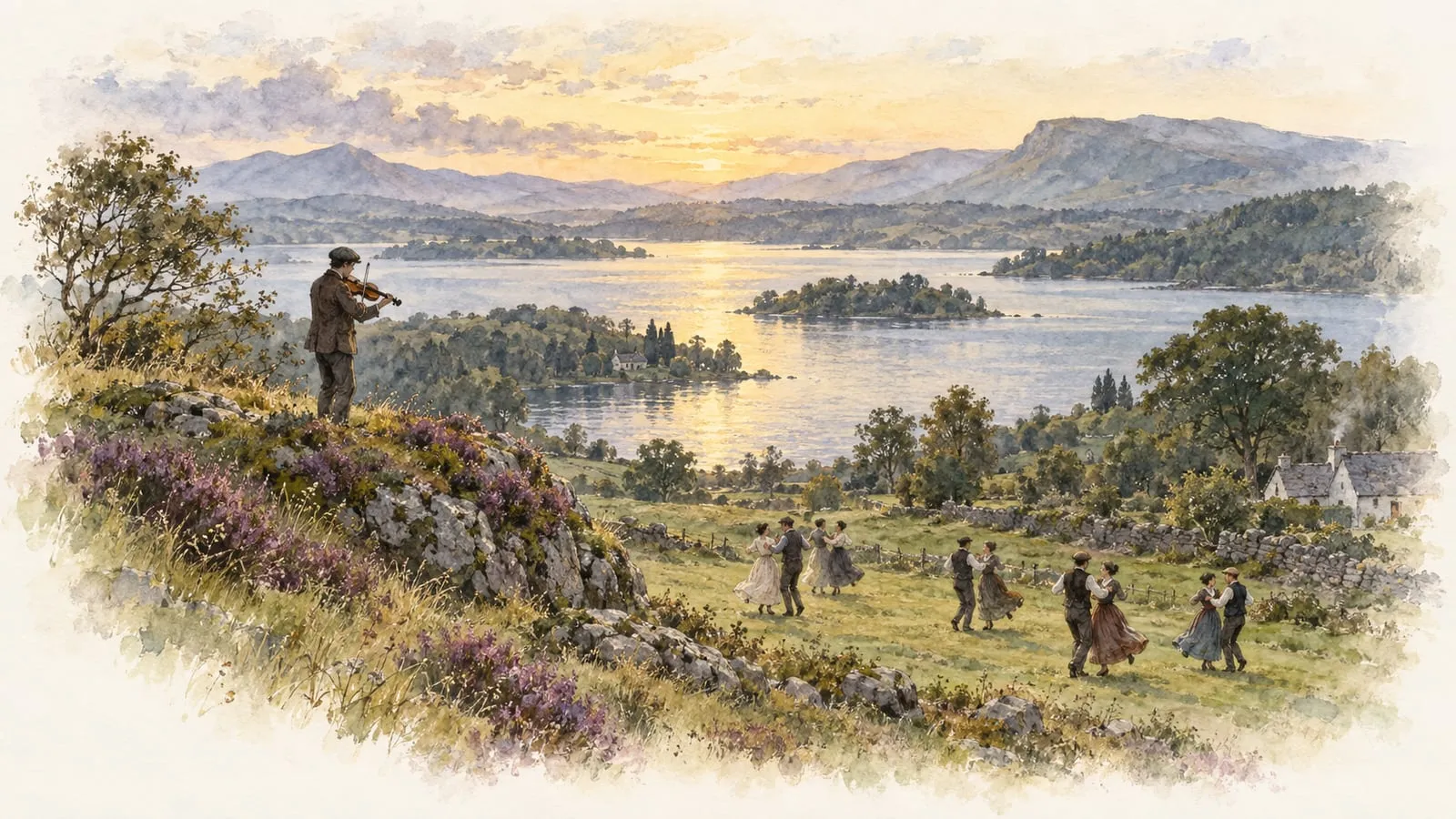
The woman declares that she is of Ireland and its holy land, and that time is running on. She asks, out of charity, for someone to come and dance with her in Ireland.
Lines 6 to 13The solitary man
Of all the crowd wandering there, one solitary man in strange clothes turns his stately head. He answers that Ireland is a long way off, time runs on and the night is getting rough.
Lines 14 to 18The call again
She repeats her call almost word for word. The refrain grows more insistent against his reluctance.
Lines 19 to 26Burst trumpets
He lists reasons not to go: the fiddlers are clumsy, the string is cursed, the drums, kettledrums, trumpets and trombone are all burst. With a malicious glance he turns her phrase back on her: time runs on.
Lines 27 to 31The last call
She calls once more, and the poem ends on her invitation, neither accepted nor withdrawn.
Themes
Ireland's call
The woman speaks for Ireland, a "Holy Land" whose call comes from the past and demands devotion. The man's refusal, with its mocking list of broken instruments, suggests a modern Ireland whose music has gone sour. The poem leaves both voices standing.
Time
"Time runs on" is said by both speakers. For her it is a reason to come now; for him it is a reason to stay put, and he ends by repeating it with malice. The same phrase carries urgency and weariness together.
The solitary
Only one man of the crowd hears her, and he is proud and strange, in "outlandish gear". He may be an image of the poet himself, drawn to the call but sceptical of the state of the dance.
Context
The poem belongs to the sequence Words for Music Perhaps, first collected by the Cuala Press in 1932 and then in The Winding Stair and Other Poems (Macmillan, 1933). Its refrain builds on a short medieval lyric, "Ich am of Irlaunde", in which a voice asks a listener, for holy charity, to come and dance in Ireland.
Yeats expands the old fragment into a dialogue, setting its ancient invitation against a voice of modern disenchantment.
Form
Thirty-one lines: a five-line refrain spoken by the woman three times, alternating with two eight-line stanzas for the man. Lines are short, of two to four beats, and rhyme loosely. The returning refrain, barely changed, makes the poem a sung call and response.