No Second Troy
Listen
Text: Poetry, by W. B. Yeats (Standard Ebooks, 2024), from the collected editions of 1908 to 1928. Public domain.
In brief
SummaryYeats refuses to blame the woman he loves for being who she is.
The poem is a string of questions about a woman who has filled the speaker's days "With misery" and lately stirred up "ignorant men" to violence. Why should he blame her, he asks. Her mind is "simple as a fire", her beauty "like a tightened bow", and she belongs to a heroic age, not to "an age like this". The final question compares her to Helen of Troy: there is no Troy left for her to burn. Blame gives way to a kind of awed acceptance.
Lines to remember
With beauty like a tightened bow, a kind
Why, what could she have done being what she is?
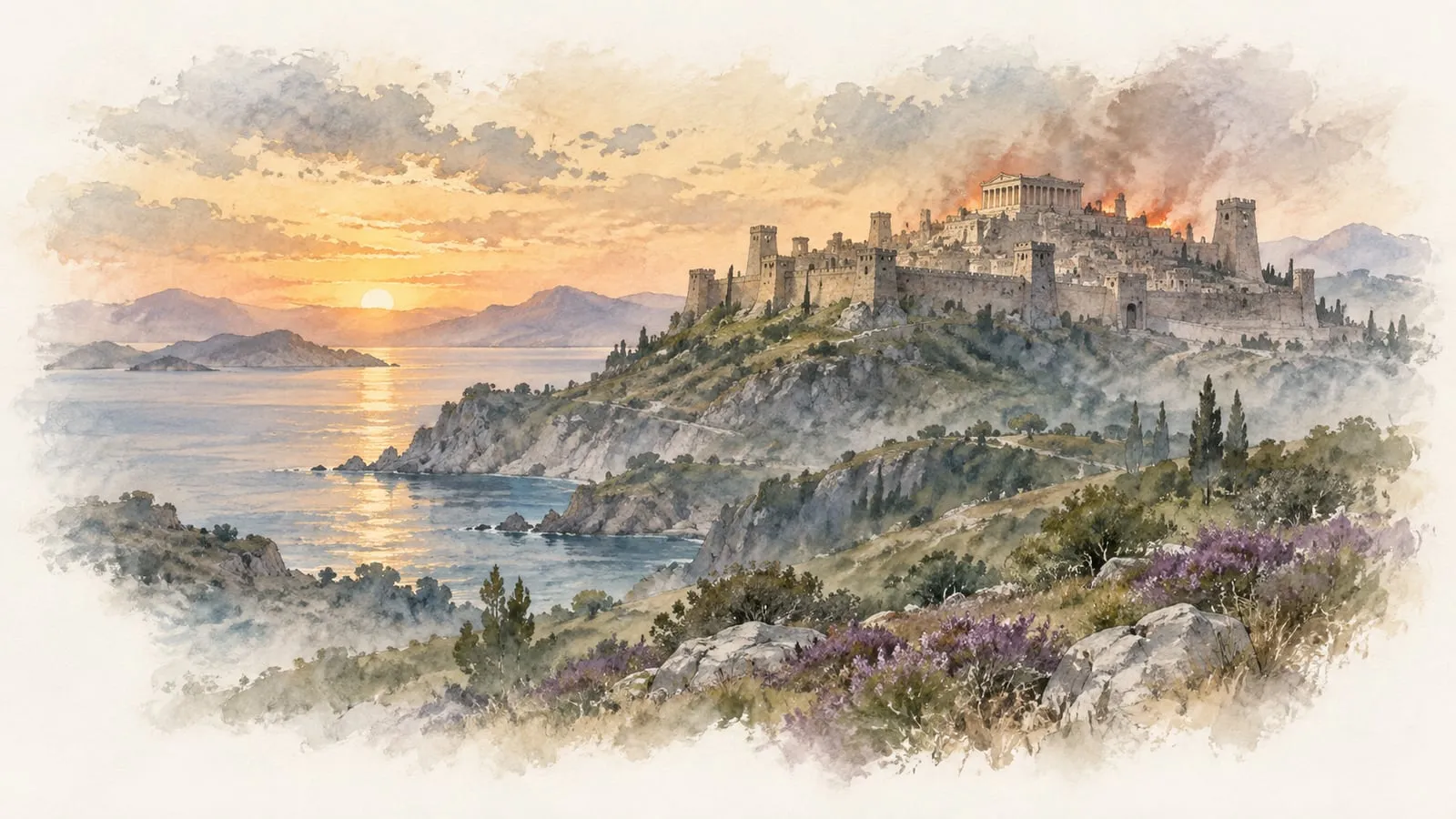
Was there another Troy for her to burn?
Line by line
Lines 1 to 5Why blame her
One long question opens the poem. Why blame her for his misery, or for teaching "ignorant men most violent ways" and hurling "the little streets upon the great", the poor against the powerful, if only they had had "courage equal to desire". His complaint turns into a defence even as he makes it.
Lines 6 to 10Fire and a bow
Nothing could have made her peaceful, with a mind "That nobleness made simple as a fire" and a beauty "like a tightened bow", ready to fire. Such beauty is "not natural in an age like this": she is "high and solitary and most stern", a figure from an older, heroic world.
Lines 11 to 12No second Troy
The first of the closing questions, "Why, what could she have done being what she is?", accepts her nature. The last line makes her Helen, whose beauty caused the burning of Troy, and suggests the modern world has no city grand enough for her to destroy.
Themes
Love and pain
The poem begins with personal hurt: she "filled my days / With misery". Yet the speaker keeps refusing to blame her. The questions let him admit his pain while forgiving it, and the forgiveness is its own form of devotion. He loves her for exactly the qualities that make her impossible to live with.
Heroic beauty
Her beauty is not soft but dangerous and noble, "like a tightened bow", "high and solitary and most stern". The comparison with Helen makes her a figure out of epic, too large for "an age like this". The poem is as much a lament for a small modern world as a portrait of a woman.
Politics and violence
Lines 2 to 5 point to her political campaigning: teaching "ignorant men most violent ways" and setting "the little streets upon the great". Yeats clearly distrusts this, but he also suggests that the people she stirs lack "courage equal to desire". Her fire is real; the times cannot match it.
Context
The poem was published in The Green Helmet and Other Poems (Cuala Press, 1910), a book in which Yeats's style grows leaner and more direct. It is one of his best-known poems about Maud Gonne, the nationalist campaigner he loved for most of his life, who refused his proposals from 1891 onwards and married John MacBride in 1903.
Yeats often compared Maud Gonne to Helen of Troy, whose beauty launched a war. Here the comparison explains both her power and her restlessness in an age that, as he sees it, has no place for heroic greatness. The same book's "A Woman Homer Sung" makes a similar comparison.
Form
Twelve lines of iambic pentameter rhymed like three quatrains, abab cdcd efef ("days" and "ways", "fire" and "desire", "this" and "is"). The whole poem is made of four questions, so it reads as a charged argument with no answer. It is a sonnet cut short, missing its closing couplet.