When You are Old
Listen
Text: Poetry, by W. B. Yeats (Standard Ebooks, 2024), from the collected editions of 1908 to 1928. Public domain.
In brief
SummaryA young lover asks a woman to picture her old age and remember him.
The speaker addresses a woman who does not return his love. He asks her to imagine herself old, dozing by the fire, taking down "this book" of his poems and remembering how she once looked. Many men loved her beauty, he says, but only one loved "the pilgrim soul" in her and the sorrows in her face. The last stanza has her murmur that love has gone, and love becomes a figure who retreats to the mountains and hides among the stars. It is a quiet, tender poem with a sting: she will understand too late.
Lines to remember
When you are old and grey and full of sleep,
But one man loved the pilgrim soul in you,
And hid his face amid a crowd of stars.
Line by line
Lines 1 to 4By the fire
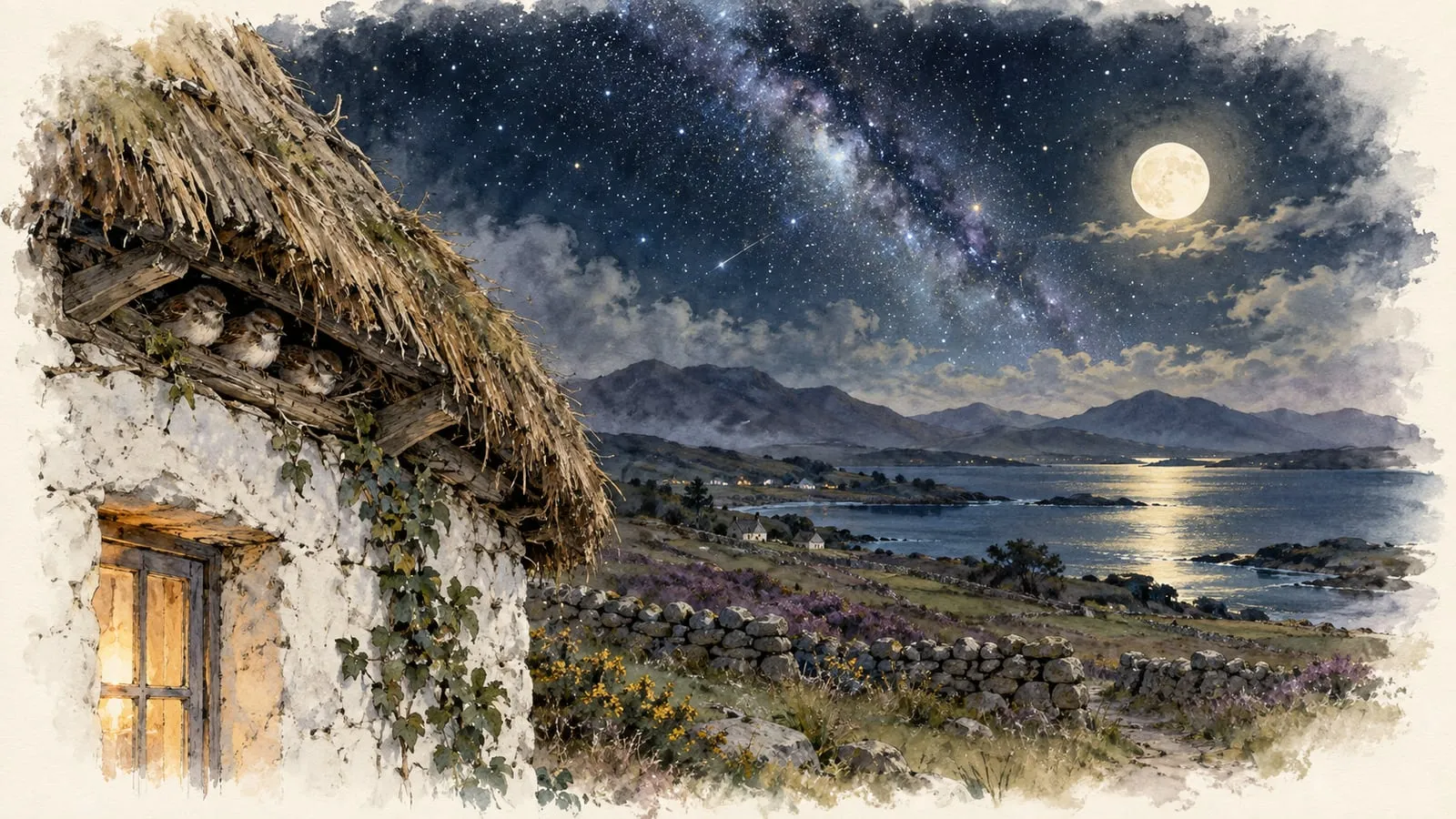
The poem opens with a command to the future. She will be "old and grey and full of sleep", nodding by the fire, and he tells her to take down "this book" and read slowly. The book is the one we are holding, so the poem becomes the thing that will stir her memory of "the soft look" her eyes once had.
Lines 5 to 8One true lover
Here he sets himself apart from her other admirers. They loved her "moments of glad grace" and her beauty, "with love false or true", but "one man" loved her restless, searching spirit and even the sorrows that marked her face as it changed. The repeated "loved" drums through all four lines.
Lines 9 to 12Love flees
Bending by the "glowing bars" of the grate, she murmurs "a little sadly" that love has fled. The ending turns love into a person who paces the mountains and hides "his face amid a crowd of stars": gone beyond reach, yet still somewhere above her, vast and lonely.
Themes
Love and loss
The poem is a love poem written from the side of rejection. The speaker does not plead; he asks her to look back from old age and see what she missed. The contrast between the many who loved "your beauty" and the "one man" who "loved the pilgrim soul in you" is the whole argument: his love was for the person, not the face.
Ageing and time
Youth and age meet in a single picture. The woman is imagined "old and grey", sleepy by the fire, while the poem remembers the "soft look" and "shadows deep" of her young eyes. Time is what gives the poem its force: the regret it predicts can only come years later, when the book is taken down again.
Poetry as memory
"Take down this book" makes the poem itself part of the story. The speaker trusts that his verse will outlast her beauty and his own presence, and that reading it will bring back what she once was. The poem works as a letter sent into the future, sealed until she is old enough to read it properly.
Context
The poem first appeared in The Countess Kathleen and Various Legends and Lyrics in 1892, among the lyrics Yeats later grouped as "The Rose". It is a free reworking of a sonnet by the French Renaissance poet Pierre de Ronsard, "Quand vous serez bien vieille", in which the poet tells his mistress she will one day sit by the fire singing his verses and regret scorning him.
It is read as a poem to Maud Gonne, whom Yeats met in January 1889 and loved for most of his life. She refused his proposals from 1891 onwards. Yeats revised the ending once: in 1892 the woman murmurs "From us fled Love" in direct speech, and from 1895 the lines take the quieter reported form printed here.
Form
Three quatrains of iambic pentameter, each rhymed abba ("sleep", "book", "look", "deep"). The enclosing rhyme folds each stanza in on itself, which suits the drowsy, inward mood. Long strings of clauses joined by "And" keep the voice slow and murmuring, like someone reading by the fire.
Revised once. The 1892 text (checked against the 1893 Boston reprint scan) ends: 'Murmur, a little sad, "From us fled Love. / He paced upon the mountains far above, / And hid his face amid a crowd of stars."' From Poems (1895) onward: 'Murmur, a little sadly, how Love fled / And paced upon the mountains overhead / And hid his face amid a crowd of stars.' Later changes are punctuation and grey/gray only. Gutenberg 38877 has a transcription error in line 6 ('will love false or true' for 'with love').