The Seeker
A Dramatic Poem in Two Scenes
Scene I
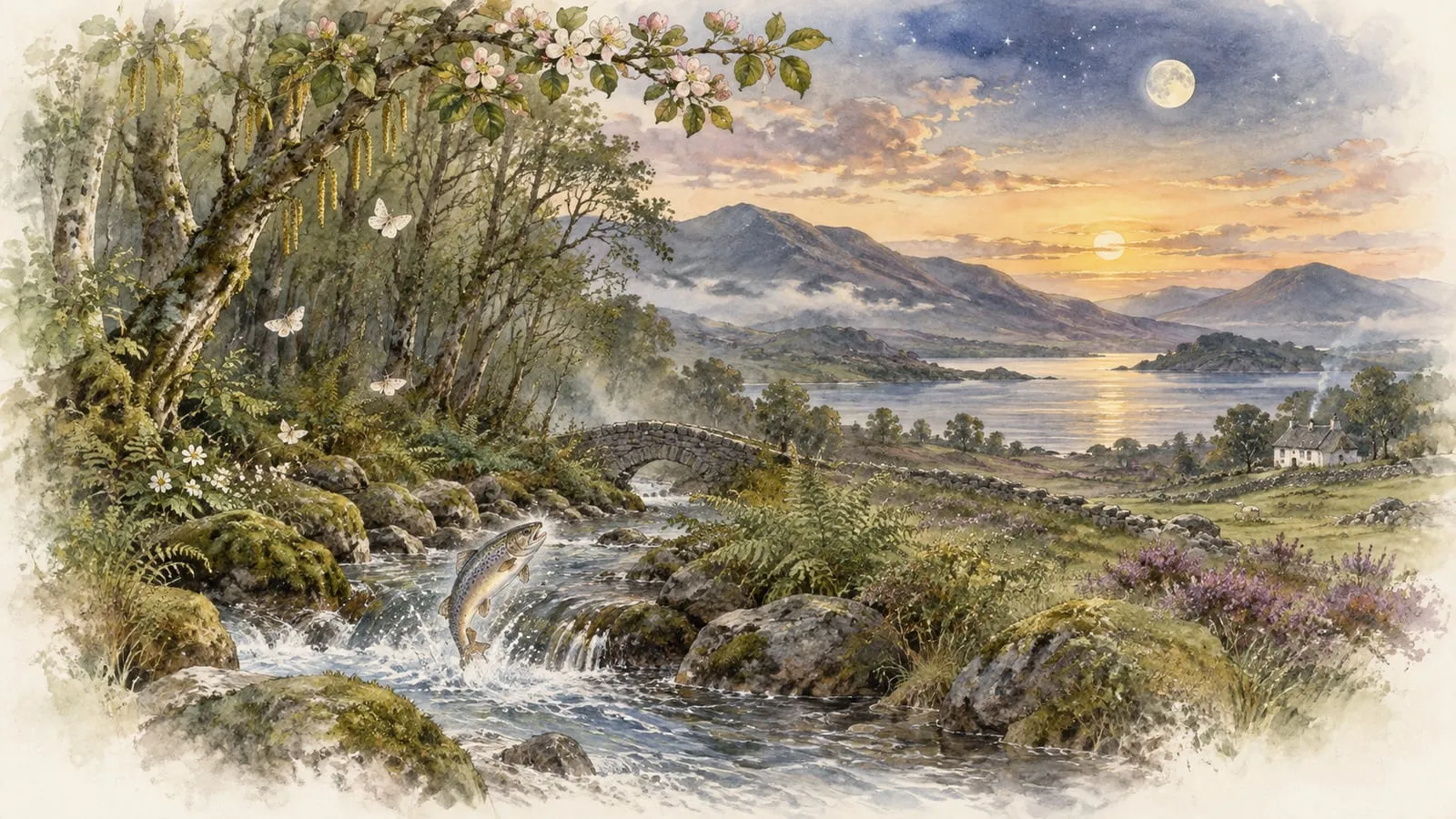
A woodland valley at evening. Around a wood-fire sit three shepherds; without a curve rises the smoke.
First Shepherd
Second Shepherd
The first Shepherd puts the flute to his lips; there comes from it a piercing cry. He drops it.
First Shepherd
Third Shepherd
Puts it to his lips. A voice out of the flute still more mournful.
First Shepherd
Second Shepherd
Third Shepherd
Enter an Old Knight. They cast themselves down before him.
Knight
Second Shepherd
First Shepherd
Knight
First Shepherd
Knight
Second Shepherd
Third Shepherd
First Shepherd
Knight
Goes.
Second Shepherd
First Shepherd
Third Shepherd
Second Shepherd
Third Shepherd
Second Shepherd
Scene II
A ruined palace in the forest. Away in the depth of the shadow of the pillars a motionless Figure.
Enter the Old Knight.
Knight
He draws nearer to the Figure. A pause.
He gathers up the leaves and presses them to his breast.
He approaches close to the Figure. A sudden light bursts over it.
Knight
Figure
Knight
Figure
Knight
The Figure raises a mirror in which the face and the form of the Knight are shadowed. He falls forward.
The Figure
Bending over him and speaking in his ear.
Knight
Dies.
Text: Poetry, by W. B. Yeats (Standard Ebooks, 2024), from the collected editions of 1908 to 1928. Public domain.
In brief
SummaryAn old knight follows a lifelong call and finds only Infamy.
A short verse play in two scenes. Three shepherds sit by their fire at evening; the flute gives out a piercing, mournful cry, and they take it for an omen. An old knight arrives, worn by sixty years of "dream-led wandering", searching for the "sullen wood" where a voice has called him since boyhood. The shepherds warn him that nothing lives there, but he goes. In a ruined palace in the forest he bows before a silent figure, begging it to speak and show its face before he dies. When light falls on it, it is a bearded witch who says "Men call me Infamy". Her voice was the one that summoned him. She holds up a mirror to him, and he dies.
Lines to remember
Men call me Infamy.
What! Lover, die before our lips have met?
Again, the voice! the voice!
Line by line
Lines 1 to 13An omen at the fire
The sheep are in and the first shepherd's dreams rove like "red- / Eyed panthers" round their young. When he and the third shepherd try the flute, it gives a piercing cry instead of a dance tune. "An omen!" say two of them; the third feels "A creeping horror".
Lines 14 to 28The knight arrives
An old knight greets them. He has spent "threescore years of dream-led wandering" over spice islands, polar seas and Indian rivers, and now a voice has told him that the "long-lost forest of the sprite, / The sullen wood" lies in this land.
Lines 29 to 38The shepherds warn him
The shepherds point him to a sunless valley, then try to stop him: goblin snakes sing there "songs of fearful things", no shepherd has entered it, and "The very squirrel dies that enters it." He simply says farewell twice and goes.
Lines 39 to 51He was a spirit
Left alone, the shepherds expect him to be "Ashes / Before the wind". They noticed his glittering eyes and trembling body, like smoke rising "blue as the halcyon's wing". They decide he was a spirit, sent by God to make them "glad with wonder".
Lines 52 to 69Before the figure
In a ruined palace strewn with fallen leaves, the knight bows before a motionless figure. Its words have lived in him since boyhood "as banded adders in my breast". The call made him a coward in battle, mocked as the "Knight of the Waterfall", yet he never complained, trusting it led to "joys unhuman".
Lines 70 to 86Begging for a face
The figure will not speak, and he feels death sucking out his soul. He asks whether his wandering, "Untouched of human joy or human love", was all for nothing, gathers the dead leaves to his breast, and begs at least to touch "Thy garment's hem".
Lines 87 to 98The face of Infamy
Light reveals "A bearded witch" with dull, unmoving eyes. "Men call me Infamy," she says, and she does not know what she is. The voice that called him was hers. She shows him his face in a mirror and he falls; as she mocks, "Lover, die before our lips have met?", he dies crying "Again, the voice! the voice!"
Themes
The quest
The knight gives his whole life to a voice he has never seen, crossing the world and giving up "human joy or human love". Everything is staked on the promise of "joys unhuman". The shepherds, content with their sheep and fire, frame him: to them he is a wonder, perhaps a spirit, but they would never follow.
Disillusion
The end is a cruel reversal. The longed-for beloved is "A bearded witch" called "Infamy", who does not even know what she is. The mirror she raises suggests that what he chased was partly himself. Even so, his last words are for "the voice", as if the call still holds him at the moment he learns its source.
Dream and action
The call makes him "A coward in the field" and the laughing-stock of other men, who say the spirits stole his heart. The poem sets the life of dream against the life of deeds and counts the cost of the first: a lost reputation, a lonely old age, and death in a ruin.
Context
The Seeker is one of Yeats's earliest works: a short verse drama printed in the Dublin University Review in 1885 and included in his first book, The Wanderings of Oisin and Other Poems (1889). He left it out of his later collections. Its dreamy knight, called away from ordinary life by a voice, anticipates the conflict between a life of dream and a life of action that runs through the title poem of that first book.
Form
A dramatic poem in two scenes, with named speakers and stage directions, written in unrhymed blank verse. Many lines are shared between speakers, so a single five-beat line may be split between two or three voices. That quick exchange among the shepherds contrasts with the knight's long, lonely speeches in the second scene.