The Players ask for a Blessing on the Psalteries and on Themselves
Earlier titled "The Players ask for a Blessing on the Psalteries and themselves"
Listen
Three voices together
First voice
Second voice
Third voice
Three voices together
Text: Poetry, by W. B. Yeats (Standard Ebooks, 2024), from the collected editions of 1908 to 1928. Public domain.
In brief
SummaryMusicians pray to heaven to bless their hands, which will not outlast their music.
A group of players, musicians who speak or chant to stringed instruments, call on the heavenly powers, the "masters of the glittering town", to come down and bless their hands, their mouths and their strings. At first the angels seem slow: one gathers his purple gown, another mutters by the wall and dreads "the weight of mortal hours". Then they hurry down "Like plovers". The players' prayer ends on a humble truth: the notes they play "shall live on" after all history is done, but the hands that play them must "ebb away". So it is the hands, not the music, that most need a blessing.
Lines to remember
The notes they waken shall live on
Our hands, our hands must ebb away.
Line by line
Lines 1 to 7The call to heaven
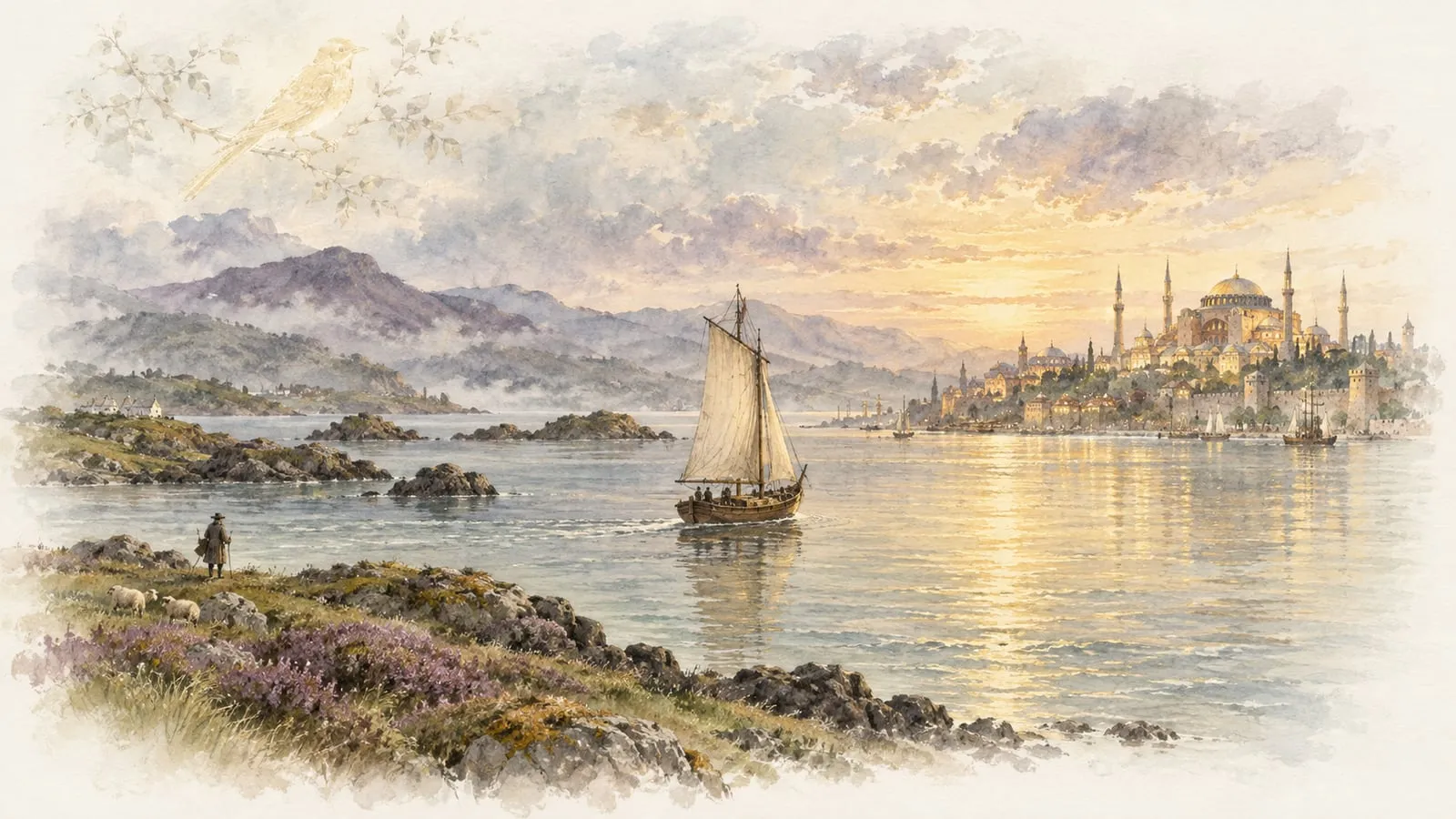
The players urge the "masters of the glittering town" to hurry and bless them. These heavenly figures are pictured like a victorious army, drunk with flags over ramparts and towers, their trumpets and wings in motion. The players ask them to lay "the shrilly trumpet down" and listen.
Lines 8 to 11Slow to come
A doubtful voice suggests that heaven may linger. The poem glimpses individual figures: one lifts "his purple gown", another "leans and mutters by the wall", reluctant because "He dreads the weight of mortal hours": time on earth is heavy to an immortal.
Lines 12 to 13They hurry down
"O no, O no!" another voice answers. The heavenly ones come quickly after all, "Like plovers that have heard the call", a sudden, natural image of birds swooping down together.
Lines 14 to 20Bless the hands
The players pray to the "kinsmen of the Three in One" to bless them. The notes they wake "shall live on" when "all this heavy history's done", but "Our hands, our hands must ebb away". The closing couplet repeats the point with quiet pathos: bless what is mortal.
Themes
Art and mortality
The poem rests on a contrast between music and musician. "The proud and careless notes live on", untouched by time, while the hands that make them "ebb away" like a tide. Art outlasts its makers, and the players accept this, asking only that their passing selves be blessed.
Heaven and earth
The heavenly powers live in a "glittering town" of towers and flags, and one of them "dreads the weight of mortal hours". Earthly time is a burden to the immortals. Yet they come down "Like plovers" to answer the call, so heaven and human art meet in the act of blessing.
Context
The poem was published in In the Seven Woods (Dun Emer Press, 1903). A psaltery is an old stringed instrument, and in these years Yeats was experimenting with having verse spoken or chanted to its notes, most closely with the actress Florence Farr, as a way of bringing the music of poetry back to the stage.
The poem is about performers rather than the art alone: its players are the living people behind the music. The contrast between lasting "notes" and passing "hands" looks ahead to later poems in which Yeats sets the permanence of art against the ageing body, most famously "Sailing to Byzantium".
Form
Twenty short lines of four beats in five verse groups of different lengths, from seven lines to two. The rhymes link across the groups ("play" and "away", "towers" and "hours", "town" and "down"), and the phrase "bless the hands that play" returns near the end. The shifts of tone suggest several voices speaking in turn, like a chorus.