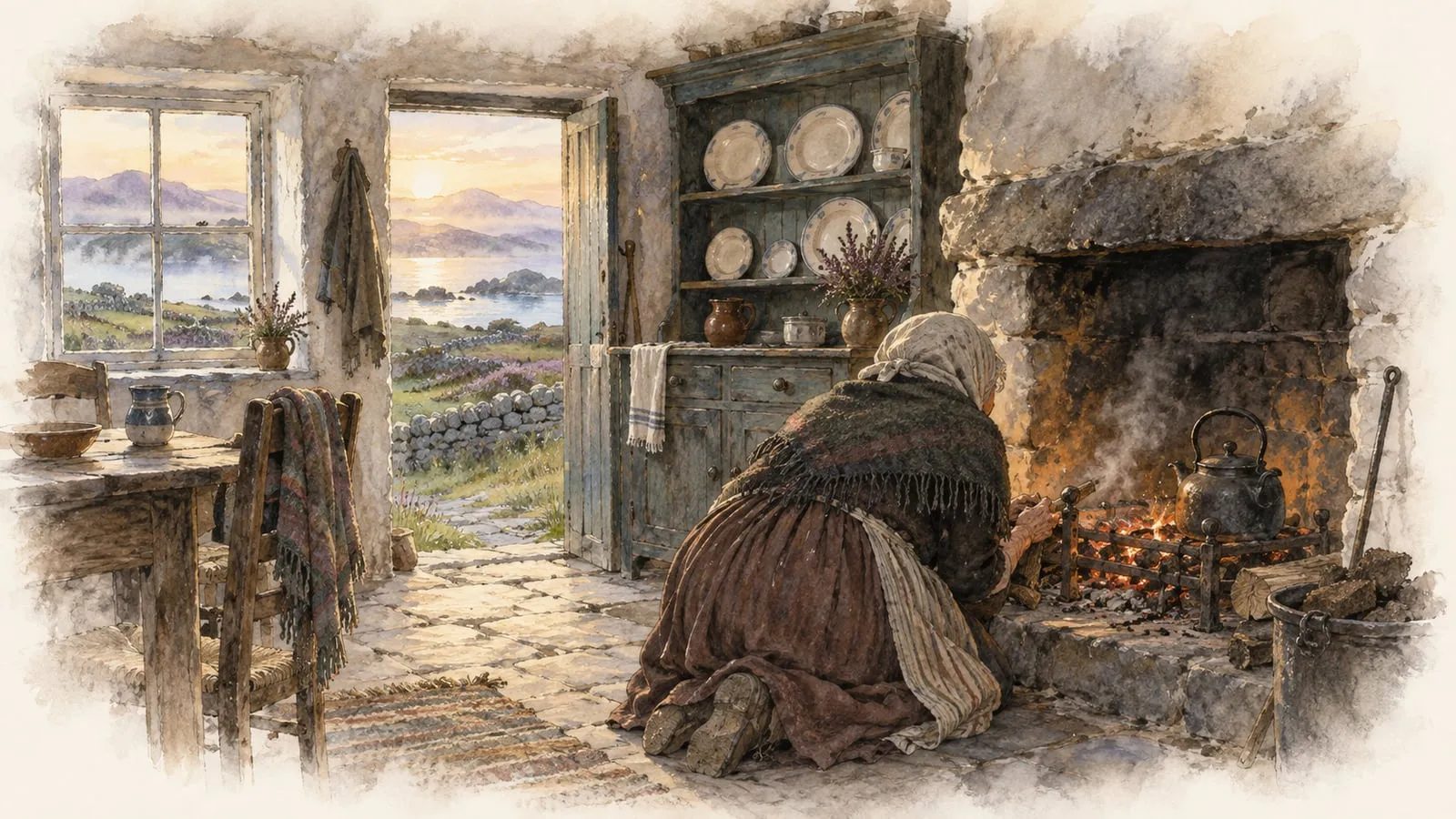
The Lamentation of the Old Pensioner
Text: Poetry, by W. B. Yeats (Standard Ebooks, 2024), from the collected editions of 1908 to 1928. Public domain.
In brief
SummaryAn old man mourns the days when he was welcome at every hearth.
This is the first version of a poem Yeats later rewrote completely. An old pensioner remembers when he had "a chair at every hearth" and nobody stared at him or asked "who may he be?" Now the people who knew him are gone, and he wanders as a stranger. The roadside trees murmur as they did long ago, which only sharpens the change in him. Each stanza ends with the same plain refrain: "And the fret lies on me."
Lines to remember
I had a chair at every hearth,
And the fret lies on me.
Line by line
Lines 1 to 6Once at home
Once he was welcome everywhere, so familiar that "no one turned to see" him. The quoted words, "Look at that old fellow there", are what strangers say now. "Therefore" he wanders, carrying "the fret", a word for worry and grief.
Lines 7 to 12The trees remain
He asks the oak and poplar why they keep murmuring "As in the old days long gone by". Nature has not changed, but "The well-known faces are all gone". The refrain returns, heavier for being repeated.
Themes
Old age and loss
The pensioner's grief is not for money or health but for belonging. He has outlived his world: "The well-known faces are all gone", and he has become "that old fellow there" to strangers. The refrain names the feeling simply, as "the fret".
Unchanging nature
The trees murmur "As in the old days long gone by". Their sameness is almost cruel, because it shows how much the human world has changed around him. He speaks to them as if they were old neighbours, the only ones left.
Context
This is the text of 1890 and 1892, which begins "I had a chair at every hearth". Yeats kept the title but rewrote the poem so thoroughly in 1925 that it became almost a different work, the bitter "The Lamentation of the Old Pensioner" that begins "Although I shelter from the rain" and ends in defiance of Time. Very few words are shared between the two versions.
Set side by side, the two show how far Yeats's style travelled in thirty-five years: this early version is gentle, wistful and close to a folk song, while the later one is harsh, compressed and angry, the voice of an old man who spits "into the face of Time".
Form
Two six-line stanzas of alternating four-beat and three-beat lines, like a ballad, with the even lines rhyming on one sound ("see", "be", "me"; "ye", "tree", "me"). The shared refrain, "And the fret lies on me", closes each stanza like the burden of a song.