The Blessed
Listen
Text: Poetry, by W. B. Yeats (Standard Ebooks, 2024), from the collected editions of 1908 to 1928. Public domain.
In brief
SummaryA seeker asks a holy man who is the most blessed soul of all.
Cumhal comes to the cave of the holy man Dathi, hoping to "gather the half of your blessedness" and learn to pray as he prays, and offers him salmon and heron in return. Dathi only smiles, and Cumhal sees a crowd of blessed souls drifting like smoke: women, children, young scholars, old churchmen. Cumhal asks which of them is the most blessed, guessing those who sing with golden thuribles. Dathi's answer is a surprise. Blessedness is like the wind, coming and going where it will, and the most blessed soul he can see is a man nodding "a drunken head", because in the redness of his wine he has seen "The Incorruptible Rose". The poem begins like a Christian legend and ends with Yeats's own mystical symbol, putting vision above ceremony.
Lines to remember
With the secrets of God in his eyes.
And blessedness goes where the wind goes,
The Incorruptible Rose,
Line by line
Lines 1 to 4At the cave mouth
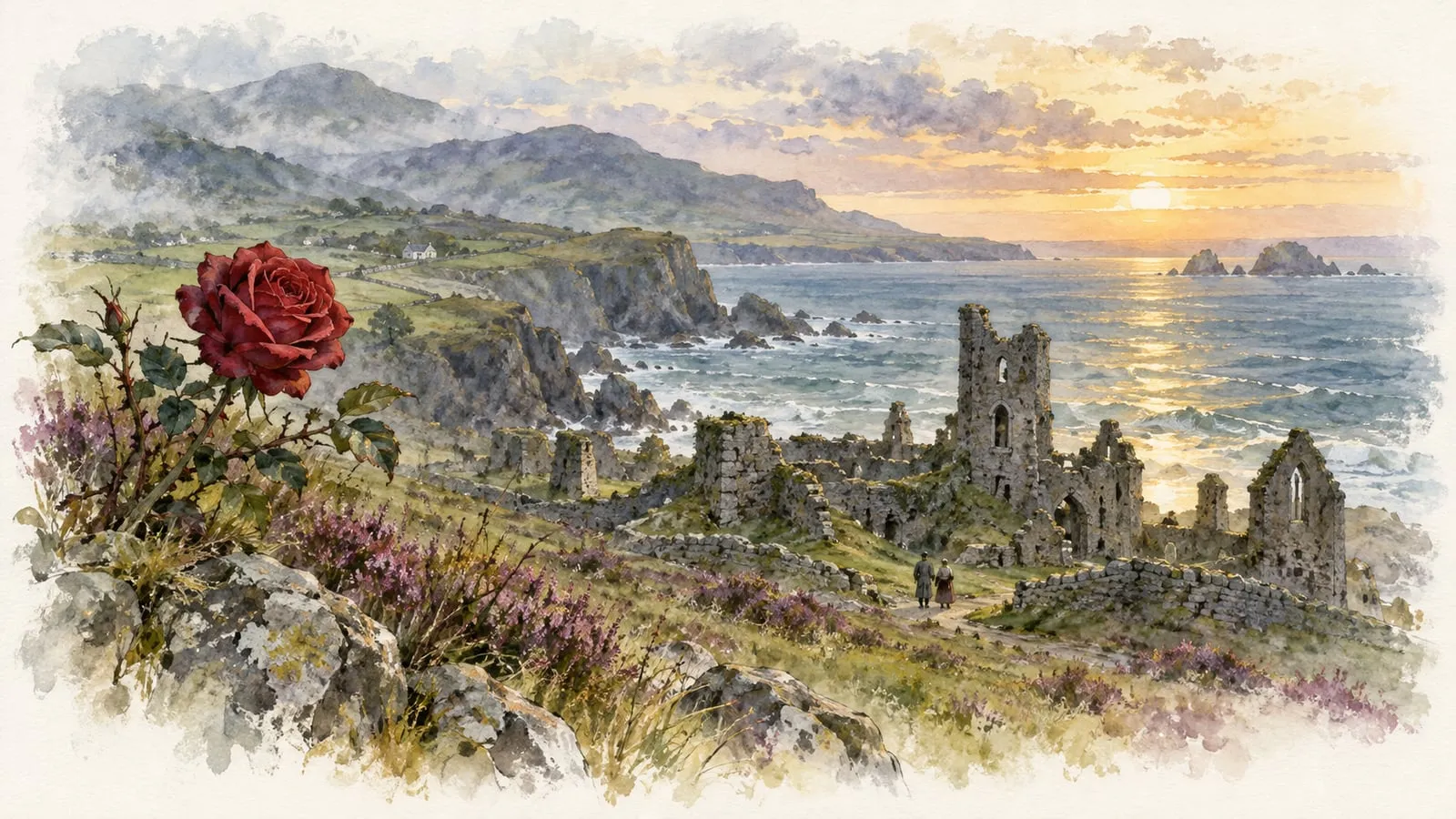
Cumhal calls out with bowed head, and Dathi appears at the mouth of his cave, blinking, "Between the wind and the wood". The wind is placed in the first stanza on purpose: by the end it will be the poem's image of blessedness itself.
Lines 5 to 10Cumhal's request
Kneeling, Cumhal explains that he has come "by the windy way" to share Dathi's blessedness and "learn to pray when you pray". Like a practical man he offers payment: salmon from the streams and heron from the skies. The bargain sounds touching and a little naive beside what follows.
Lines 11 to 16A vision of souls
Dathi does not answer but folds his hands and smiles "With the secrets of God in his eyes". Cumhal is granted a vision of blessed souls drifting "like a drifting smoke": women, children, "young men with books" and "old men with croziers and stoles", a full procession of the devout.
Lines 17 to 24Which is the blessedest
Dathi praises "God and God's mother" for sending these souls to content Cumhal. But Cumhal wants a ranking, and asks which is "the blessedest". He guesses the most splendid, the ones with "golden thuribles" singing about the wood, the way an outsider might expect holiness to look.
Lines 25 to 32The way of the wind
Dathi says his eyes are half blind with God's secrets, yet he can "follow the way of the wind". Blessedness, he says, goes where the wind goes, and when it leaves "we are dead". Then comes the surprise: the most blessed soul in the world "nods a drunken head".
Lines 33 to 40The Incorruptible Rose
Blessedness comes "in the night and the day", and only "the wise heart" knows where. The drunken man has seen "The Incorruptible Rose" in the redness of his wine, and it drops faint leaves and "the sweetness of desire" on him while the world ebbs away "In twilights of dew and of fire".
Themes
Holiness and vision
The poem overturns the expected order of sanctity. The procession of saints, scholars and churchmen with "golden thuribles" is real and blessed, but the "blessedest" soul is a man nodding over his drink. What counts is not office or ritual but the moment of vision, when someone sees "The Incorruptible Rose". Blessedness falls where it will, not where it has earned a place.
The Rose
The Rose is Yeats's chief symbol of the 1890s: an ideal beauty, spiritual and sensual at once, that stands outside time. Here it is "Incorruptible", untouched by decay, and it appears in "the redness of wine". Its "faint leaves" and "the sweetness of desire" suggest a blessing given in drowsy rapture, while "time and the world are ebbing away".
The wind
Wind blows through the poem from the start: Dathi stands "Between the wind and the wood", and Cumhal comes "by the windy way". Dathi makes it the key image: "blessedness goes where the wind goes". It cannot be gathered or bought with salmon and heron, as Cumhal hoped; it can only be followed, and it leaves when it chooses.
Context
The poem was collected in The Wind Among the Reeds (1899), a book in which the Rose is a recurring symbol. Yeats was then deeply involved in occult study, and in April 1897 he had published a book of stories called The Secret Rose. "The Blessed" shares that world: an old Irish setting, Christian figures, and a mystical Rose that stands above them all.
Cumhal and Dathi are old Irish names. The poem gives them no history beyond the scene itself, and uses them to lend the meeting the feel of an ancient legend, like the stories of saints and hermits in early Christian Ireland.
Form
Ten quatrains in a loose ballad measure, with three or four beats to a line and many extra light syllables. Only the second and fourth lines of each stanza rhyme ("stood" and "wood", "way" and "pray"). The ballad form suits a tale told like an old legend, and from the second stanza on the poem is almost all dialogue.