To the Rose upon the Rood of Time
Listen
Text: Poetry, by W. B. Yeats (Standard Ebooks, 2024), from the collected editions of 1908 to 1928. Public domain.
In brief
SummaryThe poet calls on a symbolic Rose to inspire his songs of ancient Ireland.
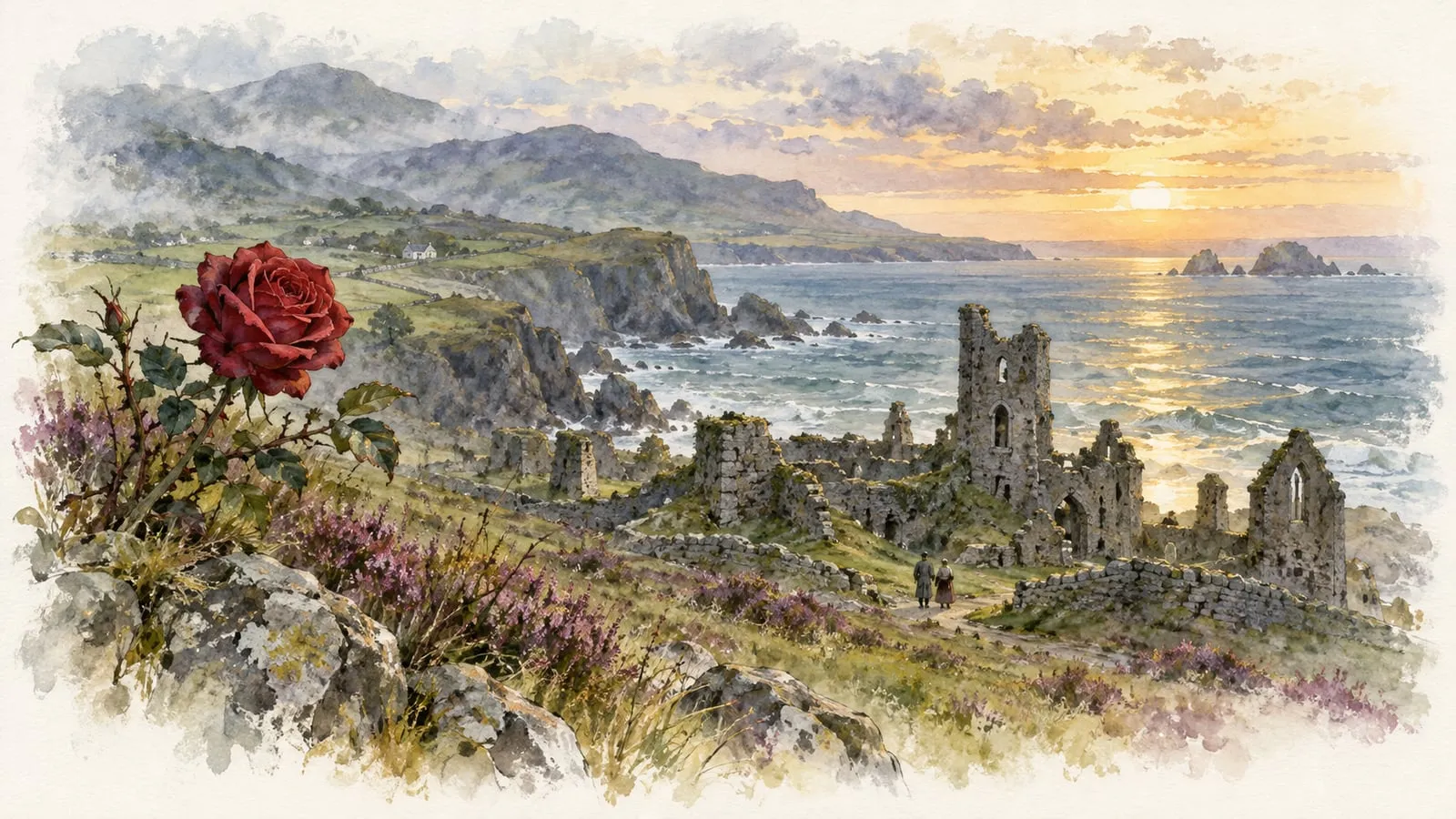
The poet addresses the Rose, a symbol of eternal beauty that is "Red", "proud" and "sad", and asks it to come near while he sings of old Irish legend: Cuchulain fighting the sea, Fergus and the Druid. Through it he hopes to see "Eternal beauty" in the small, passing things of the world. In the second stanza he draws back. If the Rose comes too close, he fears he will stop hearing ordinary life, the worm and the field mouse, and hear only the strange speech of God and the dead. He asks for just enough of its presence to sing "of old Eire and the ancient ways".
Lines to remember
Red Rose, proud Rose, sad Rose of all my days!
Eternal beauty wandering on her way.
Sing of old Eire and the ancient ways:
Line by line
Lines 1 to 8Calling the Rose
The triple address, "Red Rose, proud Rose, sad Rose", sounds like a prayer. He names his subjects: "Cuchulain battling with the bitter tide", the Druid who "cast round Fergus dreams", and the Rose's own sadness, sung by the stars as they dance "sandalled on the sea". These are the stories told in the next poems of the group.
Lines 9 to 12Beauty in small things
He wants the Rose near so that, no longer "blinded by man's fate", he can find "Eternal beauty wandering on her way" in "all poor foolish things that live a day". The eternal is to be seen inside the passing, not apart from it.
Lines 13 to 21Not too near
"Come near, come near, come near" breaks off with "Ah, leave me still / A little space". He fears losing "common things that crave": the weak worm, the field mouse, "heavy mortal hopes". Too close, the Rose would leave him hearing only God's words to "those long dead" and chanting "a tongue men do not know".
Lines 22 to 24The ancient ways
The poem settles on a balance. He asks the Rose to come near so that, before he dies, he can "Sing of old Eire and the ancient ways". The final line repeats the first, closing the poem like a circle, or like a prayer said over again.
Themes
Eternal beauty
The Rose stands for an ideal, spiritual beauty, and its title places it "upon the Rood", on the cross, joining love and suffering. Yeats makes it "sad" as well as "proud": this beauty shares in human sorrow. He hopes it will let him see "Eternal beauty" in "poor foolish things that live a day".
The ordinary world
The second stanza is a plea to keep hold of everyday life. The "weak worm hiding down in its small cave" and "The field mouse running by me in the grass" are tiny, mortal and loved. The poet senses that pure vision could cut him off from them, and from the "heavy mortal hopes that toil and pass".
Irish legend
The poem works as a preface, announcing the stories Yeats will tell: Cuchulain, Fergus, the Druid, "old Eire and the ancient ways". It links his mystical symbol to a national subject, so that Irish legend becomes the way into eternal beauty.
Context
The poem first appeared in The Countess Kathleen and Various Legends and Lyrics (1892). When Yeats gathered these lyrics under the name "The Rose" in Poems (1895), he placed this poem first, as a kind of dedication to the whole group.
The rose on a cross is a symbol from the Rosicrucian tradition, which fed into the magical and occult studies Yeats took up in these years. "Rood" is an old word for the cross, so the title sets the eternal Rose on the cross of time. The poems that follow in the group include "Fergus and the Druid" and "Cuchulain's Fight with the Sea", the legends named in lines 3 to 5.
Form
Two twelve-line stanzas of rhyming couplets in iambic pentameter ("days" and "ways", "tide" and "eyed"). The first line returns as the last, framing the poem like an invocation. The repeated "Come near" and the broken-off line 13 let the smooth couplets register a real hesitation.