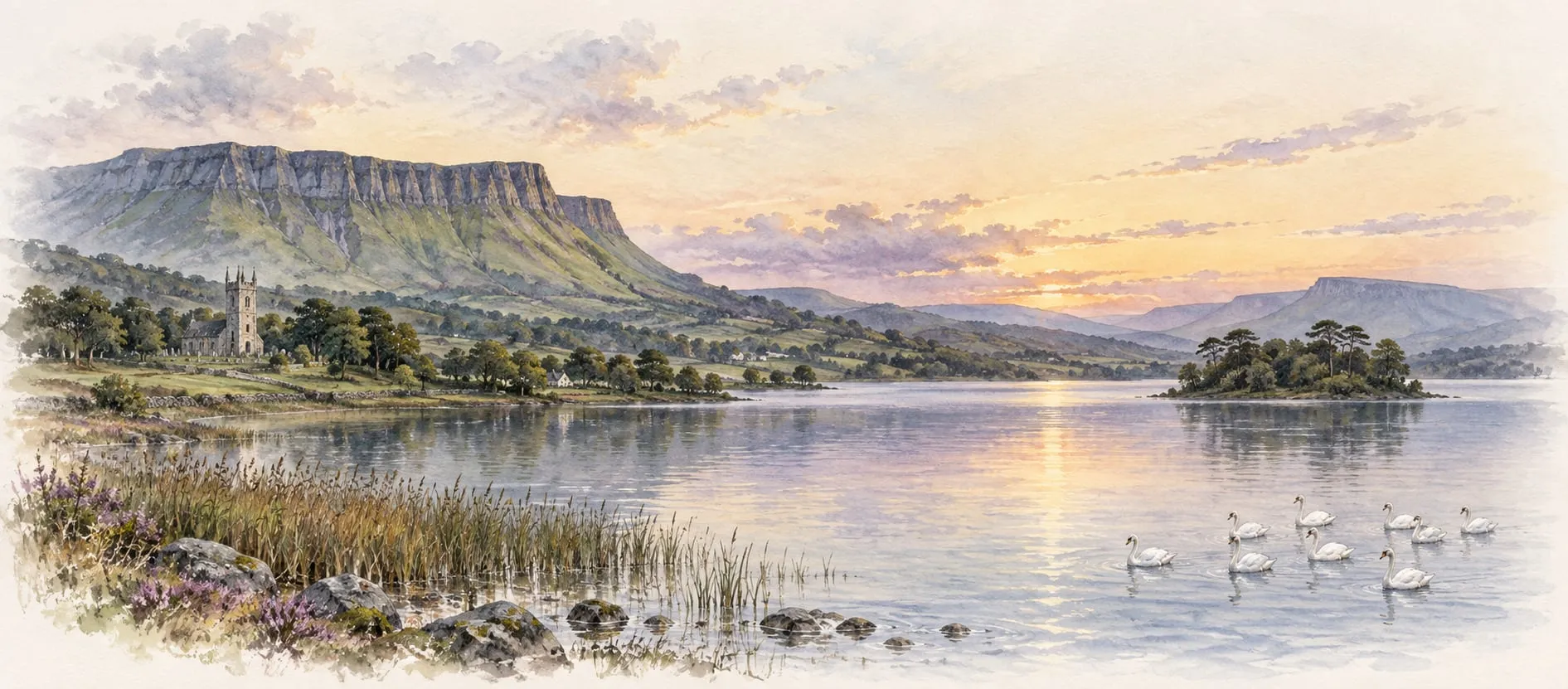
Cuchulain's Fight with the Sea
Earlier titled "The Death of Cuchulain", "Cuchullin's Fight with the Sea"
Listen
Text: Poetry, by W. B. Yeats (Standard Ebooks, 2024), from the collected editions of 1908 to 1928. Public domain.
In brief
SummaryCuchulain kills his own son unknowingly, then turns his rage on the sea.
A swineherd brings Emer news that her husband Cuchulain is coming home victorious, but with a sweet-voiced young sweetheart at his side. In jealous fury Emer goes to her son, who herds cattle, and sends him to fight "a man" at the Red Branch camp, telling him to give his name only at sword-point. The young man challenges the camp; Cuchulain, bound by the same childhood oath, fights him and deals a fatal blow. Dying, the youth names himself: "Cuchulain I, mighty Cuchulain's son." Cuchulain sits motionless in grief. King Conchubar, fearing that he will rise and kill them all, has the Druids chant spells over him for three days, until Cuchulain stirs, mistakes the waves for enemies, and fights "the invulnerable tide".
Lines to remember
Cuchulain I, mighty Cuchulain's son.
The dooms of men are in God's hidden place.
And fought with the invulnerable tide.
Line by line
Lines 1 to 8The swineherd's news
A man comes "slowly from the setting sun" to Emer, who is dyeing cloth in her fort. He is the swineherd she set to watch the road, and he no longer needs to watch it. Emer throws down her weaving and cries out, her arms "all raddled with the dye", red as if with blood.
Lines 9 to 16A rival
The swineherd says no man has ever won such spoils as Cuchulain, but he trembles as he speaks. Pressed, he throws himself down and blurts out the real news: "With him is one sweet-throated like a bird." Cuchulain has a new young love, and the whole tragedy starts from this line.
Lines 17 to 33Emer and her son
Emer strikes the swineherd and goes to her son among the cattle: "There is a man to die". The son twice insists that his father is the strongest warrior; Emer answers that he is taller now, and his father "old and sad with many wars". He asks only where to go, trusting that "He who made you bitter, made you wise".
Lines 34 to 39The oath
Emer gives exact directions. He is to camp near the Red Branch host "Between wood's rim and the horses of the sea" and give his "name and lineage" only to a man whose blade compels him, bound by the same oath. The oath is the trap: Cuchulain is bound by it too.
Lines 40 to 47Cuchulain at the feast
The scene shifts to the kings feasting. Cuchulain's "young sweetheart" kneels beside him and stares on "the mournful wonder of his eyes"; harpers sing his praise, and King Conchubar himself plays. It is a picture of glory just before it breaks.
Lines 48 to 58The challenge
Cuchulain hears a stranger singing by his fire in the wood and sends to ask his name. The answer returns: he gives his name only "At the sword point". Cuchulain accepts, since he is "the only man" of the host bound by that oath "from childhood on".
Lines 59 to 73Father and son
Cuchulain half pities the youth and asks whether no girl loves him. The young man answers, "The dooms of men are in God's hidden place." His face briefly recalls a woman Cuchulain once loved, a hint of Emer. Then war rage wakes, the old blade breaks the new one's guard, and the dying youth reveals: "Cuchulain I, mighty Cuchulain's son."
Lines 74 to 87Grief and fear
Cuchulain sits all day with "head bowed on his knees". Not even the sweetheart's caresses reach him. Conchubar, "the subtlest of all men", fears he will brood three days and "raving slay us all", so he has the Druids chant "delusions magical" to turn his fury on "the horses of the sea".
Lines 88 to 91Fighting the tide
After three days of chanting Cuchulain stirs, stares at the waves and hears "The cars of battle and his own name cried". The last line is short and terrible: he "fought with the invulnerable tide", a hero's strength wasted on the one enemy that cannot be wounded.
Themes
Jealousy and revenge
The tragedy begins with Emer's jealousy of the girl "sweet-throated like a bird". She uses their son as her weapon, sending him off with an oath she knows only his father shares. Her "raddled fist" and red-dyed arms make her anger vivid, and her revenge destroys her own son.
Fate and ignorance
Neither father nor son knows the other until too late. Both are bound by the same oath, and the young man accepts his fate calmly: "The dooms of men are in God's hidden place." Cuchulain even glimpses Emer's face in his, but the "war rage" overrides the hint, and recognition comes only with the death blow.
Heroism and futility
Cuchulain is the greatest of warriors, praised by harp and king. But his strength kills his son, and his last fight is against "the invulnerable tide", manipulated into it by Conchubar's Druids. Heroic energy, the poem suggests, can become a blind force that only magic and the sea can absorb.
Context
The poem first appeared in The Countess Kathleen and Various Legends and Lyrics (1892) as "The Death of Cuchulain", and kept that title for over thirty years. In 1925 Yeats rewrote it heavily and retitled it, calling it in his note "once again Cuchulain's Fight with the Sea". The text here is the revised version.
Cuchulain is the champion of the Ulster cycle of Irish legend, and "To the Rose upon the Rood of Time", which opens the group Yeats called "The Rose", promises to sing of "Cuchulain battling with the bitter tide". In the older tales the son is usually Connla, child of the warrior woman Aoife; Yeats makes him Emer's son. He returned to the story in his play On Baile's Strand, and the sea fight is recalled late in his life in "The Circus Animals' Desertion".
Form
A narrative poem of 91 lines in rhyming couplets of iambic pentameter ("sun" and "dun", "floor" and "more"), with a few half-lines where the dialogue breaks off. Much of the story moves through short, sharp exchanges of speech, so the couplets feel dramatic rather than smooth. The final short sentence lands with sudden force.
Revised and retitled. 'The Death of Cuchulain' in 1892-1924 (Gutenberg 38877, 49608); rewritten as 'Cuchulain's Fight with the Sea' in 1925 (Yeats's own note: 'I here revised ... and once again Cuchulain's Fight with the Sea'). About 60 per cent word overlap between the 1895 and 1925 texts.