Fergus and the Druid
Listen
Fergus
Druid
Fergus
Druid
Fergus
Druid
Fergus
Druid
Fergus
Druid
Fergus
Text: Poetry, by W. B. Yeats (Standard Ebooks, 2024), from the collected editions of 1908 to 1928. Public domain.
In brief
SummaryA king who gave up his crown asks a Druid for dreaming wisdom.
Fergus, once king of Ulster, has chased a shape-shifting Druid all day through the rocks. He explains that he handed his crown to young Conchubar, who found easy what Fergus found a burden, yet he still feels the crown's weight. He wants to be "no more a king" and to learn the Druid's "dreaming wisdom". The Druid warns him what that wisdom has cost: a feeble body, no love, no friends. Still Fergus takes the "little bag of dreams", opens it, and sees all his past lives at once. Knowing everything, he feels himself become nothing, and the whole world's sorrow falls on his heart.
Lines to remember
A king is but a foolish labourer
But now I have grown nothing, knowing all,
Ah! Druid, Druid, how great webs of sorrow
Line by line
Lines 1 to 8The shape-changer
Fergus has followed the Druid "The whole day" as he changed from a nearly featherless raven, to a weasel, to "A thin gray man half lost in gathering night". The Druid's reply is a question, and a title that stings: "king of the proud Red Branch kings".
Lines 9 to 15Giving up the crown
Fergus tells how "Young subtle Conchubar" sat beside him at judgments, and what was "burden without end" to Fergus seemed easy to him. So Fergus laid the crown on Conchubar's head "to cast away my sorrow". The Druid repeats his question word for word, unmoved.
Lines 16 to 23Still a king
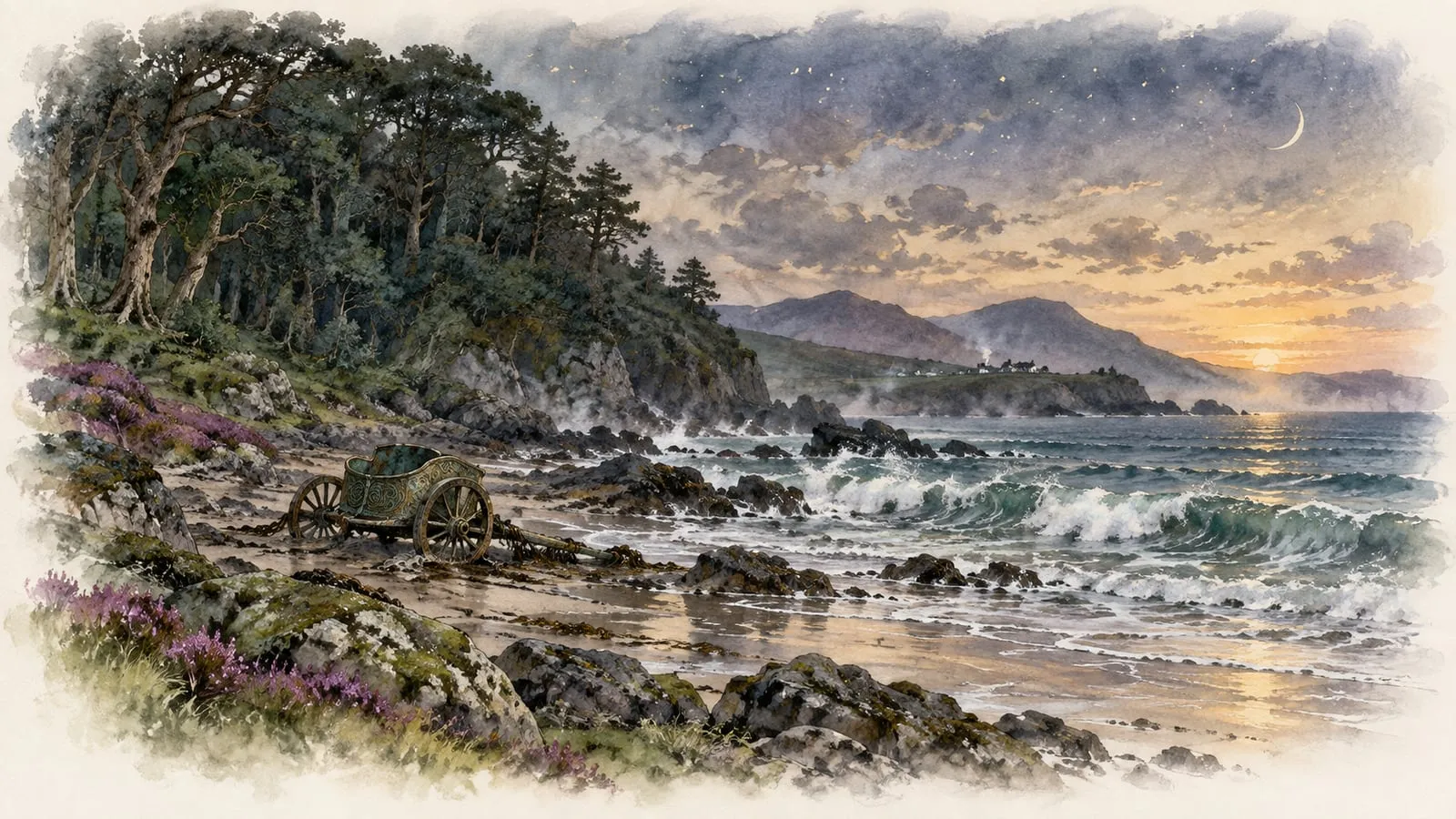
"A king and proud! and that is my despair." He feasts, walks the woods and drives his chariot by the sea, "And still I feel the crown upon my head". Asked plainly what he wants, he says: to "Be no more a king" and to learn "the dreaming wisdom that is yours".
Lines 24 to 31The Druid's warning
The Druid points to what wisdom has done to him: "thin gray hair and hollow cheeks", hands too weak to lift a sword, a body "trembling like a wind-blown reed", and "No woman's loved me, no man sought my help". Fergus answers that a king is only "a foolish labourer", and the Druid hands over the "little bag of dreams".
Lines 32 to 42Many lives
Fergus sees his life "go dripping like a river" through past forms: a drop in the sea, a gleam on a sword, a fir tree, a slave at a quern, a king on a golden chair. All were "wonderful and great", but knowing all, he has "grown nothing". He ends astonished at the "great webs of sorrow" hidden in that "small slate-coloured thing".
Themes
Power and its burden
Fergus finds kingship a "burden without end" and hands it on, but the feeling of the crown stays "upon my head". His definition of a king, "a foolish labourer" who "wastes his blood to be another's dream", is one of Yeats's early statements of the cost of public life.
Wisdom and sorrow
The Druid's wisdom does not bring peace. It has left him frail and unloved, and when Fergus gains it he feels "the whole world weighs down upon my heart". The poem's last line, with its "great webs of sorrow", suggests that to know everything is to share in all the world's grief.
Change and many lives
The poem opens with the Druid changing "from shape to shape" and ends with Fergus seeing himself pass "From change to change" through many existences. Both men have escaped a single fixed identity, but the escape makes Fergus feel he has "grown nothing", dissolved rather than freed.
Context
The poem first appeared in The Countess Kathleen and Various Legends and Lyrics (1892), and Yeats later placed it in the group of lyrics he called "The Rose". It follows "To the Rose upon the Rood of Time", which names the Druid "Who cast round Fergus dreams, and ruin untold".
Fergus mac Roich and Conchubar come from the Ulster cycle of Irish legend, the world of the Red Branch warriors and Cuchulain. In the old tales Fergus loses his throne to Conchubar through a trick; Yeats makes the abdication a free choice, driven by weariness with power. Fergus returns in the song "Who Goes with Fergus?".
Form
A dialogue in unrhymed iambic pentameter (blank verse), passing back and forth between Fergus and the Druid in eleven speeches. The Druid's repeated question, "What would you, king of the proud Red Branch kings?", works like a refrain that forces Fergus to say what he really wants. Lines 21 and 22 are half-lines, shared between the two speakers.