He hears the Cry of the Sedge
Earlier titled "Aedh hears the Cry of the Sedge"
Listen
Text: Poetry, by W. B. Yeats (Standard Ebooks, 2024), from the collected editions of 1908 to 1928. Public domain.
In brief
SummaryA lonely lover learns his love must wait for the end of the world.
The speaker walks beside a desolate lake and hears the wind crying in the sedge. The rest of the poem is what that cry seems to tell him: he will not sleep beside his beloved until the universe itself comes apart. That end is pictured in huge images, the axle of the stars breaking, the banners of East and West flung into the deep, the girdle of light undone. The poem sets one small human wish against the scale of the whole cosmos, and puts its fulfilment beyond the end of time.
Lines to remember
Where wind cries in the sedge:
Your breast will not lie by the breast
Line by line
Lines 1 to 3By the lake
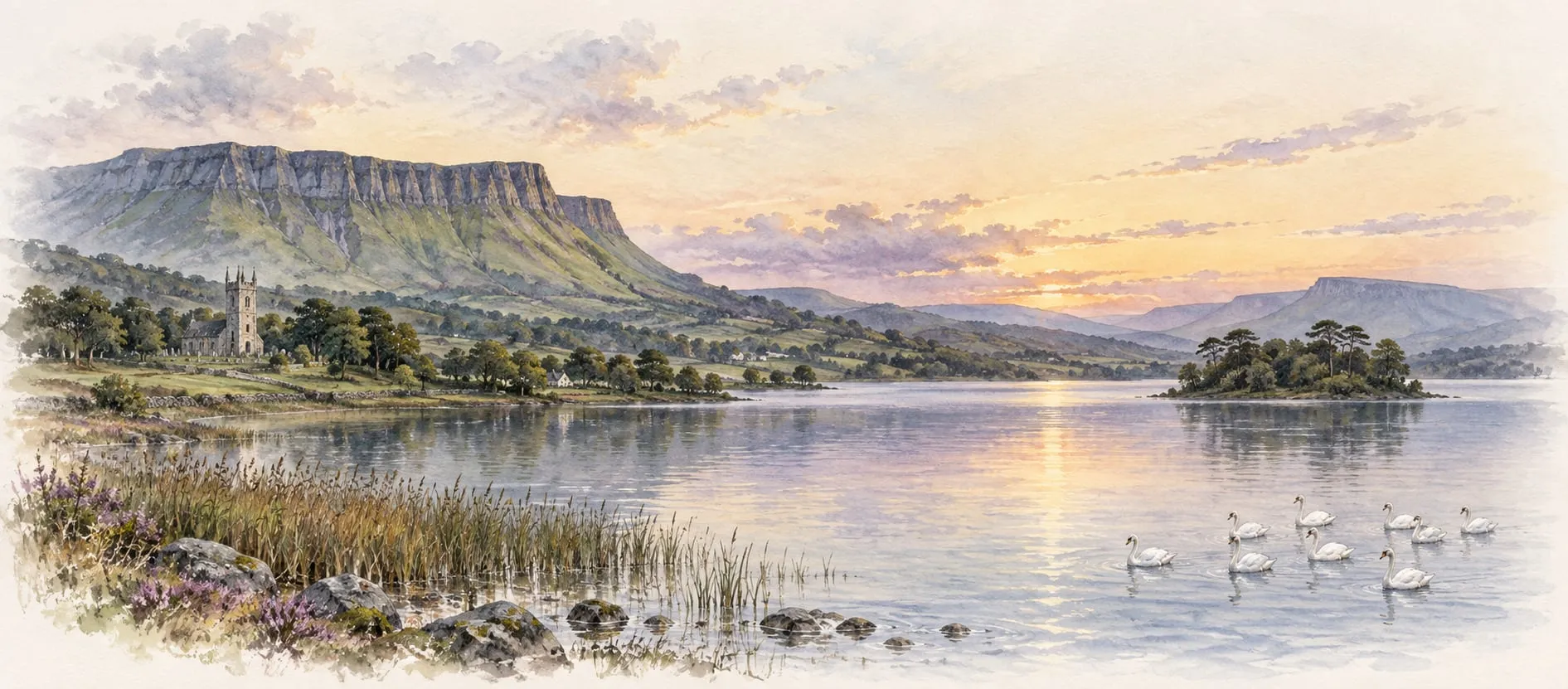
The setting is bare and lonely: a man wandering by "this desolate lake" while "wind cries in the sedge". The rhyme of "edge" and "sedge" and the short three-beat lines give the opening a thin, reedy sound, and the crying wind prepares for the voice that follows.
Lines 4 to 8The world undone
Line 4 begins a list of things that must happen first. The "axle" that "keeps the stars in their round" must break, unseen "hands" must hurl "The banners of East and West" into the deep, and "the girdle of light" must come loose. Each image is of order coming undone.
Lines 9 to 10Not until then
Only after all that will "Your breast" lie by the breast "Of your beloved in sleep". The sedge seems to speak to him directly, and the huge sentence ends on the quiet, intimate word "sleep".
Themes
Frustrated love
The real subject arrives only in the last two lines: the speaker will not lie beside the woman he loves. Everything before that sets the condition, and the condition is impossible. By tying his hope to the collapse of the universe, the poem says his love will never be answered in this world, while making that love feel as large as the stars.
The end of the world
Yeats's early poems often long for an apocalypse, a moment when time and the visible world give way. Here it is drawn in three images: a broken "axle", hurled "banners", an unbound "girdle of light". They are grand but strangely calm, as if the end of things would be a release rather than a terror, the only door through which the lovers could meet.
Context
The poem appeared in The Wind Among the Reeds (Elkin Mathews, London, 1899) as "Aedh hears the Cry of the Sedge". Aedh was one of several named voices Yeats gave to the love poems in that book, alongside Hanrahan and Michael Robartes. From 1906 he replaced the name with a plain "He", so the poem now reads as the poet's own.
Form
A single ten-line sentence in short lines of mostly three beats. The rhymes interlock rather than pair off: "edge" and "sedge", "lake" and "break", "round" and "unbound", "West" and "breast", "deep" and "sleep". Holding "sleep" back until the last word makes the long sentence close on the thing he wants most.
Title only: 1899 persona title "Aedh hears the Cry of the Sedge" (Gutenberg 32233) replaced from 1906 (Gutenberg 49608). Check wording against the 1899 text before choosing a version.