The Secret Rose
Listen
Text: Poetry, by W. B. Yeats (Standard Ebooks, 2024), from the collected editions of 1908 to 1928. Public domain.
In brief
SummaryThe poet prays to the mystic Rose and waits for the world's end.
The poem is a prayer to the Rose, Yeats's symbol of a secret, eternal beauty. He asks it to "Enfold me in my hour of hours", and then names those it already holds: those who sought it at the Holy Sepulchre or in the wine vat, the Magi, and a line of heroes from Irish legend who gave up the world for a vision or a woman. All are gathered into one long, rolling sentence. Then the speaker turns to himself: "I, too, await" the great wind that will blow the stars about like sparks from a forge. The last lines ask whether that hour has come, and close on the opening words, so the poem ends where it began, still waiting.
Lines to remember
Far off, most secret, and inviolate Rose,
And lost the world and Emer for a kiss;
Like the sparks blown out of a smithy, and die?
Line by line
Lines 1 to 7The prayer
The poem opens with three epithets heaped on the Rose: "Far off, most secret, and inviolate". He asks to be enfolded among those who sought it in religion or "in the wine vat", and who now rest beyond the "tumult of defeated dreams", deep in the sleep "Men have named beauty".
Lines 8 to 12The Magi and a king
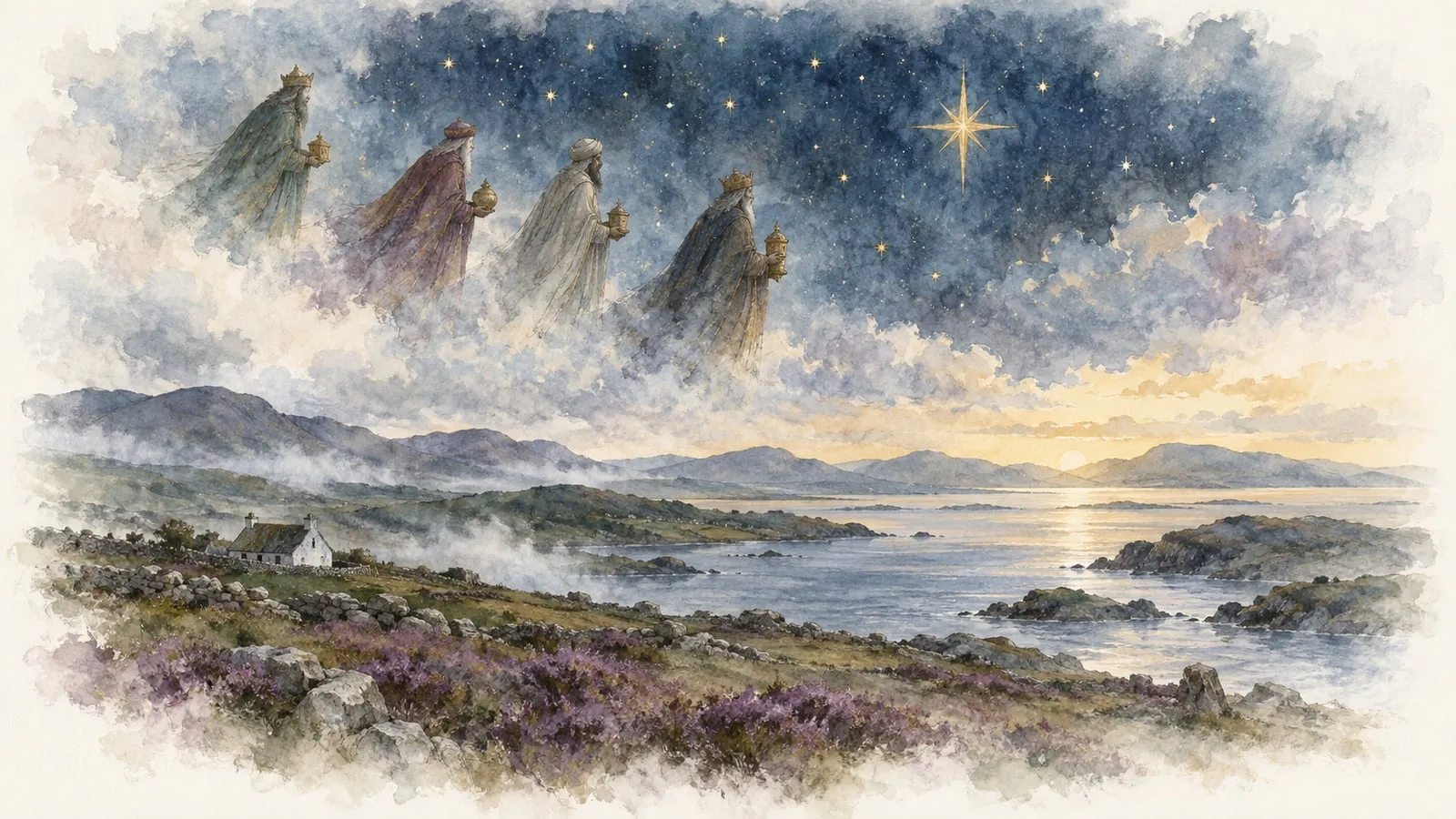
The Rose's "great leaves" hold the "crowned Magi" with their ancient beards and helms "of ruby and gold". Then comes a king who saw Christ's "Pierced Hands" and cross rise in "Druid vapour", and who died in a "vain frenzy". Legend tells this of Conchubar, king of Ulster.
Lines 13 to 15Cuchulain and Fand
Next is the man who "met Fand walking among flaming dew" and "lost the world and Emer for a kiss". This is Cuchulain, the great hero of Ulster, drawn from his wife Emer by the otherworldly Fand. Like everyone in the list, he gives up the real world for an unearthly beauty.
Lines 16 to 18The hero and his dead
Another hero "drove the gods out of their liss", their fairy fort, and then feasted and wept over "the barrows of his dead" until "a hundred morns had flowered red". The poem does not name him, and the chain of "And him who" keeps the list rolling on.
Lines 19 to 21The dreaming king
The "proud dreaming king" flung away his crown and his sorrow to live among "wine-stained wanderers in deep woods", calling "bard and clown" to him. Readers usually take him to be Fergus, the king in Irish legend who gave up his throne for a life of dreams.
Lines 22 to 26The seeker
The last figure sold everything, "tillage, and house, and goods", and searched for "numberless years" until he found a woman of such loveliness that men "threshed corn at midnight by a tress" of her hair. The wonder is told with the plainness of a folk tale.
Lines 27 to 32The poet waits
After "A little stolen tress", the speaker joins the list himself: "I, too, await" the Rose's "great wind of love and hate". He imagines the stars blown about the sky like sparks from a smithy, and dying. The poem ends by asking if the hour has come, and repeats its opening like a spell.
Themes
The Rose as ideal
The Rose here is not a flower but an ideal: a hidden, eternal beauty that draws people out of ordinary life. It is "inviolate", untouched, and it gathers in all who gave everything for vision, whether through faith, wine, war or love. The speaker's wish to be enfolded by it is a wish to join that company, whatever the cost.
Irish legend
Most of the figures come from old Irish stories: Fand and Emer, the hero who fought the gods, the king who fled to the woods. Yeats sets them beside the Magi and the Holy Sepulchre, as if Irish myth and Christian story belonged to one sacred history. Each hero pays heavily, like the one who "lost the world and Emer for a kiss".
The end of the world
The poem looks forward to a final hour when a "great wind of love and hate" will scatter the stars "Like the sparks blown out of a smithy". The end of things is desired, not feared. In Yeats's poems of this time the apocalypse is the moment when the hidden world of the Rose would at last break into this one.
Context
The poem appeared in The Wind Among the Reeds (1899). Its title is shared with The Secret Rose, the book of stories Yeats published in April 1897 in a gold-stamped rose binding designed by Althea Gyles. The Rose was the master symbol of his work in the 1890s, drawing together Irish myth, Christian imagery and the occult ideas he was then studying.
Form
Thirty-two lines of iambic pentameter in rhyming couplets ("Rose" and "those", "kiss" and "liss", "sky" and "die"). But the sentences run far past the rhymes, so the couplets are barely felt, and most of the poem is one enormous sentence. The last line repeats the first, with a question mark added, closing the poem like a circle.