The Magi
Listen
Text: Poetry, by W. B. Yeats (Standard Ebooks, 2024), from the collected editions of 1908 to 1928. Public domain.
In brief
SummaryThe restless wise men search the sky for a new mystery.
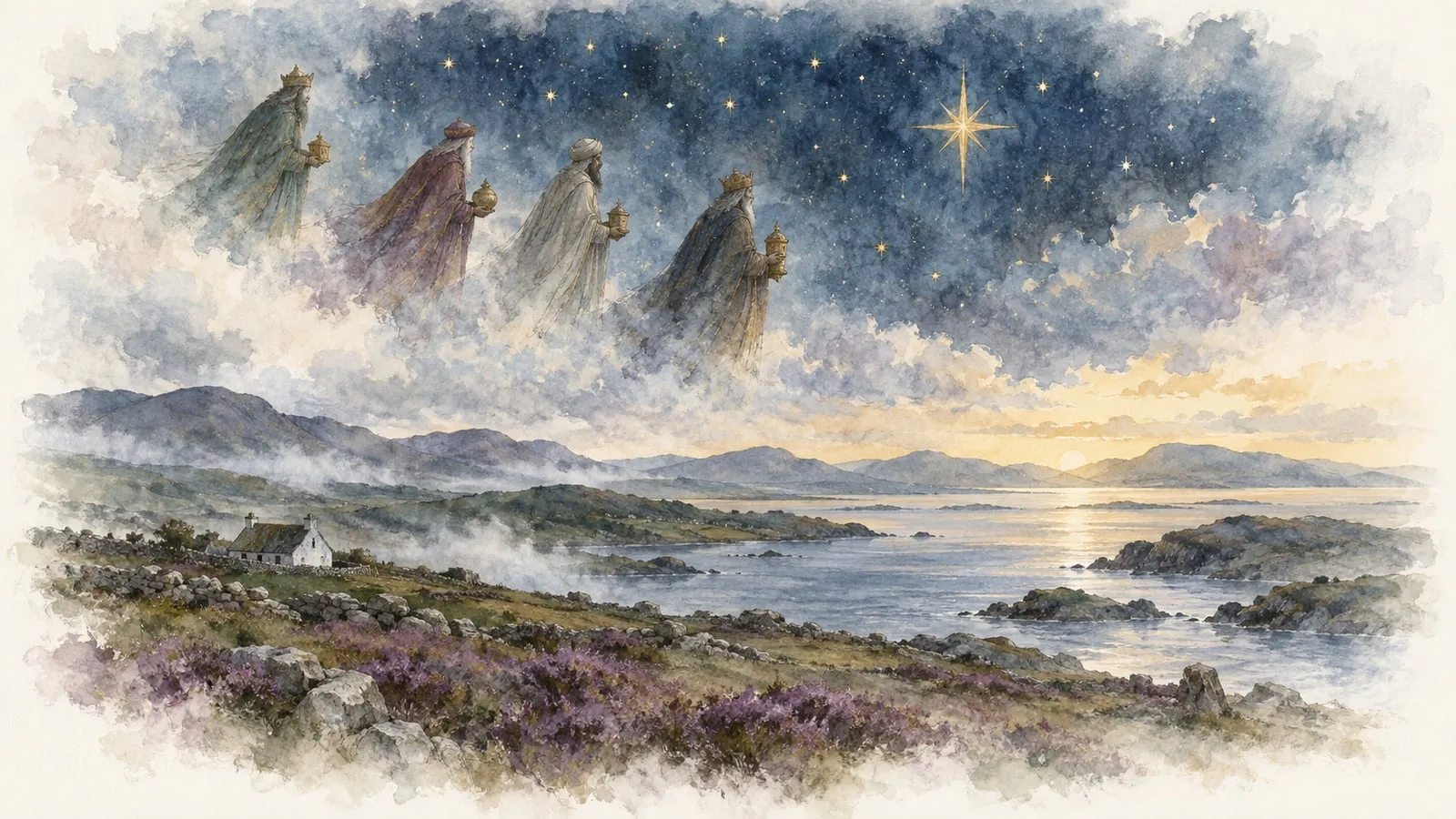
The poet sees in his mind's eye the Magi, the wise men of the Christmas story, appearing and disappearing in the blue depth of the sky. They are stiff and painted, with ancient faces worn like rain-beaten stones and silver helmets hovering side by side. They are still unsatisfied. The turmoil of Calvary did not answer their longing, and they wait, eyes fixed, hoping to find once more "The uncontrollable mystery on the bestial floor": a birth like the one they saw in the stable at Bethlehem.
Lines to remember
Now as at all times I can see in the mind's eye,
With all their ancient faces like rain-beaten stones,
The uncontrollable mystery on the bestial floor.
Line by line
Lines 1 to 4Figures in the sky
The vision is constant, seen "Now as at all times". The Magi look like figures in an old painting, in "stiff, painted clothes", and their faces are "like rain-beaten stones", worn down by ages of waiting. They are "the pale unsatisfied ones".
Lines 5 to 8Waiting again
The repeated "And all their" builds a solemn procession. "Calvary's turbulence", the crucifixion, has left them unsatisfied, so they hope to see again "The uncontrollable mystery on the bestial floor", a divine birth among the animals of a stable.
Themes
Spiritual hunger
The Magi are defined by longing: "unsatisfied" appears twice. Having witnessed one revelation, they want another. The poem pictures a hunger for mystery that no single answer, even Christianity's, can end. Their faces, "like rain-beaten stones", show how long they have waited, and the poet sees them "at all times", as if their longing were also his own.
History as cycle
The Magi hope "to find once more" what they found at Bethlehem, as if history might repeat itself with a new revelation. The "uncontrollable mystery" is wild and unpredictable, and the "bestial floor" suggests that it arrives among animals, not in palaces.
Context
The poem was collected in Responsibilities (Cuala Press, 1914), where it stands next to "The Dolls". Yeats had written about the Magi before, in his story "The Adoration of the Magi" (1897), in which three old men receive a vision of a new revelation. His later "The Second Coming" returns to the idea of a new and terrible birth.
Form
Eight long, six-beat lines rhymed ABAB CDCD ("eye" and "sky", "more" and "floor"), forming one sentence. The slow, heavy lines and the repeated "And all their" give the vision the stately pace of a procession in a painting.