She Who Dwelt Among the Sycamores
A Fancy
Text: Poetry, by W. B. Yeats (Standard Ebooks, 2024), from the collected editions of 1908 to 1928. Public domain.
In brief
SummaryA boy follows a feather into a wood and meets Lady Quietness.
A little boy, with a young goat trotting beside him, sees a grey feather gleam at the edge of a sycamore wood. In the next four lines he is inside the wood, following the grey gleam of a ringdove, while noon wraps the trees in violet haze and the winds stand listening on tiptoe. Deep in the wood the two of them stop among daffodils, their eyes drooping, and find a maiden weaving on a seat of moss. She names herself "lone Lady Quietness" and tells the boy she is weaving his destiny. The poem is a small dream-fable, subtitled "A Fancy".
Lines to remember
Noon wrapt the trees in veils of violet weather,
"I am lone Lady Quietness, my sweet,
And on this loom I weave thy destiny."
Line by line
Lines 1 to 4Outside the wood
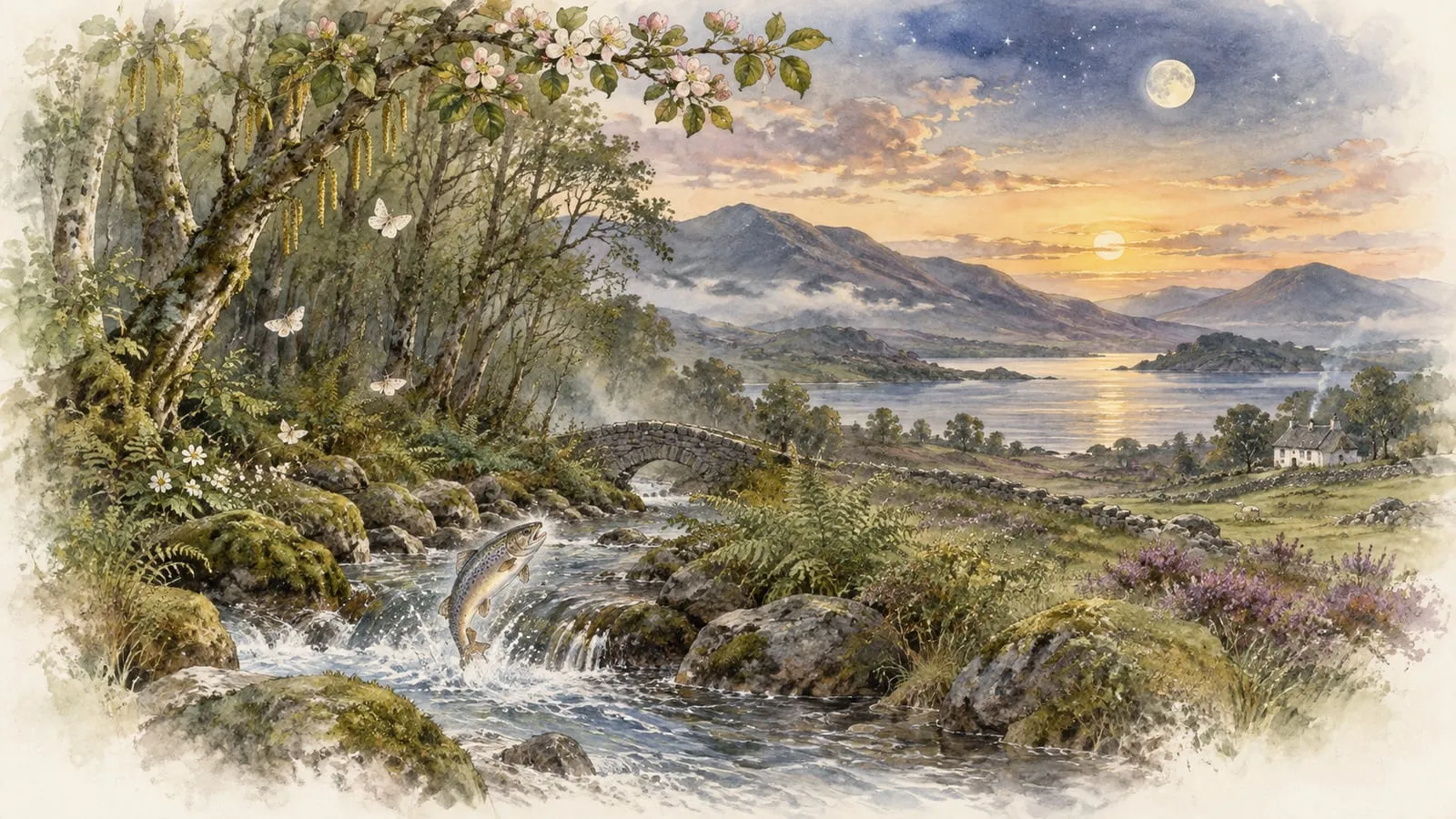
A little boy stands "outside the sycamore wood" and sees "an ash-grey feather" gleam at its edge. Beside him trots a kid, a young goat, led by "one soft white ear for tether". The scene is small, playful and exact.
Lines 5 to 8Into the wood
Line 5 repeats line 1 with one word changed: now he is "inside". He follows "a ringdove's ash-grey gleam of feather" deeper in. The air turns strange: noon wraps the trees "in veils of violet weather", and the winds stand "on tiptoe", as if waiting.
Lines 9 to 12The heart of the wood
Boy and goat pause, "the six feet" (two and four) sunk in "lemon daffodils". The sentence breaks into fragments, a bee, the long grass, drooping eyes, a seat of moss, like a drowsy mind taking in the scene piece by piece, until they see "a maiden weaving".
Lines 13 to 14Lady Quietness
She speaks the closing couplet: she is "lone Lady Quietness", and on her loom she weaves the boy's destiny. The fancy ends on a hint that his future will belong to stillness and dream.
Themes
Enchantment
The feather works like a lure in a fairy tale. The boy moves from "outside" to "inside" the wood, and with each step the world grows stranger: violet noon, listening winds, drooping eyes. The wood is a place where ordinary time stops, and the maiden at its heart is the kind of spirit Yeats's early poems often find in lonely places.
Destiny
The last line gives the fancy its weight. Lady Quietness weaves the boy's "destiny" on her loom, like the Fates of old stories who spin human lives. That his destiny is woven by Quietness suggests a life given to dreaming and solitude, perhaps a poet's life, though the poem only hints at this.
Context
This is one of the early poems Yeats later left out of his collections, and it shows the soft, decorative manner of his first work: coloured light, "lemon daffodils", a spirit named after a mood. Quietness pictured as a woman returns in "Maid Quiet", a later and much barer lyric.
Form
A sonnet: fourteen lines of five-beat verse. The first eight lines rhyme abbaabba on only two sounds ("wood", "feather", "tether", "mood"), and the last six alternate ("feet", "bee", "seat", "she"). The near-repetition of lines 1 and 5 marks the step from outside to inside, and the broken phrases of lines 9 to 12 slow the poem into a trance.