A Prayer on going into my House
Listen
Text: Poetry, by W. B. Yeats (Standard Ebooks, 2024), from the collected editions of 1908 to 1928. Public domain.
In brief
SummaryA blessing on a new home, and a curse on anyone who spoils it.
The poet asks God to bless his tower and cottage, and his heirs, so long as everything stays unspoiled, with no furniture too fancy for shepherds in Galilee. He asks that for part of each year he may handle and look at only what the great and passionate have used over the centuries. That is his norm, though a dream of Sinbad's painted chest would count too. Then the blessing turns into a curse: anyone who spoils the view by cutting down an ash or putting up a government cottage should have his life shortened and his soul chained at the bottom of the Red Sea.
Lines to remember
God grant a blessing on this tower and cottage
Manacle his soul upon the Red Sea bottom.
Line by line
Lines 1 to 4A blessing
The prayer blesses the "tower and cottage" and the poet's heirs, on one condition: that all "remain unspoiled". Simplicity is the rule: no "table, or chair or stool" too fine for "shepherd lads in Galilee", the world of the Gospels.
Lines 5 to 8Things the great have used
He asks to live, for part of each year, among only what "the great and passionate have used / Throughout so many varying centuries". The house is to be a place where old, lasting things set the standard.
Lines 9 to 11Room for dreams
"We take it for the norm", he says, and then widens it: if he should dream that Sinbad has brought him "a painted chest" from beyond "the Loadstone Mountain", that dream counts as part of the norm too. Legend and imagination are part of the house's furniture.
Lines 12 to 16A curse
"That dream is a norm", he insists, and then the tone changes abruptly with "some limb of the devil" who might cut down an ash or put up "a cottage / Planned in a government office". The curse is comic in its thoroughness: "shorten his life, / Manacle his soul upon the Red Sea bottom".
Themes
Tradition
The poet wants to live among things used by "the great and passionate" over "so many varying centuries". The simple furniture of "shepherd lads in Galilee" and the old tower belong to a long past, and the prayer asks that nothing new and mean should break that continuity.
Home and landscape
The blessing covers not only the buildings but the view around them. Cutting down "an ash / That shades the road" or building a standard government cottage would spoil it, and the curse shows how fiercely the poet guards the place he has chosen.
Imagination
The "norm" is not only real objects. Sinbad and "the Loadstone Mountain" come from the Arabian Nights, and the poet makes room for such dreams alongside the plain furniture. The house is to hold both simple use and wild imagining.
Context
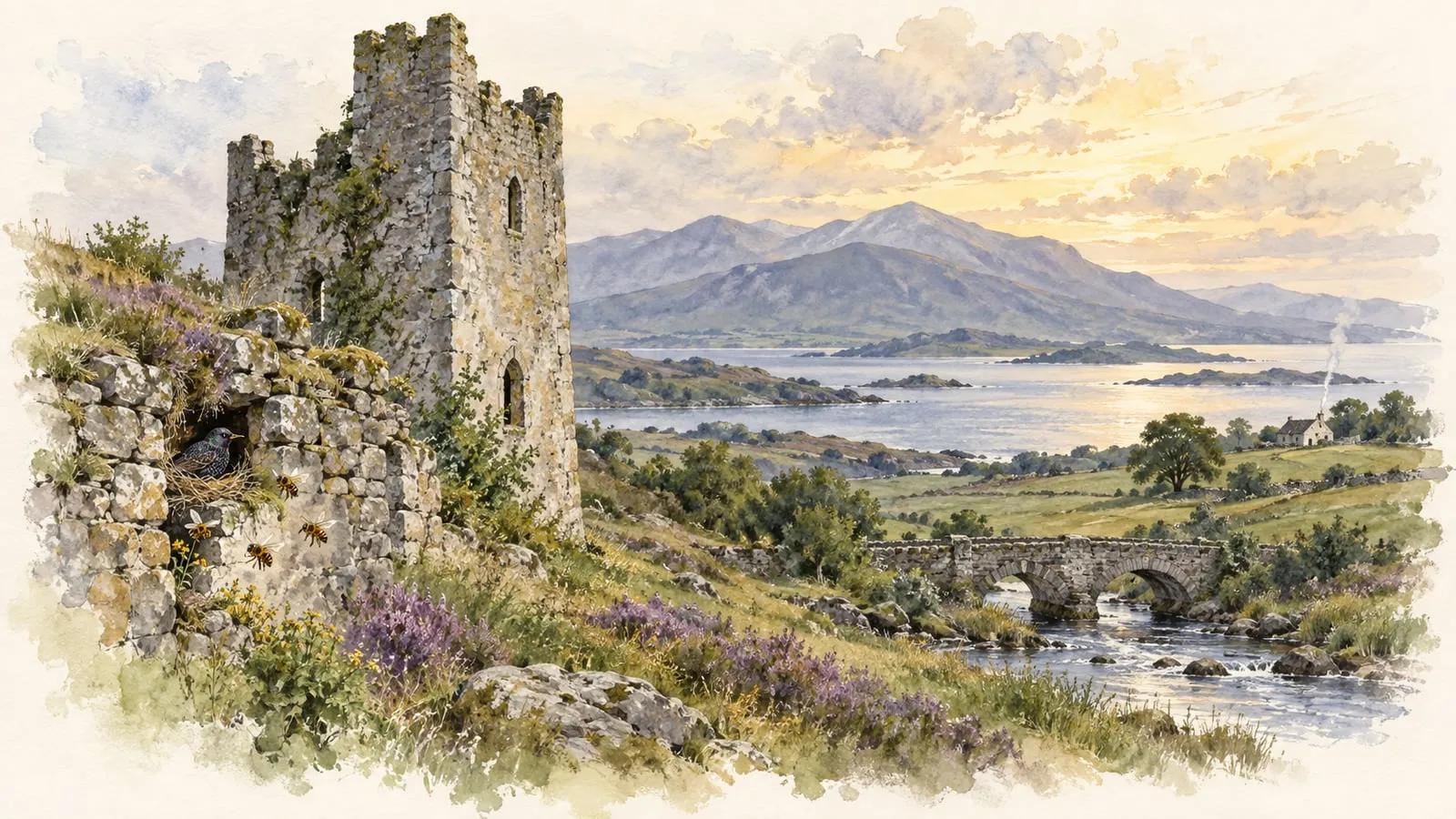
The poem was added to The Wild Swans at Coole in the enlarged Macmillan edition of 1919. The "tower and cottage" are Thoor Ballylee, the medieval stone tower near Gort in County Galway that Yeats bought in 1917, with its attached cottage. He restored it as a summer home for his family, and it became one of the great symbols of his later poetry.
"Manacle his soul upon the Red Sea bottom" draws on an old belief that troublesome spirits could be banished to the Red Sea. Mixing a solemn blessing with a mock-solemn curse, the poem strikes the proud, half-humorous note of ownership heard in several later poems about the tower.
Form
Sixteen lines of blank verse (unrhymed pentameter) in one block, with long sentences running across the lines. The verse moves from the calm of a prayer to the energy of a curse, and the heavy stresses of the last line, "Manacle his soul upon the Red Sea bottom", sound like a sentence passed.