A Nativity
About the text
Yeats first published this poem in 1939. It is out of copyright in Ireland and the EU, but in the United States it stays in copyright until the start of 2035, and this site is served partly from American servers. So for now we give the notes without the full text; it will appear here in 2035.
It begins: What woman hugs her infant there?
In brief
SummaryGreat artists attend a birth, and the mother looks on in terror.
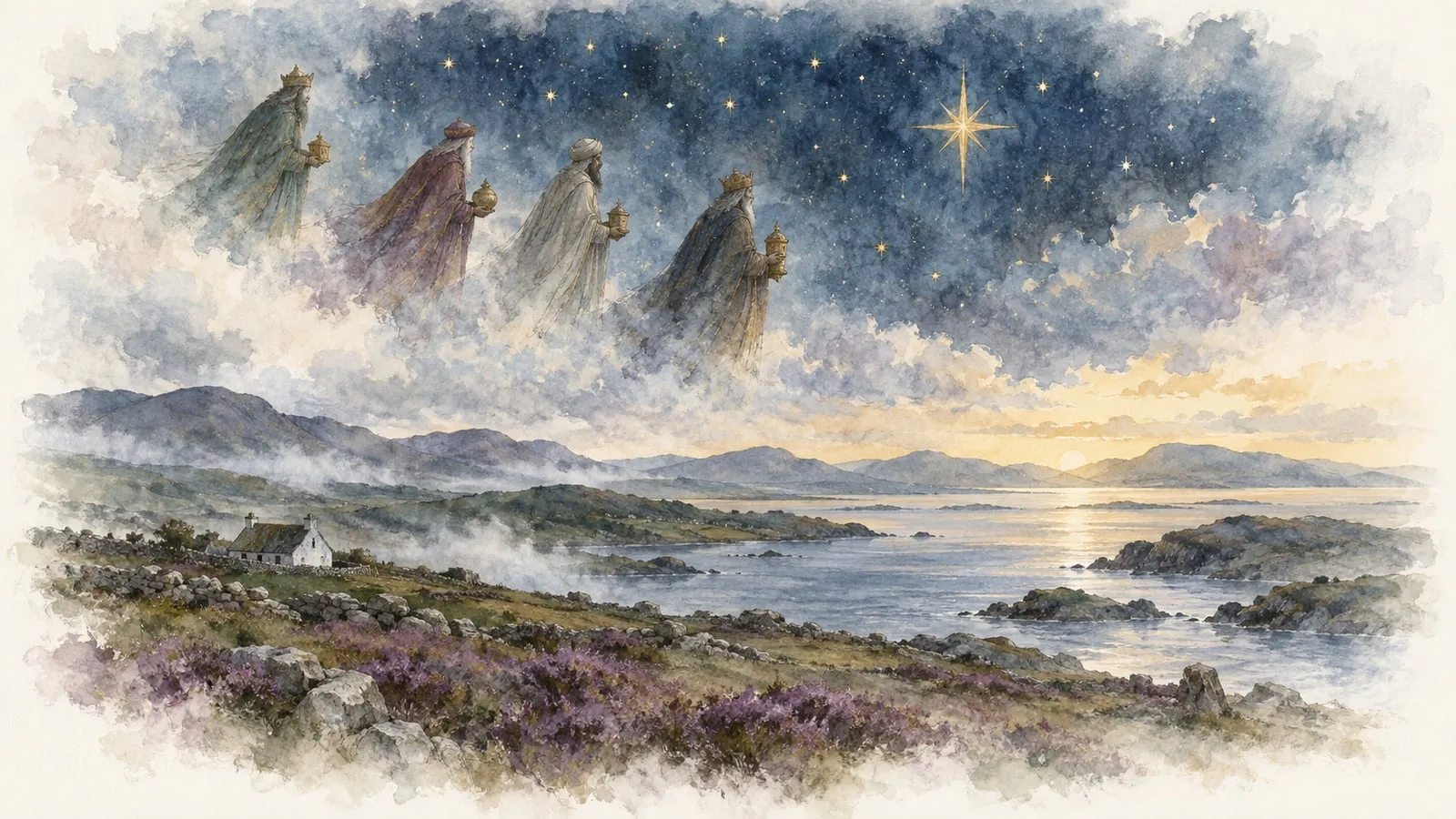
A strange Christmas scene told in six question-and-answer couplets. A woman hugs her new baby, and another star has shot down to her ear. The questions then ask who made the scene: who made the drapery glisten, who waterproofed the ceiling, who keeps flies and moths away, who drives out the fools. Each answer names a great artist or actor, as if the nativity were a painting or a stage set they had built. The final couplet drops the game: why is the woman terror-struck, and can there be mercy in that look?
Lines to remember
Can there be mercy in that look?
Line by line
Lines 1 to 2The woman and the star
The poem opens on a mother hugging her infant. "Another star" suggests that this is one birth in a series, a new era announced from the heavens; the star shooting at her ear may recall the old belief that Mary conceived through the ear, hearing the angel's word.
Lines 3 to 10The artists at work
Four couplets name the makers. Delacroix made the drapery shine, Landor stretched a tarpaulin over the roof, Irving with his proud plume brushes away flies and moths, and Talma with his thunderbolt hurries out the knaves and dolts. Painters, writers and actors guard the scene like shepherds or kings.
Lines 11 to 12Terror
The last couplet asks two questions and answers neither. The woman is terror-struck, perhaps at what she has borne, and the poem wonders whether mercy can be found in her look, or in the look of the child. The playful tone gives way to dread.
Themes
Art and the sacred
The scene is lit, roofed and guarded by great artists, as though the nativity were a painting or a play. Yeats suggests that the images by which people meet the sacred are made by art: Delacroix's glistening drapery, the actors' grand gestures. The divine birth reaches us through human craft.
A new age
"Another star" implies that this is not the only such birth. In Yeats's view of history, each new era is announced by a divine birth, and each brings terror as well as hope. The mother's terror and the open question about mercy echo the uneasy births of "The Second Coming" and "The Mother of God".
Context
The poem was first published in Last Poems and Two Plays (Cuala Press, Dublin, 1939). It treats the Christian story, as "The Mother of God" and "A Stick of Incense" do, with a mixture of strangeness and irreverence, and it pictures the scene less as history than as a staged or painted image.
The names are almost certainly those of Romantic and Victorian artists Yeats admired: the French painter Eugène Delacroix, the English writer Walter Savage Landor, and the actors Henry Irving and François-Joseph Talma, both famous for grand, heroic performances. Yeats had seen Irving on the stage in his youth.
Form
Twelve four-beat lines in six couplets, each a question followed by an answer, with some half rhymes (there and ear, so and Delacroix). The riddle pattern is broken in the last couplet, where both lines are questions and no answer comes, leaving the poem open and uneasy.