The Lover tells of the Rose in his Heart
Earlier titled "Aedh tells of the Rose in his Heart"
Listen
Text: Poetry, by W. B. Yeats (Standard Ebooks, 2024), from the collected editions of 1908 to 1928. Public domain.
In brief
SummaryA lover longs to remake the ugly world for his beloved.
The poem lists the world's ugly, worn and broken things: a child crying by the road, a cart creaking, a ploughman's heavy steps in wintry mud. All of them, the lover says, wrong the image of his beloved, which "blossoms a rose in the deeps of my heart". In the second stanza he longs to rebuild everything, earth, sky and water, into "a casket of gold" fit to hold his dreams of her. The poem is a wish for perfection so strong that ordinary life feels like an insult.
Lines to remember
All things uncomely and broken, all things worn out and old,
Are wronging your image that blossoms a rose in the deeps of my heart.
Line by line
Lines 1 to 4The ugly world
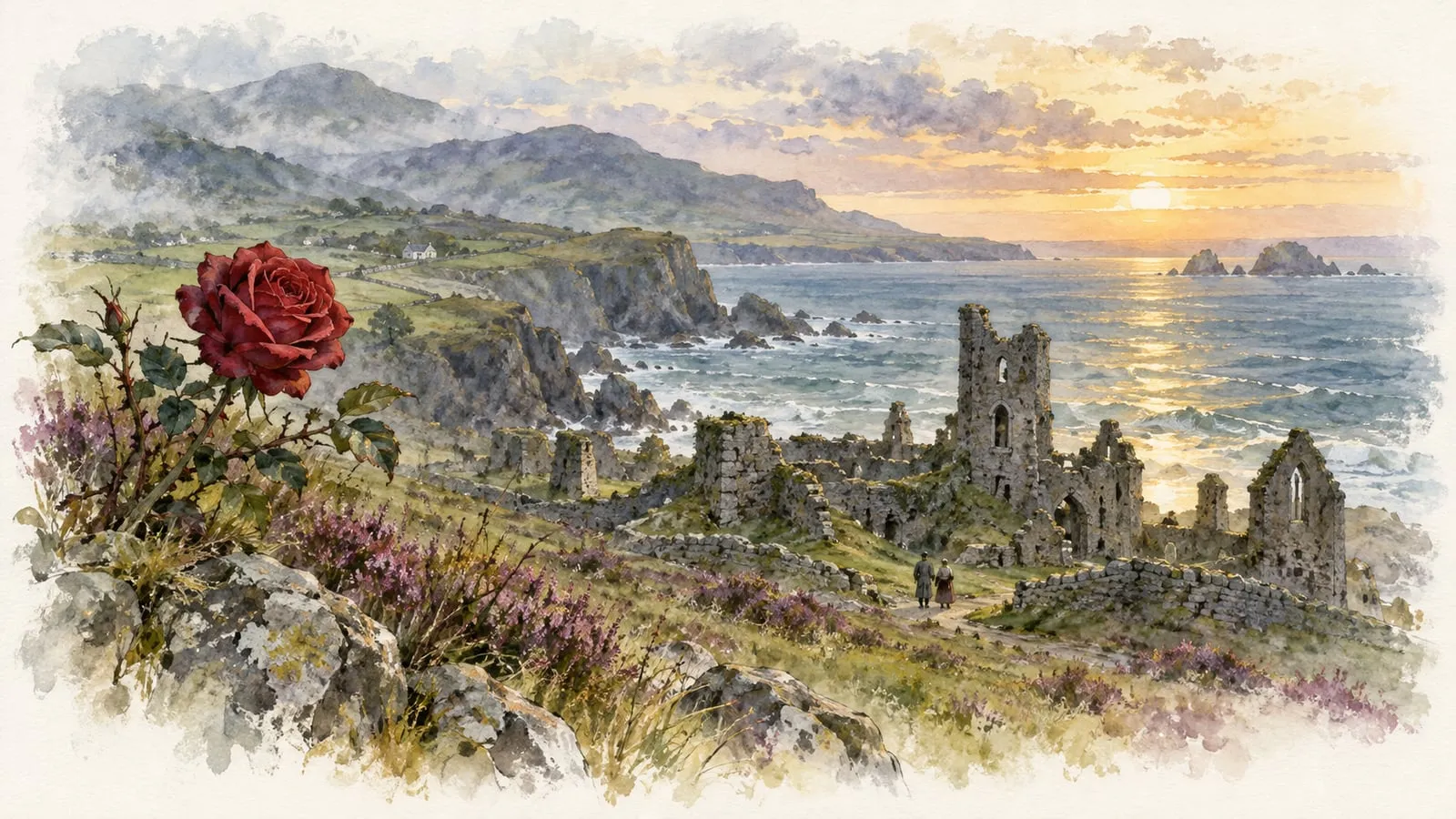
The first line piles up "All things uncomely and broken", and the next two give examples, heard as much as seen: "The cry of a child by the roadway", "the creak of a lumbering cart", a ploughman "splashing the wintry mould". These are "wronging your image", which grows like a rose in his heart.
Lines 5 to 8Remaking it
"The wrong of unshapely things" is "too great to be told". He hungers "to build them anew", sitting apart "on a green knoll", and to remake earth, sky and water "like a casket of gold". The last line repeats the rose image, now enclosed as the treasure in that casket.
Themes
Ideal beauty
The beloved exists in the poem only as an "image", a rose blooming inside the poet. That image is so perfect that the real world, with its crying child and creaking cart, seems to wrong it. The rose is the ideal, and the poem measures everything else against it.
Art and remaking
The lover's answer to ugliness is to "build them anew", as an artist would. He imagines sitting "apart" on a green knoll, reshaping the world into "a casket of gold". It is the poet's dream of remaking reality in words, and also a withdrawal from ordinary, suffering life.
Context
The poem appeared in The Wind Among the Reeds (1899) as "Aedh tells of the Rose in his Heart". Aedh was one of several imagined speakers Yeats used in that book to voice different sides of himself. From 1906 the title became the more general "The Lover tells of the Rose in his Heart". The rose, a central symbol of his poems in the 1890s, here stands for the beloved's image and for ideal beauty.
Form
Two quatrains of long, six-beat lines rhymed ABAB. Only two rhyme sounds run through the whole poem ("old", "mould", "told", "gold" and "cart", "heart", "apart"), and both stanzas end on the same phrase. The long lines and heavy rhymes give the poem a slow, incantatory weight.
Title only: 1899 persona title "Aedh tells of the Rose in his Heart" (Gutenberg 32233) replaced from 1906 (Gutenberg 49608). Check wording against the 1899 text before choosing a version.