The Hour before Dawn
Listen
Text: Poetry, by W. B. Yeats (Standard Ebooks, 2024), from the collected editions of 1908 to 1928. Public domain.
In brief
SummaryA one-legged beggar meets a sleeper who wants to sleep till Judgement Day.
On a cold night a cursing, one-legged beggar stumbles across Croghan, the old seat of Queen Maeve, looking for shelter. Moving some stones, he uncovers a hollow in the rock where a big lad with a beery face lies snoring beside a tub of magic beer. Woken, the sleeper explains that the beer sends you to sleep for as long as you wish, and that he has chosen to sleep away "all Time", waking only when birds and sheep disturb him. The beggar, who loves life and wants only a warm south wind, is outraged. The sleeper answers that all life secretly longs for the Last Day, when there will be "nothing but God left". The beggar beats him, walls him in with stones and flees, and does not thank God until he sees the dawn. It is a comic tale with a serious quarrel at its heart: life, however hard, against the wish for oblivion.
Lines to remember
In the bad hour before the dawn.
For all life longs for the Last Day
The clouds were brightening with the dawn.
Line by line
Lines 1 to 15The beggar on Croghan
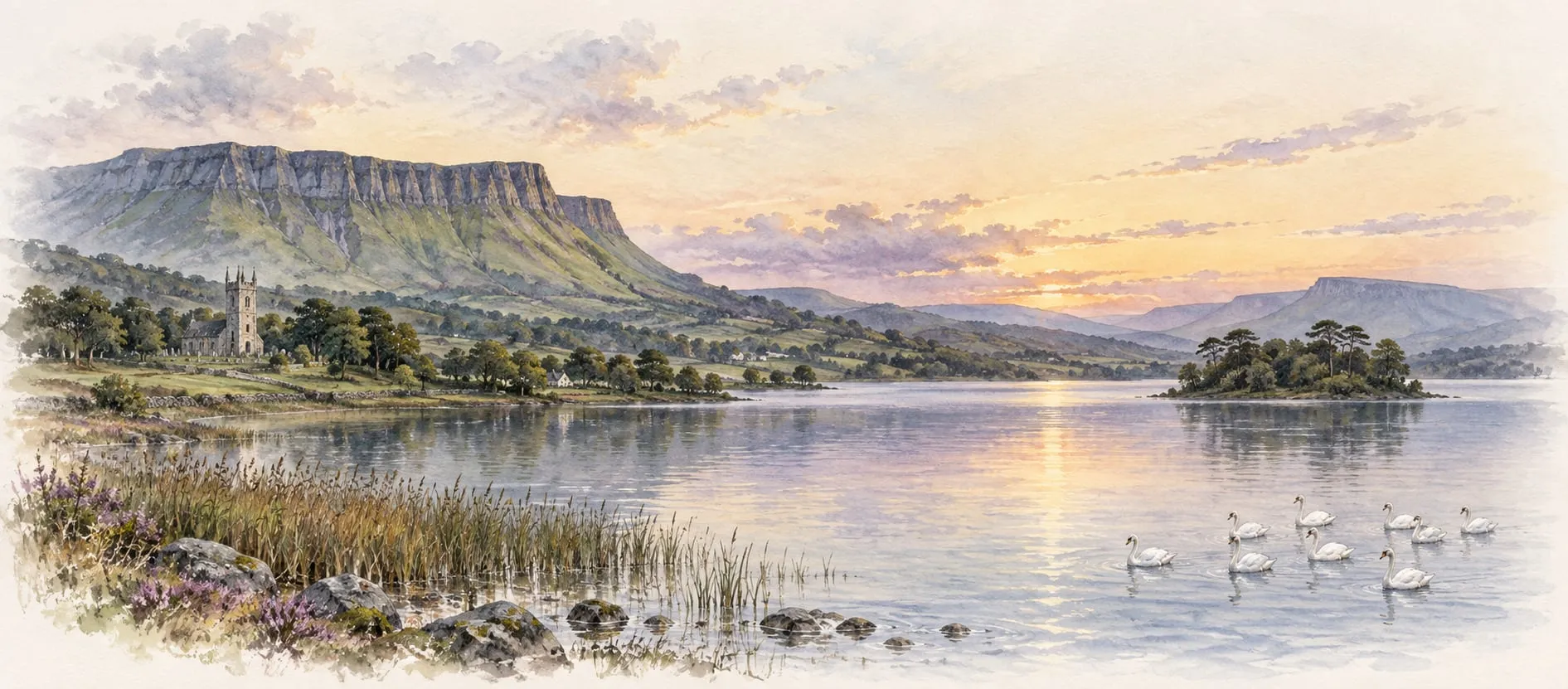
"A cursing rogue with a merry face" hops on "one sturdy leg" across Croghan, where Queen Maeve's sons were nursed. The land is empty: two lapwings, an old sheep, "not a house to the plain's edge". He decides to build a shelter from a heap of stones.
Lines 16 to 32The hollow in the rock
The stones topple and reveal "A dark deep hollow in the rock". He almost runs, since an old history says "Hell Mouth" is near, but inside is only "A great lad with a beery face" snoring by a tub of beer. Laughing at his fear, he crawls in.
Lines 33 to 43Waking the sleeper
The sleeper wakes, grumbling that night "grows uneasy near the dawn" and asking which of "Maeve's nine brawling sons" has roused him. Their first exchange is quick and quarrelsome. The beggar will not be called a ghost; the sleeper means to sleep "another century".
Lines 44 to 55The ladle
The beggar reaches for the beer, but the sleeper stops him. This is beer "dragged from Goban's mountaintop", and no "half-legged fool" will drink it without proving he can value it, least of all "In the bad hour before the dawn".
Lines 56 to 62The magic beer
"Why, beer is only beer," says the beggar. Not this beer: say how long you want to sleep, drink, and "you will sleep that length". The beggar is tempted. He would sleep till winter is over, since "This blast has chilled me to the bone."
Lines 63 to 79The sleeper's story
The sleeper began the same way, sleeping out bad weather or a lack of women to kiss. But year by year less seemed worth waking for, until he chose "this burrow under ground" to "sleep away all Time". Only the lapwings and bleating sheep still wake him.
Lines 80 to 90The beggar's anger
The beggar, squatting "Upon his hunkers in the hole", is furious. This is "no right man" to mock everything he loves. He would have "a merry life enough" with "a good Easter wind" or a wind from the south: his wants are small and alive.
Lines 91 to 106Longing for the Last Day
The sleeper answers with a dark philosophy. What people really wish for is not spring but death, "For all life longs for the Last Day", when "Michael's trumpet" sounds and "there be nothing but God left". He alone is "blessed", waiting for God "in a drunken sleep".
Lines 107 to 122Beating and flight
The sleeper drinks and stretches out. The beggar pummels him, "But might have pummelled at a stone", then walls him in, praying and cursing by turns. He flees "that juggling plain" and gives God thanks only when "The clouds were brightening with the dawn."
Themes
Life against oblivion
The two men stand for opposite choices. The beggar, crippled and cold, still has a "merry face" and wants only a south wind. The sleeper has found life less and less worth waking for and chooses "nothingness". The beggar's violence is a defence of every "pleasant thought / And every comfortable thing" the sleeper's creed would rob him of.
The end of time
The sleeper claims that "all life longs for the Last Day", when flesh and bone disappear and souls become "but sighs". His drunken sleep is a way of hurrying towards it. The poem does not simply mock him: the beggar also prays, and the ending, with thanks given at dawn, suggests that life, not escape from it, is the gift.
Legend and the land
The setting is full of old Ireland: Croghan, Queen Maeve's sons, "Hell Mouth", and beer from "Goban's mountaintop". The beggar treats these legends with half-fear, half-laughter. The plain itself becomes "juggling", full of tricks and illusions, and the dawn at the end is a return from legend to plain daylight.
Context
"The Hour before Dawn" was collected in Responsibilities (Cuala Press, 1914), as the last and longest of a group of poems about beggars and hermits. Yeats revised it heavily after 1916; the text here is the later version.
Croghan (Cruachan, in County Roscommon) was the royal seat of Queen Maeve of Connacht in the old Irish sagas, and a cave there was long said to be an entrance to the otherworld, which the poem calls "Hell Mouth". Goban is the smith of the old Irish gods, whose ale was said to preserve drinkers from age and death.
Form
One hundred and twenty-two lines of rough tetrameter, rhyming mostly in alternate lines ("face", "crutch", "place", "much"), with many half-rhymes. Narrative passages frame long speeches, and the quick exchanges in lines 40 to 62 are set out as short verse paragraphs, like dialogue in a play. The rough four-beat line keeps the tone close to a folk tale.
Revised after 1916 (about 77 per cent word overlap between Gutenberg 36865 and Standard Ebooks).