The Indian upon God
Earlier titled "From the Book of Kauri the Indian: Section V. On the Nature of God"
Listen
Text: Poetry, by W. B. Yeats (Standard Ebooks, 2024), from the collected editions of 1908 to 1928. Public domain.
In brief
SummaryEach creature by a lake imagines God in its own image.
A dreamy speaker walks by the water at evening and overhears the creatures talking about God. The eldest moorfowl says God is an "undying moorfowl" whose dripping wing makes the rain. A lotus says He hangs on a stalk, and the whole tide is a raindrop between His petals. A roebuck is sure God is a gentle roebuck, since nothing else could have imagined a creature so soft. A peacock declares that God is "a monstrous peacock" whose starry tail waves over the night sky. The poem is gentle and comic, but its point is serious: every creature makes God in its own likeness.
Lines to remember
The rains are from His dripping wing, the moonbeams from His eye.
He is a monstrous peacock, and He waveth all the night
Line by line
Lines 1 to 5By the water
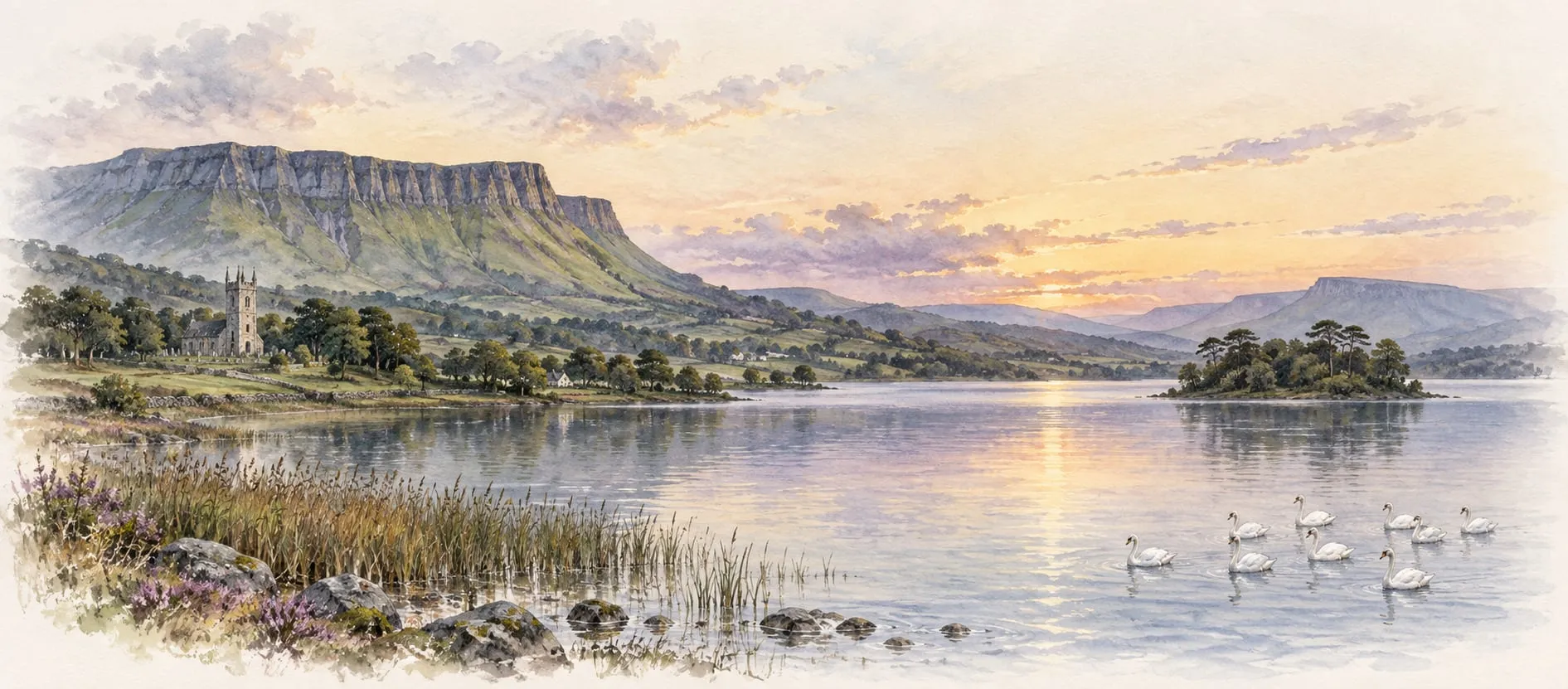
The speaker drifts along the lake at evening, "My spirit rocked in evening light" and then "in sleep and sighs", with rushes round his knees. The repetition sets a trance-like mood. He watches moorfowl stop their chasing and hears the eldest speak.
Lines 6 to 8The moorfowl's God
To the moorfowl, God is "an undying moorfowl" who holds the world "between His bill". Everything is explained in bird terms: "The rains are from His dripping wing, the moonbeams from His eye."
Lines 9 to 12The lotus's God
A lotus flower insists that God "hangeth on a stalk", and that all the moving water, "this tinkling tide", is only "a sliding drop of rain between His petals wide". The scale shrinks the world to a flower's size.
Lines 13 to 16The roebuck's God
A roebuck, eyes "Brimful of starlight", calls God "The Stamper of the Skies" and reasons that He must be a gentle roebuck, since no other God could conceive "a thing so sad and soft". This is the tenderest of the four answers.
Lines 17 to 20The peacock's God
Last and grandest, the peacock declares that God is "a monstrous peacock" whose tail waves all night above us, "lit with myriad spots of light". The starry sky becomes a fanned tail, a vain and splendid close.
Themes
Images of God
Each creature describes God as a larger version of itself: a moorfowl, a lotus, a roebuck, a peacock. The roebuck even gives the reason: only a gentle God could have made "a gentle thing like me". The poem gently suggests that people do the same, shaping the divine to fit their own nature.
Humour and wonder
The creatures are a little absurd, especially the vain peacock with his "monstrous" God. Yet each answer is also beautiful: rain from a dripping wing, the tide as a raindrop in a flower, the night sky as a peacock's tail. The poem laughs at its speakers and admires them at the same time.
Context
The poem was first collected in The Wanderings of Oisin and Other Poems (London, January 1889). It once carried a much longer title, "From the Book of Kauri the Indian: Section V. On the Nature of God", as if it were a chapter of an ancient scripture. Yeats later placed it among the early lyrics he called "Crossways", beside two other Indian poems, "Anashuya and Vijaya" and "The Indian to His Love". It reflects his early interest in Indian thought.
Form
Twenty long lines in rhyming couplets ("trees", "knees"; "pace", "chase"), each line with seven beats and a swaying pause in the middle. The easy, regular rhythm matches the speaker's dreamy stroll, and the repeated "I passed a little further on" moves the poem forward like a walk from one voice to the next.