The Fisherman
Listen
Text: Poetry, by W. B. Yeats (Standard Ebooks, 2024), from the collected editions of 1908 to 1928. Public domain.
In brief
SummaryDisgusted with his public, Yeats imagines an ideal reader: a solitary fisherman.
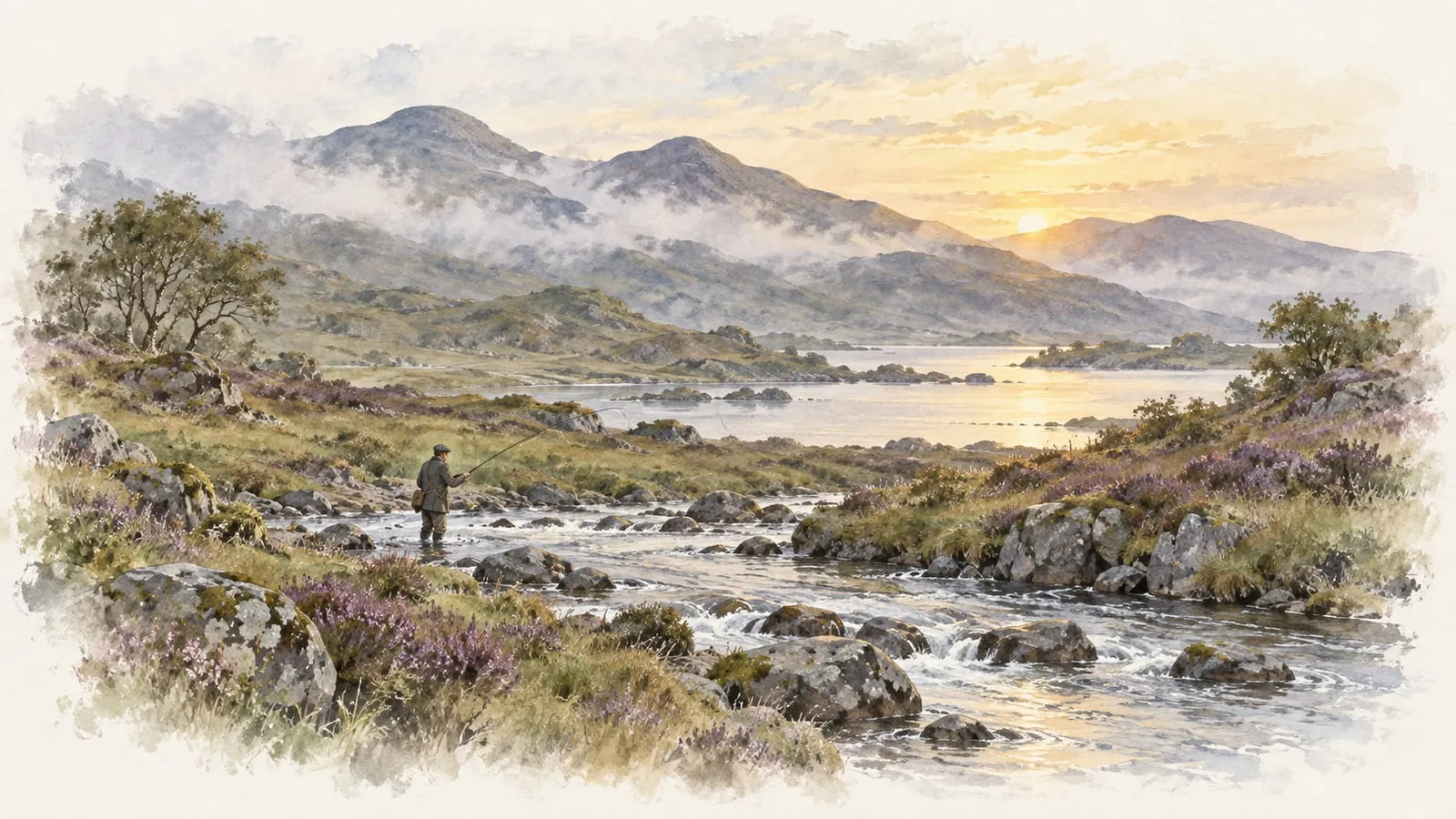
The poet pictures a freckled man in grey Connemara clothes who climbs at dawn to a grey place on a hill to fish. This man has long been in his mind, because the real audience he writes for has disappointed him: the living men he hates, the craven, the insolent, the witty and the clever who drag down the wise and "great Art". In scorn of that public he invented the fisherman, a man "who does not exist", and vowed to write for him, before he is old, one poem "as cold / And passionate as the dawn".
Lines to remember
To write for my own race
A man who does not exist,
And passionate as the dawn.
Line by line
Lines 1 to 8The fisherman at dawn
The poem opens with a clear picture: "The freckled man" in "grey Connemara clothes", heading at dawn "To a grey place on a hill" to cast his flies. The poet has called him up in his mind for a long time. The grey, the dawn and the solitude make him quiet, plain and clean.
Lines 9 to 12Hope and reality
All day the poet had compared what he hoped writing "for my own race" would be with "the reality". The phrase "my own race" means the Irish people, the audience he had meant to serve, and these four lines set up the bitter list that follows.
Lines 13 to 24The real audience
The reality is a bitter catalogue: "The living men that I hate", "The dead man that I loved" and has lost, the "craven" and "insolent", knaves cheered by drunkards, witty men aiming jokes "at the commonest ear", and clever men repeating "catch-cries". It ends in "The beating down of the wise / And great Art beaten down".
Lines 25 to 36Imagining a man
About a year ago, "In scorn of this audience", he began imagining the fisherman: the sun-freckled face, the grey cloth, the climb to where "stone is dark under froth", the turn of the wrist as the flies drop. Then comes the admission: "A man who does not exist, / A man who is but a dream".
Lines 37 to 40The vow
The poem ends with a cry: "Before I am old" he will write this man one poem "as cold / And passionate as the dawn". The paradox of cold passion describes the art he wants: clear, hard and exact, yet full of feeling, like a fisherman's dawn.
Themes
Poet and audience
Yeats wanted to write "for my own race", but the real public has let him down. Lines 13 to 24 list its faults with rare anger, ending in "great Art beaten down". The fisherman is his answer: a reader who is "wise and simple", solitary, and free of the crowd's cheap jokes and "catch-cries".
Ideal and real
The fisherman is lovingly detailed, from his "sun-freckled face" to "the down turn of his wrist", yet he is "A man who does not exist, / A man who is but a dream". The poem admits this freely. The ideal reader is invented, but inventing him gives the poet a standard to write towards.
Art and nature
The fisherman lives in wild country, among grey hills, streams and froth, at dawn. The poem Yeats wants to write should be like that place and time: "as cold / And passionate as the dawn". Plain, bare and intense, it is a picture of the harder, cleaner style he was seeking.
Context
First printed in Poetry (Chicago) in February 1916, the poem was collected in The Wild Swans at Coole (Cuala Press, 1917). By then Yeats had spent years in Irish public life, running the Abbey Theatre and campaigning for Irish art, and his poems of this period often turn on the gap between his hopes for Ireland and the public he found.
The fisherman's "grey Connemara clothes" place him in the west of Ireland, in the country Yeats knew from his summers in County Galway. The poem shares its mood with "September 1913", and its closing wish for a poem "cold / And passionate" became a touchstone for the leaner style of his middle years.
Form
Forty short lines of three beats, rhymed alternately ("still" and "hill", "goes" and "clothes"), in two verse paragraphs of 24 and 16 lines. Some rhymes are only near ("hate" and "seat", "one" and "dawn"). The short, spare lines match the style the poem calls for: plain, tight and unornamented.